Showing posts with label Energy_Animal. Show all posts

26/04/2010

Jospa, the power of waves

Via Joss Fitzsimons.
Very cool wave energy conversion machine, from Ireland.

www.jospa.ie
chuter-pivot5
The chuter

Check out their videos, really inspirational for the Energy_Animal.

12/04/2010

Energy_Animal video


Full report : https://sites.google.com/a/opensailing.net/www/labs/energy_animal/Energy_Animal001

Video on Facebook | Youtube | Vimeo | Dailymotion | download HD movie (160Mb .mov)


The Energy_Animal is a device that produces renewable energy from the wind, the sun, and the waves.
The Energy_Animal can produce energy is a variety of irregular weather conditions, producing a reliable output.
Mostly made of free recycled materials, attracting and concentrating marine life instead of repelling it.
One Energy_Animal can be part of an energy farm, or it can drift on its own.
It is going where there is more energy to be collected, or where energy is most needed.
It is cheap to build, the design of the Energy_Animal is open-source, so there can be many concurrent or merging versions of different Energy_Animals. There is no development time, generation after generation a better design is emerging.
The idea is to produce cheap reliable green energy evolutive devices for a rapidly changing world.

We need a green energy revolution now, and we are responsible for it.

Concept characteristics of Energy_Animal001
  • Hybrid renewable energy 
  • Recycled materials 
  • Probiotic Impact 
  • Distributed Intelligence 
  • Lightweight & Reconfigurable 
  • Open-Source & Evolutionary 
http://energyanimal.org

Credits 

Design : Cesar Harada, Open_Sailing, Royal College of Art, Design Interactions
Film : Antonia Nottebohm, University of Munich, 2010
Science : Dr. Heller, Prof. Chaplin, Southampton University
Thanks to : Jessica Spurrell, Soumik Sengupta, Aga Wypychowska,
Fiona Raby, Anthony Dunne, Tim Olden, Vamessa Rolf, Helen Bailey, Jennifer Indovina.

Commissioned by :
EPSRC (Engineering and Physical sciences Research Council).
NESTA (National Endowment for Science, Technology and the Arts).
Design Interactions, RCA (Royal College of Art), London.
http://opensailing.net http://energyanimal.org 

22/03/2010

Sea Water for Cold Fusion

http://www.cbsnews.com/video/watch/?id=4967330n
When I recently mentioned salty water battery, I was told there's much more you can do with salty water...


Watch CBS News Videos Online

Now, Cold Fusion as some call it, is a very disputed piece of science, and many dismiss the truth behind this.

17/03/2010

Very nice collection of pictures about wave power researches :
http://science.gallery.youngester.com/2009/06/renewable-energy-from-ocean.html


Image Hosted by ImageShack.us


Power is currently being harvested from the ocean in two different ways:


There are three basic ways to tap the ocean for its energy. We can use the ocean's waves, we can use the ocean's high and low tides, or we can use temperature differences in the water. Let's take a look at each.

Image Hosted by ImageShack.us

Wave Energy
Kinetic energy (movement) exists in the moving waves of the ocean. That energy can be used to power a turbine. In this simple example, to the right, the wave rises into a chamber. The rising water forces the air out of the chamber. The moving air spins a turbine which can turn a generator.

When the wave goes down, air flows through the turbine and back into the chamber through doors that are normally closed.

This is only one type of wave-energy system. Others actually use the up and down motion of the wave to power a piston that moves up and down inside a cylinder. That piston can also turn a generator.

Most wave-energy systems are very small. But, they can be used to power a warning buoy or a small light house.

Image Hosted by ImageShack.us

Tidal Energy

Pictures of La Rance Tidal Station Another form of ocean energy is called tidal energy. When tides comes into the shore, they can be trapped in reservoirs behind dams. Then when the tide drops, the water behind the dam can be let out just like in a regular hydroelectric power plant.

Tidal energy has been used since about the 11th Century, when small dams were built along ocean estuaries and small streams. the tidal water behind these dams was used to turn water wheels to mill grains.

In order for tidal energy to work well, you need large increases in tides. An increase of at least 16 feet between low tide to high tide is needed. There are only a few places where this tide change occurs around the earth. Some power plants are already operating using this idea. One plant in France makes enough energy from tides (240 megawatts) to power 240,000 homes.

This facility is called the La Rance Station in France. It began making electricity in 1966. It produces about one fifth of a regular nuclear or coal-fired power plant. It is more than 10 times the power of the next largest tidal station in the world, the 17 megawatt Canadian Annapolis station.

Image Hosted by ImageShack.us

Ocean Thermal Energy Conversion (OTEC)

The idea is not new. Using the temperature of water to make energy actually dates back to 1881 when a French Engineer by the name of Jacques D'Arsonval first thought of OTEC. The final ocean energy idea uses temperature differences in the ocean. If you ever went swimming in the ocean and dove deep below the surface, you would have noticed that the water gets colder the deeper you go. It's warmer on the surface because sunlight warms the water. But below the surface, the ocean gets very cold. That's why scuba divers wear wet suits when they dive down deep. Their wet suits trapped their body heat to keep them warm.

Power plants can be built that use this difference in temperature to make energy. A difference of at least 38 degrees Fahrenheit is needed between the warmer surface water and the colder deep ocean water.

Image Hosted by ImageShack.us

Advantages of Tidal and Wave Generators

Today’s most promising water-based generators operate something like floating wind turbines anchored to the sea floor. Moving ocean water creates pressure that turns a hydraulic turbine, which in turn is linked to a generator that converts the hydraulic energy into electricity.

Ocean-powered generators have important advantages over both conventional forms of power and other renewable energy alternatives, such as wind and solar power. Ocean-generated energy is:

* Clean. Unlike coal, oil, or nuclear energy, the electricity produced by tidal or wave generators is emission free. Powering houses with ocean-generated electricity could potentially save millions of tons of carbon emissions each year.
* Unobtrusive. Ocean-borne generators ride the waves without protruding above the water’s surface, so they don’t obstruct views the way today’s huge wind turbines can.
* Consistent. Waves and tidal movements are predictable and occur all year round, so ocean generators aren’t affected by clouds or seasonal changes as solar collectors are.


Image Hosted by ImageShack.us

Moving from Experimental Technology to Commercial Reality


Wave and tidal generators are currently in advanced phases of testing or initial commercial operation in several locations around the world. A tidal current generator developed by Sea Generation Ltd. began operating in Northern Ireland’s Strangford Lough in June, 2007, with a potential capacity of 1.2 megawatts. A wave farm consisting of three generators built by Pelamis Wave Power opened off Portugal in September, 2008. Operating at full capacity, the farm can generate enough electricity to power more than 1,500 houses. Both of those projects, though, have been dogged by technical problems caused by the harsh ocean environment.

British company Checkmate Seaenergy developed a new, simpler generator, the Anaconda Wave Energy Converter, to help combat breakdowns caused by the corrosive effects of seawater. While the Seagen and Pelamis turbines are primarily made of metal, the Anaconda is made mainly from fabric and rubber.

A small-scale Anaconda generator has just completed testing in a tank in Hampshire, England. If the tests prove successful, larger versions of the power generator will be tested in the ocean. Checkmate Seaenergy, the Anaconda’s maker, hopes to have wave generators in commercial production by 2014.

Image Hosted by ImageShack.us

Future Prospects for Renewable Energy from the Ocean

Many governments have set ambitious targets for generating electricity from renewable sources. The European Union plans to generate 20% of its electricity from renewables by the year 2020. The United States recently set a target of generating 25% of all electricity renewably by 2025.

As with many new technologies, getting the funding to overcome technical problems and test new installations is one of the major obstacles standing between ocean-power generation and commercial success. Even in a difficult economic climate, the new water-powered generators are promising enough that governments and private companies are pressing ahead with plans to generate a small but significant part of their electricity needs from the ocean.

Image Hosted by ImageShack.us

Generating technologies for deriving electrical power from the ocean include tidal power, wave power, ocean thermal energy conversion, ocean currents, ocean winds and salinity gradients. Of these, the three most well-developed technologies are tidal power, wave power and ocean thermal energy conversion. Tidal power requires large tidal differences which, in the U.S., occur only in Maine and Alaska. Ocean thermal energy conversion is limited to tropical regions, such as Hawaii, and to a portion of the Atlantic coast. Wave energy has a more general application, with potential along the California coast. The western coastline has the highest wave potential in the U.S.; in California, the greatest potential is along the northern coast.

Image Hosted by ImageShack.us

Image Hosted by ImageShack.us

Energy

California has more than 1,200 kilometers (745 miles) of coastline, and the combined average annual deep water wave power flux is over 37,000 megawatts (MW) of which an upper limit of about 20 percent could be converted into electricity. This is sufficient for about 23 percent of California's current electricity consumption. However, economics, environmental impacts, land-use and grid interconnection constraints will likely impose further limits to how much of the resource can be extracted. Although technology is still at a relatively immature pilot project stage, economic projections indicate that ocean energy could become cost-competitive over the long-term.

Image Hosted by ImageShack.us

Current Pilot Projects

In the spring of 2009, the Sonoma County Water District applied to the Federal Energy Regulatory Commission (FERC) for three wave project preliminary permits. The projects will be located in state waters offshore Del Mar Landing (the northwestern portion of the county) and off Fort Ross further to the south. Each of the three projects would begin as pilots in the two to five megawatt (MW) range, could potentially expand to commercial facilities in the 40-200 MW range, and would include substations, transmission lines, appurtenant facilities, and submersible electric cables.

With these applications, the total number of FERC permits and applications for wave and tidal projects in California waters totals twelve.

Image Hosted by ImageShack.us

Wave Energy

Wave energy conversion takes advantage of the ocean waves caused primarily by interaction of winds with the ocean surface. Wave energy is an irregular and oscillating low-frequency energy source that must be converted to a 60-Hertz frequency before it can be added to the electric utility grid.

Although many wave energy devices have been invented, only a small proportion have been tested and evaluated. Furthermore, only a few have been tested at sea, in ocean waves, rather than in artificial wave tanks.

As of the mid-1990s, there were more than 12 generic types of wave energy systems. Some systems extract energy from surface waves. Others extract energy from pressure fluctuations below the water surface or from the full wave. Some systems are fixed in position and let waves pass by them, while others follow the waves and move with them. Some systems concentrate and focus waves, which increases their height and their potential for conversion to electrical energy.

A wave energy converter may be placed in the ocean in various possible situations and locations. It may be floating or submerged completely in the sea offshore or it may be located on the shore or on the sea bed in relatively shallow water. A converter on the sea bed may be completely submerged, it may extend above the sea surface, or it may be a converter system placed on an offshore platform. Apart from wave-powered navigation buoys, however, most of the prototypes have been placed at or near the shore

The visual impact of a wave energy conversion facility depends on the type of device as well as its distance from shore. In general, a floating buoy system or an offshore platform placed many kilometers from land is not likely to have much visual impact (nor will a submerged system). Onshore facilities and offshore platforms in shallow water could, however, change the visual landscape from one of natural scenery to industrial

The incidence of wave power at deep ocean sites is three to eight times the wave power at adjacent coastal sites. The cost, however, of electricity transmission from deep ocean sites is prohibitively high. Wave power densities in California's coastal waters are sufficient to produce between seven and 17 megawatts (MW) per mile of coastline

According to the European Union, "Among the different converters capable of exploiting wave power, the most advanced is unquestionably the Pelamis Wave Energy Converter, a kind of "undulating sea serpent" developed by Ocean Power Delivery. This technology is the object of a commercial contract for installation of a farm in Portugal. In 2007, three machines, with a total capacity of 2.25 megawatts (MW(, are in installation phase, and should be joined by 27 others in the years to come. Another 5 MW project is being studied for England this time."
None of these plants are located in California, although economic feasibility studies have been performed for a 30 MW wave converter to be located at Half Moon Bay. Additional smaller projects have been discussed at Fort Bragg, San Francisco and Avila Beach. There are currently no firm plans to deploy any of these projects

As of the mid-1990s, wave energy conversion was not commercially available in the United States. The technology was in the early stages of development and was not expected to be available within the near future due to limited research and lack of federal funding. Research and development efforts are being sponsored by government agencies in Europe and Scandinavia

Many research and development goals remain to be accomplished, including cost reduction, efficiency and reliability improvements, identification of suitable sites in California, interconnection with the utility grid, better understanding of the impacts of the technology on marine life and the shoreline. Also essential is a demonstration of the ability of the equipment to survive the salinity and pressure environments of the ocean as well as weather effects over the life of the facility

Image Hosted by ImageShack.us

Permitting Issues. Some of the issues that may be associated with permitting an ocean wave energy conversion facility include:

* Disturbance or destruction of marine life (including changes in the distribution and types of marine life near the shore)
* Possible threat to navigation from collisions due to the low profile of the wave energy devices above the water, making them undetectable either by direct sighting or by radar. Also possible is the interference of mooring and anchorage lines with commercial and sport-fishing.
* Degradation of scenic ocean front views from wave energy devices located near or on the shore, and from onshore overhead electric transmission lines

Tidal Energy

Another form of ocean energy is called tidal energy. When tides comes into the shore, they can be trapped in reservoirs behind dams. Then when the tide drops, the water behind the dam can be let out just like in a regular hydroelectric power plant.

Tidal energy has been used since about the 11th Century, when small dams were built along ocean estuaries and small streams. the tidal water behind these dams was used to turn water wheels to mill grains.

In order for tidal energy to work well, you need relateivel large increases in tides. An increase of at least 16 feet between low tide to high tide is generally needed. There are only a few places where this tide change occurs around the earth. Some power plants are already operating using this idea.

Image Hosted by ImageShack.us

According to the European Union:

"Ninty percent of today's worldwide ocean energy production is represented by a single site: the La Rance Tidal Power Plant (240 MW) that was commissioned in 1966. This type of installation has remained unique in the world and has only been reproduced at much smaller capacities in Canada (20 MW), China (5 MW) and Russia (0.4 MW).

"This type of project was abandoned for many years because of very high initial investment costs as well as the strong local impact that results from it. However, the present economic situation has encouraged South Korea to build a 260 MW dam closing off Sihwa Lake, which is set to be commissioned in 2009. Lighter new techniques, like hydro turbines, are being developed today to harness ocean currents. The leader in this field, the British company, Marine Current Turbine (MCT), should install 1.2MW in Northern Ireland following its 300 kW pilot project in Bristol Bay."

Image Hosted by ImageShack.us

Ocean Thermal Energy Conversion (OTEC)

The idea of using the temperature of water to make energy actually dates back to 1881 when a French Engineer by the name of Jacques D'Arsonval first thought of OTEC. The final ocean energy idea uses temperature differences in the ocean. If you ever went swimming in the ocean and dove deep below the surface, you would have noticed that the water gets colder the deeper you go. It's warmer on the surface because sunlight warms the water. But below the surface, the ocean gets very cold. That's why scuba divers wear wet suits when they dive down deep. Their wet suits trapped their body heat to keep them warm.

Power plants can be built that use this difference in temperature to make energy. A difference of at least 38 degrees Fahrenheit is needed between the warmer surface water and the colder deep ocean water. The cold ocean water can also be used to cooling buildings, and desalinated water is often a by-product.

Image Hosted by ImageShack.us


Image Hosted by ImageShack.us

Image Hosted by ImageShack.us

Image Hosted by ImageShack.us

Image Hosted by ImageShack.us

Image Hosted by ImageShack.us

Image Hosted by ImageShack.us

Image Hosted by ImageShack.us

Image Hosted by ImageShack.us

Image Hosted by ImageShack.us

Image Hosted by ImageShack.us

Image Hosted by ImageShack.us

Image Hosted by ImageShack.us

Image Hosted by ImageShack.us

Image Hosted by ImageShack.us

Image Hosted by ImageShack.us

Image Hosted by ImageShack.us

Image Hosted by ImageShack.us


24/02/2010

Lighting The Oceans With Wave Power

http://www.yankodesign.com/2010/02/24/lighting-the-oceans-with-wave-power/
Via Kuroda Chiaki, thanks.

The Wavelight concept coverts mechanical energy captured by ocean waves into electrical energy to illuminate a series of LED lamps. Each lamp is tethered to its neighbor with a weight anchored to the sea floor. The lights are designed to attract attention for rescue operations or to warn passing ships to steer clear. A very intriguing design but are LEDs powerful enough? What happens if the anchor isn’t long enough to reach the sea floor?

Designers: Zhang Yakun, He Siqian, Zhu Ningning, Chen Chen & Mu Zhiwei

Wavelight by Zhang Yakun, He Siqian, Zhu Ningning, Chen Chen & Mu Zhiwei


wavelight04
wavelight05
wavelight06


wavelight07

30/01/2010

Open_Sailing documentary

Hello, I'm Antonia Nottebohm, I am a film maker from Munich living in Barcelona now doing a documentary on Open_Sailing. Yesterday, we were in the towing tank in Southampton University, testing Anaconda new principles... video coming soon!!!


08/01/2010

http://impact-art.ning.com/profiles/blogs/nuclear-first

Nuclear FiRST
It is now widely accepted that nuclear power is a key solution to the dual issues of reducing our environmental impact, and security of energy supply. Nuclear First offers a unique doctoral training programme that aims to address the need for specialist skills in nuclear fission and engineering.

On 9th November this year, the Government identified ten suitable sites for the next generation of nuclear power plants. Public consultations are currently taking place around the UK to resolve where and how to host the resulting waste. This is seen by many as the most risky part of the nuclear process.

When making decisions, public consultations are almost exclusively focusing on safety and risk. However, there are also potential benefits for local communities that choose to host such a site, such as employment opportunities and access to a renewable source of energy. With this project I aim to combine the individual expertise of the doctoral students and those living in close proximity to nuclear plants through a series of workshops, to help consider both the deliberate and unexpected payback/consequences a nuclear waste facility could offer, such as the design/evolution of unique landscapes fed by an abundance of heat and energy.


Cesar Harada commented :
My websites, a couple of my blogs have been surgically hacked and destroyed after I published UK, Japanese and french nuclear waste locations in the oceans rifts (deep sea) in the late 70's and 80's. At the time, the governments were proudly showing off their technological advances and "forever lasting containers"... Nothing to be proud of these days, out of fashion it seems.
There is no freedom of information, nor governmental dialog and transparency on these issues, and when it comes to what is "widely accepted" I can testify from my own experience, it is not very difficult to make the loud one quiet.
I'll be quiet.
...

What I want to say here : in a developed country like the US, nuclear represents only 19.3% of the electric production (ref1). How can a not so "widely spread" technology receive such a wide strategical protection and undermining of oppositions? We can control way better the long term effects of fossil energies production and waste treatment, and, just to give an example, the cost per megawatt per hour (in the US again) for coal is inferior to nuclear, and equivalently reliable (Nuclear 30.0$/Mw-hr VS Coal 29.1$/Mw-hr) (ref 2).

So, I dont know what is going to be discussed during your workshop, but I question the starting point to be that : there is no more option but to accept nuclear power as an evidence, when there are other better options avaible.
I am not against nuclear, I just think they may be better options out there we must consider to be fair.

ref1 : Net Generation by Energy Source by Type of Producer, (c. 2006), accessed 2008-03-28, Washington: U.S. Dept. of Energy, Energy Information Administration.
ref2 : http://www.nucleartourist.com/basics/costs.htm

Energy_Animal_Anaconda1 presentation proposal

Anaconda Energy Animal

7 m long presentation. 3 computer screens + 3 headphones
1 main prototype + 5 small annex objects

Cesar Harada, Valentin Heller, Jessica Spurrel, Design Interactions Royal College of Art, Southampton University. EPSCR, NESTA, Checkmate,  Open_Sailing, 2010.
cesarharada.com, opensailing.net, soton.ac.uk, bulgewave.com, checkmateuk.com, epsrc.ac.uk, nesta.org.uk, rca.ac.uk

12/12/2009

xMAx for the Energy_Animal communication device

Broadband On Radio Waves Speeds Beyond Wi-Max: xMax is Next. Thanks to Joe Mauriello for this link.

http://www.masternewmedia.org/broadband/broadband_technologies/wireless/xMax_radio_based_wireless_broadband_20050707.htm

A new wireless communications technology that symbiotically rides on existing public broadcast radio frequency waves could revolutionize the way we could connect to the Internet or provide broadband access to remote areas that are too expensive to be served by cable or present-day data-transmission technologies.

This latest innovation in broadband communications, is a "discrete" radio-frequency-based data transmission system that leverages traditional television, radio and pager systems bands without ever interfering with them.

The new system effectively extends what was thought possible until now, extending our ability to deliver data at lower cost and over greater distances than existing technologies.

The new technology may also come to be appreciated for its non-harmful effects on humans. The new radio-based approach may in fact spare us quite a few health risks (nobody ever talks about this side of things) which are instead a constant factor when we deal with today's popular very high-frequency transmission bands, like the ones used by mobile phones and other wireless transmission systems.

Overall, the advantages offered are then not only the fact that the public radio spectrum can be stretched in its capacity while not requiring the use of additional frequencies, but also the fact that at the lower frequency bands in which this new technology works data can travel much farther while having greater ease to pass through buildings walls and physical barriers than other existing competing wireless technologies.

Long range and high-speed are two of the key characteristics of xMax, a cutting edge radio-waves-based broadband solution which appears to be even better than Flash-OFDM, an alternative broadband system approach for remote and rural areas.

As a wireless data distribution system, xMax promises a reach of over 40-square miles while being able to serve between a minimum of a few hundred users to a theoretical maximum of a thousand or more.

xMax leverages a unique approach to data distribution via radio frequencies by embedding a very weak signal within the selected radio carrier band. The signal used is so weak that it cannot be easily picked-up by traditional radio antennas.

By using unique receiving units equipped with special filters, xMax-enabled devices can detect and receive the weak radio signal embedded in the radio wave without ever interfering or disturbing the main carrier.

Though prestigious academics like Princeton University Professor Schwartz have declared xMax not a very efficient way to send data over the airwaves, they also concluded that the results that can be achieved are indeed effective.

Obviously such a technology could represent a boon to many Internet service providers and telecom operators who would be able to offer and utilize this cost-effective technology to serve wireless broadband to rural and geographically remote areas which other competing operators would find too costly to cover.

Present third-generation mobile phone networks need base-stations to relay the signals every few miles. With xMax that can be significantly improved as the new technology offers a 400 to 500 percent improvement in range over more traditional technologies.

With WiMax and Flash OFDM, which need dedicated radio frequency bands, if you they are set to operate at frequency ranges above 1GHz, the signal used has no comparable effectiveness in penetrating physical obstacles and building walls as well as being able to have reach greater than a few miles.

XG Technology, the Florida-based company behind this revolutionary invention company behind xMax, has already been talking to multiple chip makers to make this new technology become a market reality. According to the company, xMax-enabled radio chips should cost $5-$6 when built in large quantities while base stations will be around $350,000.
Stay tuned.
Exelent news for openet.org and the Energy_Animal.

openet.org

>> Are we free on the internet ?
- No we are not. We are under surveillance.
>> Can we create an infrastructure-less internet? An Infrastructure-less civilization?
- The technology already exists, may it be mesh-networks on short ranges, or packet radios on long distances. The less infrastructure, the more robust, check this disaster wifi coverage devices!.
>> Do we need the companies, the states, the militaries to organise and moderate it?
- No we don't. The whole open-source communities will support this initiative, you will.

>> Can we can build a true civilian internet?
- Shall we try ... ?

openet.org

We may not have to re-invent TCP-IP ... Some repeaters or open-source mesh-networking computer like the OXO OLPC (One Laptop Per Child) use something close to this system ...


More video detailled explanations and relation to the smart grid ...

Here is packet radio station brief video explanation :


File:International amateur radio symbol.svg

This is the international symbol for amateur radio, included in the logos of many IARU member societies. The diamond holds a circuit diagram featuring components common to every radio: an antenna,inductor andground. antenna,inductor and ground. Maybe the openet doesn't have a ground, a country ...

See also OpenNet.net initiative, more about politics, let's be about empowering people with simple technical solutions. Coolest group here. We can do pretty wild stuff, like bouncing a radio wave signal to the moon - back to earth with a relatively simple equipment !


And there are many ways to create signal relays : in the oceans, in the air (1966 military study), have strong long-wave signal that bounce on the atmosphere. Our network could be much more fluid, wet networks, creating nodes by capillary action, This is when loose network and thermodynamic system and notions of boundaries become useful / useless ... Open_Architecture ?

File:System boundary.svg

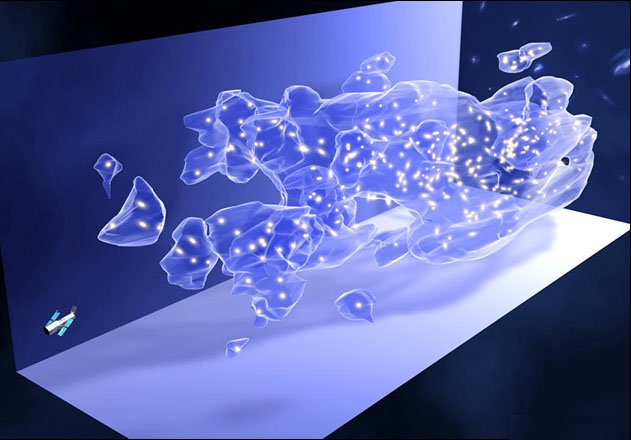
A "loose network", this is how our universe is being described anyway ...


[Image: Courtesy of NASA/ESA/MASSEY, via the BBC, via BLDGBLOG].

"Astronomers have mapped the cosmic 'scaffold' of dark matter upon which stars and galaxies are assembled," the BBC reports. Producing the map "involved nearly 1,000 hours of observations with the Hubble Space Telescope." But it was time well-spent: the map now "confirms that galaxy clusters are located within clumps of this invisible material. These clumps are connected via bridges of dark matter called filaments. The clumps and filaments form a loose network – like a web."

So where do we start ?
For the people, for the earth ? ...


Now we have accepted we are in a multiverse, are we ready to engage with a "multinet" (multiple Internet)? Maybe an Openet (an open network) is a good start? Will the politic follow (Barack Obama: On Net Neutrality) ?


I made this "multinet" illustration from Matt Britt, wikipedia internet map.

Prototype Street Lamplamp absorber of CO2

Tyca reveals lamps that could absorb CO2.
source : http://www.frenchcleantech.com/

Pierre Calleja Inspects a Prototype Street Lamp in His Laboratory Photo: Regis Duvignau

Pierre Calleja is the talented inventor of a process that is already revolutionary : the lamp absorber of CO2. Pierre Calleja runs the innovative company named Tyca based in Libourne (Gironde) and specializing in aquaculture and aquariology. At a time when everyone is looking for solutions to counteract the pollution in our cities (especially pollution), he had the idea to develop a CO2 canister lamp.

It is equipped with a tank containing micro algae to absorb CO2, to issue in exchange for oxygen, while continuing to grow in the light. The lamp of this patent was filed by Tyca that had already been contacted not only by private customers, but also by large groups such as Vinci. The city of Libourne in turn could be one of the first laboratories of real experience of the lamp. This lamp absorber of CO2 is not yet commercially available.Car parks, tunnels, stations and buildings could develop in the future streetlights Calleja.

A revolutionary solution for its efficiency, since a lighting of 1.5 m3 can capture 1 ton of CO2 per year. Multiplied by the number of fixtures that exist in a city as Paris and it is the Amazon forest that is planted on our streets!

Labels

design (116) structure (81) architecture (69) Energy_Animal (53) Nomadic_Ecosystem (46) art (43) Instinctive_Architecture (42) free energy (36) 3d (34) graphic (33) Swarm_Operating_System (32) Ocean (31) presentation (31) maps (28) Ocean_Cookbook (23) biology (23) communication (23) navigation (21) Open_Politics (20) strategy (20) water (20) boat (19) computing (19) survival (19) Life_Cable (18) construction (18) farm (18) safety (17) algae (16) posting (16) materials (15) wave (15) ecology (14) politics (14) technology (14) london (13) physics (13) agriculture (12) battery (12) Openet (11) food (11) animal (10) craft (10) culture (10) fishes (10) mechanics (10) Open_Sailing (9) chemistry (9) media (9) open-source (9) plastic (9) theory (9) video (9) TED (8) behaviour (8) competition (8) engine (8) exploration (8) performance (8) technique (8) philosophy (7) sociology (7) Open_Games (6) biomass (6) inflatable (6) seasteading (6) wind (6) OS_Polar (5) USA (5) animation (5) electronics (5) legal (5) medecine (5) pollution (5) berlin (4) data (4) ethics (4) money (4) psychology (4) reportage (4) service (4) statistics (4) sun (4) Brazil (3) Cesar Harada (3) Observation (3) Protei (3) TEDxOilSpill (3) catastrophy (3) engineering (3) garbage (3) google (3) history (3) identity (3) kite (3) mapping (3) metareciclagem (3) oil spill (3) recovery (3) research (3) sailing (3) science (3) space (3) spain (3) sustainable (3) tradition (3) AI (2) Argo (2) CAD (2) Environment (2) Exploration. Robots Swarm .Sea (2) Jellyfish (2) LABB (2) Louisiana (2) NL (2) NOLA (2) Object Oriented Politics (2) Open Hardware (2) Pachube (2) Pacific (2) Plastiki (2) TEDxBoston (2) UK (2) World Environment Organization (2) ants (2) austria (2) autonomy (2) com (2) coral (2) des (2) endangered species (2) fiction (2) geography (2) gulf of mexico (2) model (2) news (2) open architecture initiative (2) open innovation (2) organisation (2) plant (2) post (2) preservation (2) product (2) protection (2) rca (2) reserve (2) robots (2) simulation (2) skeleton (2) social (2) symbol (2) text (2) treatment (2) waste (2) Adhocracy (1) Aerial (1) Articles (1) BBC (1) BLDGBLOG (1) BP (1) BP oil spill (1) Balloon (1) Bangladesh (1) Barataria (1) Barcelona (1) Bay (1) Black (1) Boston (1) CCCB (1) Colet Castano (1) Crafts (1) Decentralize (1) Distributed System (1) Documentary (1) Dream (1) Environmental Concerns (1) Europe (1) Flight (1) Germany (1) Grassrootsmapping (1) Grenelle (1) Grier (1) Helium (1) Hydrogenase. Architecture (1) Institute (1) JP (1) Jimmy (1) John (1) Kaku (1) Kiel (1) Kim (1) Korea (1) LA Bucket Brigade (1) Luxembourg (1) NOAA (1) New Orleans (1) New York (1) Nina (1) Noah (1) Norway (1) Oceanography (1) Oil (1) Photography (1) Plane (1) Plater (1) Pope (1) Pragmatism (1) Resistance (1) Robot (1) Rotterdam (1) Ruairi Glynn (1) Sketchup (1) Snyder (1) Sphere (1) Spill (1) Stitching (1) TEDxMidAtlantic (1) Talk (1) Tilling (1) Tribe (1) Trondheim (1) Tumas (1) Uros (1) V2_ (1) Vision (1) Washington DC (1) Werner (1) Wood (1) Woods Hole (1) YouTube (1) Zygmunt (1) accident (1) admin (1) alternative (1) anaconda (1) appropedia (1) aquanaut (1) architecture for humanity (1) ars (1) autarcy (1) autark (1) awareness (1) ball (1) baltic (1) belgium (1) biodiversity (1) biofuel (1) brainstorming (1) broadcast (1) buoy (1) canada (1) carbon (1) cardboard (1) carton (1) cesar (1) clear climate code (1) climate (1) cold fusion (1) collaboration (1) concepts (1) cruise (1) current (1) deadly (1) deep (1) departure (1) developing (1) disposal (1) dispute (1) diving (1) diy (1) drone (1) eartquake (1) edgcm (1) events (1) excellent (1) experimental (1) exploring (1) farming (1) farms (1) file (1) fire (1) flickr (1) floating (1) florida (1) fluid dynamics (1) forum (1) france (1) future (1) futurology (1) generator (1) geodesic (1) geoengineering (1) graduate (1) green (1) grey (1) habitation (1) halley vi research station (1) harada (1) hybrid (1) icon (1) ideas (1) ideology (1) independent (1) indian (1) indonesia (1) industrial (1) inhabitat (1) innovation (1) instructables (1) insurance (1) japan (1) kelp (1) ledger (1) lloyds (1) louisina (1) machine (1) magnet (1) maths (1) message (1) messaging (1) metal (1) mimicry (1) mission blue (1) mobile (1) modular (1) monitoring (1) nasa (1) natural (1) naviagation (1) nice (1) nucelar (1) open source (1) opportunity (1) pachbox (1) park (1) participation (1) patch (1) pelamis (1) people (1) photo (1) pirate radio (1) planning (1) pods (1) polar (1) pop (1) popular (1) power (1) pr (1) press (1) raft (1) reef (1) render (1) renewable (1) repost (1) rogue (1) sewage (1) ship (1) ships (1) shit (1) software (1) sound (1) speculation (1) studies (1) study (1) super-collider (1) sylvia earle (1) system (1) temporary (1) toxic (1) tv (1) typography (1) underwater (1) utopia (1) weather (1) web (1) whales (1) wired (1) workshops (1) young (1) youth (1)

This blog is embeded inside the official Open_Sailing website, visit us here : http://opensailing.net

Open_Sailors