http://www.ted.com/talks/lalitesh_katragadda_making_maps_to_fight_disaster_build_economies.html
We dont need to map things to think the world, we can update the maps day after day, from satellite view.
Showing posts with label communication. Show all posts
Showing posts with label communication. Show all posts

13/12/2009
Open_Sailing in EL PAIS (spanish) 2009 12 12

www.elpais.com/articulo/Tendencias/Buscarse/vida/alta/mar...
www.elpais.com/fotografia/Tendencias/Estacion/internacion...

Buscarse la vida en alta mar
El artista Cesar Harada propone un sistema de viviendas flotantes para mudarse a aguas internacionales | ROBERTA BOSCO - Barcelona - 12/12/2009
"La mejor forma de predecir el futuro es inventarlo". La frase es del ingeniero informático Alan Kay, pero Cesar Harada ha decidido convertirla en su lema e inventar su futuro en alta mar. Harada (Bayona, Francia, 1983) es artista, hijo del escultor japonés Tetsuo Harada y de madre francesa. Vive entre Londres y París, por el momento. Porque, mientras la mayoría de los mortales planea trasladarse al campo o la playa, Harada quiere irse a vivir en aguas internacionales de los océanos.
Por eso ha puesto en marcha Open Sailing (www.opensailing.net). Este proyecto interdisciplinar, abierto y colaborativo explora las posibilidades de la arquitectura marina. "La idea es desarrollar y construir un sistema de viviendas flotantes, que permitan la vida humana de forma totalmente autónoma, sostenible y respetuosa, pero también divertida y agradable" explica Harada.
Este peculiar arquitecto -acompañado por dos colaboradores, Carla Castaño (de Barcelona) y Ollie Palmer (de Londres)- ha presentado en Barcelona Open Sailing, en el marco del encuentro Now solar sobre tecnologías y energías sostenibles, que ha organizado un workshop en el Centro de Cultura Contemporánea de Barcelona (CCCB) en colaboración con la Fundación Terra.
Tras intentar construir un prototipo de vivienda pensado para ocho personas, para evitar los obstáculos burocráticos, Harada ha reducido las dimensiones. Y ahora trabaja en algo parecido a una Estación Internacional Oceánica, más pequeña, pero con los módulos indispensables para vivir, producir energía, cultivar vegetales en jardines flotantes abonados con los desechos orgánicos y criar (o más bien atraer) los peces lanzando plancton en el agua. "Podemos hacer converger los rayos del sol en un determinado perímetro del mar para calentar el agua y crear un hábitat más favorable a los peces", indica Harada.
La Estación Oceánica, prevista para el próximo verano, se basa en una arquitectura instintiva que reacciona como un animal. "Cuando la situación es favorable los módulos se alejan del elemento central, si es peligrosa se reagrupan", explica Harada. Para su diseño se ha inspirado en una medusa con largos tentáculos y una especie de vela que se hincha cuando quiere desplazarse. Y sus viviendas flotantes son un híbrido entre un barco y una plataforma petrolífera (pero mucho más bonitas) que se desplazan gracias al viento y las corrientes. En el proyecto trabajan 40 personas, incluidos científicos.
El proyecto se inició como una estrategia de supervivencia, a partir de la recopilación de un mapa de los miedos en el que todos pueden participar a través de (www.hi-ve.net) con la idea de convertir estos miedos en una fuerza de energía positiva. "Los océanos son los lugares más seguros del planeta", concluye Harada.
Original .pdf download : international-ocean-station.org/download/20091212el-pais_...
Original .txt download : international-ocean-station.org/download/20091212el-pais_...
opensailing.net
Website galery

Website article

Original PDF, print quality

12/12/2009
xMAx for the Energy_Animal communication device
Broadband On Radio Waves Speeds Beyond Wi-Max: xMax is Next. Thanks to Joe Mauriello for this link.
http://www.masternewmedia.org/broadband/broadband_technologies/wireless/xMax_radio_based_wireless_broadband_20050707.htm
A new wireless communications technology that symbiotically rides on existing public broadcast radio frequency waves could revolutionize the way we could connect to the Internet or provide broadband access to remote areas that are too expensive to be served by cable or present-day data-transmission technologies.
This latest innovation in broadband communications, is a "discrete" radio-frequency-based data transmission system that leverages traditional television, radio and pager systems bands without ever interfering with them.
The new system effectively extends what was thought possible until now, extending our ability to deliver data at lower cost and over greater distances than existing technologies.
The new technology may also come to be appreciated for its non-harmful effects on humans. The new radio-based approach may in fact spare us quite a few health risks (nobody ever talks about this side of things) which are instead a constant factor when we deal with today's popular very high-frequency transmission bands, like the ones used by mobile phones and other wireless transmission systems.
Overall, the advantages offered are then not only the fact that the public radio spectrum can be stretched in its capacity while not requiring the use of additional frequencies, but also the fact that at the lower frequency bands in which this new technology works data can travel much farther while having greater ease to pass through buildings walls and physical barriers than other existing competing wireless technologies.
Long range and high-speed are two of the key characteristics of xMax, a cutting edge radio-waves-based broadband solution which appears to be even better than Flash-OFDM, an alternative broadband system approach for remote and rural areas.
As a wireless data distribution system, xMax promises a reach of over 40-square miles while being able to serve between a minimum of a few hundred users to a theoretical maximum of a thousand or more.
xMax leverages a unique approach to data distribution via radio frequencies by embedding a very weak signal within the selected radio carrier band. The signal used is so weak that it cannot be easily picked-up by traditional radio antennas.
By using unique receiving units equipped with special filters, xMax-enabled devices can detect and receive the weak radio signal embedded in the radio wave without ever interfering or disturbing the main carrier.
Though prestigious academics like Princeton University Professor Schwartz have declared xMax not a very efficient way to send data over the airwaves, they also concluded that the results that can be achieved are indeed effective.
Obviously such a technology could represent a boon to many Internet service providers and telecom operators who would be able to offer and utilize this cost-effective technology to serve wireless broadband to rural and geographically remote areas which other competing operators would find too costly to cover.
Present third-generation mobile phone networks need base-stations to relay the signals every few miles. With xMax that can be significantly improved as the new technology offers a 400 to 500 percent improvement in range over more traditional technologies.
With WiMax and Flash OFDM, which need dedicated radio frequency bands, if you they are set to operate at frequency ranges above 1GHz, the signal used has no comparable effectiveness in penetrating physical obstacles and building walls as well as being able to have reach greater than a few miles.
XG Technology, the Florida-based company behind this revolutionary invention company behind xMax, has already been talking to multiple chip makers to make this new technology become a market reality. According to the company, xMax-enabled radio chips should cost $5-$6 when built in large quantities while base stations will be around $350,000.
Stay tuned.
openet.org
>> Are we free on the internet ?
- No we are not. We are under surveillance.
>> Can we create an infrastructure-less internet? An Infrastructure-less civilization?
- The technology already exists, may it be mesh-networks on short ranges, or packet radios on long distances. The less infrastructure, the more robust, check this disaster wifi coverage devices!.
>> Do we need the companies, the states, the militaries to organise and moderate it?
- No we don't. The whole open-source communities will support this initiative, you will.
>> Can we can build a true civilian internet?
- Shall we try ... ?
openet.org
We may not have to re-invent TCP-IP ... Some repeaters or open-source mesh-networking computer like the OXO OLPC (One Laptop Per Child) use something close to this system ...
More video detailled explanations and relation to the smart grid ...
Here is packet radio station brief video explanation :

This is the international symbol for amateur radio, included in the logos of many IARU member societies. The diamond holds a circuit diagram featuring components common to every radio: an antenna,inductor andground. antenna,inductor and ground. Maybe the openet doesn't have a ground, a country ...
See also OpenNet.net initiative, more about politics, let's be about empowering people with simple technical solutions. Coolest group here. We can do pretty wild stuff, like bouncing a radio wave signal to the moon - back to earth with a relatively simple equipment !

And there are many ways to create signal relays : in the oceans, in the air (1966 military study), have strong long-wave signal that bounce on the atmosphere. Our network could be much more fluid, wet networks, creating nodes by capillary action, This is when loose network and thermodynamic system and notions of boundaries become useful / useless ... Open_Architecture ?

A "loose network", this is how our universe is being described anyway ...

[Image: Courtesy of NASA/ESA/MASSEY, via the BBC, via BLDGBLOG].
"Astronomers have mapped the cosmic 'scaffold' of dark matter upon which stars and galaxies are assembled," the BBC reports. Producing the map "involved nearly 1,000 hours of observations with the Hubble Space Telescope." But it was time well-spent: the map now "confirms that galaxy clusters are located within clumps of this invisible material. These clumps are connected via bridges of dark matter called filaments. The clumps and filaments form a loose network – like a web."
So where do we start ?
For the people, for the earth ? ...

Now we have accepted we are in a multiverse, are we ready to engage with a "multinet" (multiple Internet)? Maybe an Openet (an open network) is a good start? Will the politic follow (Barack Obama: On Net Neutrality) ?

I made this "multinet" illustration from Matt Britt, wikipedia internet map.
- No we are not. We are under surveillance.
>> Can we create an infrastructure-less internet? An Infrastructure-less civilization?
- The technology already exists, may it be mesh-networks on short ranges, or packet radios on long distances. The less infrastructure, the more robust, check this disaster wifi coverage devices!.
>> Do we need the companies, the states, the militaries to organise and moderate it?
- No we don't. The whole open-source communities will support this initiative, you will.
>> Can we can build a true civilian internet?
- Shall we try ... ?
openet.org
We may not have to re-invent TCP-IP ... Some repeaters or open-source mesh-networking computer like the OXO OLPC (One Laptop Per Child) use something close to this system ...
More video detailled explanations and relation to the smart grid ...
Here is packet radio station brief video explanation :
This is the international symbol for amateur radio, included in the logos of many IARU member societies. The diamond holds a circuit diagram featuring components common to every radio: an antenna,inductor andground. antenna,inductor and ground. Maybe the openet doesn't have a ground, a country ...
See also OpenNet.net initiative, more about politics, let's be about empowering people with simple technical solutions. Coolest group here. We can do pretty wild stuff, like bouncing a radio wave signal to the moon - back to earth with a relatively simple equipment !
And there are many ways to create signal relays : in the oceans, in the air (1966 military study), have strong long-wave signal that bounce on the atmosphere. Our network could be much more fluid, wet networks, creating nodes by capillary action, This is when loose network and thermodynamic system and notions of boundaries become useful / useless ... Open_Architecture ?
A "loose network", this is how our universe is being described anyway ...
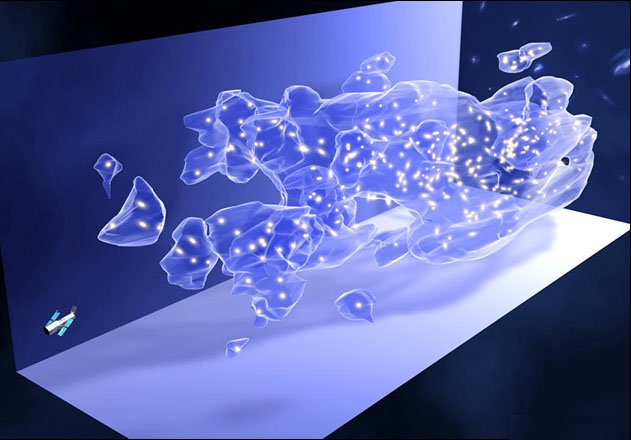
[Image: Courtesy of NASA/ESA/MASSEY, via the BBC, via BLDGBLOG].
"Astronomers have mapped the cosmic 'scaffold' of dark matter upon which stars and galaxies are assembled," the BBC reports. Producing the map "involved nearly 1,000 hours of observations with the Hubble Space Telescope." But it was time well-spent: the map now "confirms that galaxy clusters are located within clumps of this invisible material. These clumps are connected via bridges of dark matter called filaments. The clumps and filaments form a loose network – like a web."
So where do we start ?
For the people, for the earth ? ...
Now we have accepted we are in a multiverse, are we ready to engage with a "multinet" (multiple Internet)? Maybe an Openet (an open network) is a good start? Will the politic follow (Barack Obama: On Net Neutrality) ?
I made this "multinet" illustration from Matt Britt, wikipedia internet map.
Vital function map, world threat maps

This is the concept map of the project : read from the bottom to the top, from the 2012 fears volcano, giving birth to the open sailing station. Download pdf (11.6mb) / see .jpg (2.6mb) / see flickr page

This is the geographical map of both 2012hopes.com and opensailing.net : 2012hopes.com suggests the ideal location, Open Sailing figures out how we will live and thrive in this new geographical context. download pdf (7.6mb) / see .jpg (1.4mb) / flickr page

The maps have all been programmed on maps.google.com, you can save individual map and ad them as your own (if you have a gmail account which is free and amazing) : all maps directory by 2012hopes@googlemail.com. You can also view these maps confortably using google earth.

We have printed 300 of these maps to A1 size, if you want one email us, we'll arrange, we'll appreciate donations since they are expensive to print.

We might send the map as it is supposed to be : folded, to fit in your pocket, an authentic survival pratical map.

City Symbiosis
Michael Rakowitz is not an architect, but he has probably made more houses than many architects in the last ten years. Architects should be envious of the artist's production and vision. He is working with the margins of society. His project Parasite uses a building's heat exhaust to inflate plastic sheeting, creating dwellings for the homeless. For Rakowitz the project is about community involvement as well as dwelling design. He is responsive to the needs of his "clients."

Courtesy Michael Rakowitz
Bill S.’s paraSITE shelter. He requested as many windows as possible, because “homeless people don’t have privacy issues, but they do have security issues. We want to see potential attackers, we want to be visible to the public.” Six windows are placed at eye level for when Bill is seated and six smaller windows for when Bill is reclining.
The article on these structure at World Changing highlights the social impact of his projects. The social agenda is remincient of Archigram, Archizoom and the social idealist and critics of the sixties,where the concept of building was challanged to mean utopian spaces, inflatable huts, or technological phenomena in the guise of a natural environment.

Copyright David Green - Courtesy Archigram
Projects like the living pod,above, imagines a green field condition where the building tapped into site resources to make its own place. Parasite deals with the roughness and tactics of city dwelling. These structures are deployable in the aims of allowing their inhabitants to move when they are at the limits of the law.
At The Functionality we want to encourage this type of tactical thinking. Architects, artists, urban designers, even graphic designers need to re-examine how we will approach the city, our suburbs and even our housing as the economic and environmental conditions unfold. We think the sooner we start the better off we will be.
Advanced Architecture
< Ollie Palmer >
http://www.advancedarchitecturecontest.org/
We should be entering this contest.
Deadline is monday September 28th 2009
CAN WE DESIGN BUILDINGS WITH THE PRECISION OF A CHIP AND THE INTELLIGENCE OF A NETWORK?
CAN IMPROVISATION BE MORE SELF-SUFFICIENT THAN TOTAL PLANNING?
HOW CAN WE RE-NATURALIZE OUR CITIES?
IS IT POSSIBLE TO HAVE COMPLEX HOUSES CONSTRUCTED WITH THE SAME PRECISION AS A CAR?
CAN OUR CITIES BE DIRECTLY DESIGNED AND TRANSFORMED BY THEIR INHABITANTS?
HOW CAN WE FOCUS OUR SKILLS AND RESOURCES ON CONSTRUCTING SELF-SUFFICIENT BUILDINGS?
WHAT ARE THE KEY CONCEPTS FOR THE CONSTRUCTION OF THE HABITAT OF THE 21ST CENTURY?
HOW CAN WE INSERT SELF-SUFFICIENT BUILDINGS INTO HISTORIC URBAN FABRICS?
HOW CAN WE ACHIEVE FULLY ENERGY-EFFICIENT CITIES?
We can do it, reachable.Looking for fundraiser
<yoko>
Open_sailing_01 is looking for a fund-raiser.
:::::::::::::::::::::::::::::::::::::::::::::::::::::::::::::::::::
FUNDRAISER WANTED Earn 5% of all contribution/ donation funds you obtain
ART and OCEAN LOVERS WANTED FOR FUNDRAISING EFFORT
Support an award winning interactive art project + Earn 5% of all contribution/ donation funds you obtain.
(Ongoing Temporary Work)
http://international-ocean-station.org/blog/
Open_Sailing is an interactive art project, and the winner of the [next big idea] voestalpine Art and Technology Grant for the Prix Ars Electronica 2009, one of the most important yearly prizes in the field of electronic and interactive art, digital culture and music (http://www.aec.at/).
The project is currently on show at RCA SHOW 2009 at the Royal College of Art, London (http://www.rca.ac.uk/), and following its closure, will be in preparation for the Ars Electronica Festival taking place this September in Linz, Austria.
Open_Sailing is globally coordinated project based on an open source approach, aimed at researching and developing an alternative system of human habitation at sea.
We currently have a number of projects in developmental stages, including the prototype ship-craft that is now under construction in South London, and several research ‘labs’ involving engineering, new technologies, art & design, food & drink, etc, are in development.
Significant funding must be found for all of these projects, for which we anticipate raising money through grants and support.
We are looking for an experienced individual, committed, responsible, and more than anything motivated, who can help Open_Sailing to its fruition☺
The individual will be responsible for
- researching and approaching potential sources such as trusts, corporations, statutory bodies, major donors, individuals and others.
- drafting and preparing supporting materials and correspondences
- overseeing and monitoring income and expenditures of the project
- achieving a money-raising target
You will be promised a share of 5% of all contribution/ donation cash funds you obtain, and participation in the Ars Electornica Festival 2009 as one of the representative contributor of Open_Sailing.
:::::::::::::::::::::::::::::::::::::::::::::::::::::::::::::::::::
Anyone interested can contact: Cesar Harada : cesar.harada@opensailing.net
<yoko>
World Ocean Day
Did you know that yesterday (8th June) was World Ocean Day?
Click here or here to find out more.
Click here or here to find out more.
Hello friends,


Today is World Oceans Day - not yet as high profile a calendar event as Mothers' Day or Fathers' Day, yet equally worthy of celebration since the oceans are the source of all life on earth – home to most of the planet's species.


Millions of people depend on the oceans for their livelihood, their food, or both. It's estimated that the oceans absorb 30-50 percent of the carbon dioxide our fossil-fueled civilization emits. The oceans produce half of the oxygen we breathe. Quite literally, if the oceans die, our planet dies.


Yet we are fishing out our oceans, catching too much, and wasting much of what we catch. We use destructive fishing methods to scrape the sea-floor clean of centuries-old coral and other living things in search of a few premium species.


We send more and more boats out chasing fewer and fewer fish. We strip the fins from sharks.


And we ignore the warnings of scientists when they recommend that we cut back on fishing for bluefin tuna, cod and salmon.


The End of the Line The End of the Line is a new film released across the UK today for special World Oceans' Day premiere screenings, which tells the story of this relentless quest to catch fish at any cost, and points the finger at the politicians, corporations and chefs who are to blame. It's a stark wake-up call to those of us who blithely assume that there will always be 'plenty more fish in the sea'.


After seeing a preview a few days ago comedian Stephen Fry told his Twitter follwers "Staggered by brilliance of The End of the Line. PLEASE go & see it when it opens 50 screens nxt wk. Rarely felt so strongly about anything". Stephen's one of a large number of celebrities who are now demanding that the fashionable Nobu resteraunt chain take endangered bluefin tuna off its menus. Others include Ted Danson, Woody Harrelson, Sting, Charlize Theron, Stuart Townsend, Alicia Silverstone and Zac Goldsmith.


Here at Greenpeace we think this film is essential viewing, which is why we're proud to be supporting it. Watch the trailer and you'll see that this is more than just another film - it will change the way we think about the oceans. And please tell your friends - the more people who see it in the first few days, the more screenings it will get in cinemas in the weeks and months to come. Once you've seen it, I think you'll agree that this is a film that needs to be seen by as many people as possible.


So please celebrate World Oceans Day by going to see The End of The Line if you can. Check here for the list of participating cinemas - some have special guest Question and Answer sessions.


Help us spread the word about the film


If you use Facebook, Twitter, or other social networking sites, you can easily help us to get the word out by inviting your friends to take a look.


Thank you,


Willie Mackenzie

Monday, June 8th, 2009
Open_Sailing funding
We're looking for media, sponsorship and technology partners for Open_Sailing.

Click here to read on-screen
Click here for a printable version
Open_Sailing website and contacts
Click here to read on-screen
Click here for a printable version
Open_Sailing website and contacts
Sustainable Art Awards
YEAH !!!!
We got selected to compete for another award !

As you know the RCA show is our priority, thousands and thousands of visitors are expected there, and the dates are overlapping :
- Sustainable awards : 17th to 28th of June
- RCA Show : 25th of June to 5 of July
So, some of the Bash exhibitions might get transfered during the exhibition.
Just as a reminder : we have the Area 10 event the 13th of June, we are showing the Open_Sailing_01 assembled for the first time.
Good news = More work ! What shall we show?
We got selected to compete for another award !

Congratulations!So, I know we already got a lot of work, but we have to organise ourselves to get this event done nicely.
I am very happy to inform you that your work has been selected to be exhibited as part of the Sustainable Art Awards.
Your pieces must be transported to our studios by Friday 12th of June 2009.
Location: BASH Studios, 65 - 71 Scrutton Street, London, EC2A 4PJ.
Just a few reminders:
- The set up will take place Saturday 13th of June at 11AM. Volunteers will be attending to set up your work if you can not attend.
- On the 16th of June we will host a opening party (invite enclosed) for the Sustainable Art Awards.
- The time and date of the exposition is from the 17th to the 28th of June.
If you have any questions please do not hesitate in contacting me.
All the best,
Gina Whitehead
Sustainable Art Awards coordinator
--
BASH STUDIO 65-71 Scrutton Street, London, EC2A 4PJ
Bash Creations Limited is a limited company registered in England and Wales. Reg. number: 6061744. Registered office: Lear House, 259 Cranbrook Road, Ilford, Essex IG1 4TG.
As you know the RCA show is our priority, thousands and thousands of visitors are expected there, and the dates are overlapping :
- Sustainable awards : 17th to 28th of June
- RCA Show : 25th of June to 5 of July
So, some of the Bash exhibitions might get transfered during the exhibition.
Just as a reminder : we have the Area 10 event the 13th of June, we are showing the Open_Sailing_01 assembled for the first time.
Good news = More work ! What shall we show?
23/11/2009
Open Sailing 4 minutes concept video
Download the original quicktime .mov video here (44 mb).
Also visible on vimeo / youtube / dailymotion / sevenload : Script of the video in .txt (3 kb).
This 3 minutes video explains the Open_Sailing main concepts. Buzz it, spread the world.
shipais.com, amazing feed
http://www.shipais.com/currentmap.php?map=thamesrhine


Really cool feed of major ship positions. Below, from their FAQ :
http://www.shipais.com/what.php (very interesting page by the way, telling us who need to publisize its position constantly by categories).
As part of the global maritime safety system, ships over 300 tons are now required to broadcast their positions using AIS.
A ship transmits "dynamic" information at intervals of between 2 and 12 seconds depending on the vessel's speed or 3 minutes if at anchor.
Thanks to Ollie Palmer for the link.
New concept designs! 20090301
Here are two concept designs for the Open_Sailing prototype's main shelter...


Download the Illustrator files here!
Octagonal Structure
Catamaran Structure
By Ollie


Download the Illustrator files here!
Octagonal Structure
Catamaran Structure
By Ollie
Low Cost Internet Access At Sea

Although satellite links at sea are quite common, the speed of data transmission for most users is very low, from 600 bps to 64 kbps, with around 10 kbps being a typical speed. This, combined with usage costs of around € 20 per megabyte, has created an environment in which many ship owners cannot reliably access the Internet, or use it regularly.
The Wired Ocean approach uses a hybrid solution, combining Ku-band satellites for the downlink and narrow L-band satellites for the return channel. While at sea, the downlink (forward) channel offers a speed of 512 kbps and the uplink (return) channel speed is 9.6 kbps for Globalstar and up to 64 kbps for Inmarsat. This configuration promises to be more economical than purely narrowband satellite systems, with cost savings of as much as 70% over current systems.
Telephone, television and now Internet
The ship's internet communications are managed through a specialised client server developed by Wired Ocean. This server interfaces with a tracking TV Receive Only (TVRO) antenna for the downlink and various types of narrowband communications equipment for the uplink. The ship's TVRO is used to receive internet data while simultaneously providing signals to the ship's televisions.By using Eutelsat's Eurobird located at 28.5° East and Hotbird at 13° East, Wired Ocean is able to provide its service for the two most watched European TV locations.
As many ships already have TVRO and a satellite phone, addition of the Wired Ocean server now gives them the triple play (telephone, television and internet) for an incremental capital outlay.
Pilot trials
From July to December 2005, ten trials were carried out on various vessels, including five yachts in the Mediterranean Sea, three fishing vessels in UK waters and the North Sea, a container ship operating between Iceland and continental Europe and an oil & gas supply vessel in the North Sea.The trials proved Wired Ocean to be exceptionally reliable, with the satellite/hub operating at 99.954% availability and as much as 15.2 gigabytes of data was down-linked. The results of these trials not only demonstrated the pent-up demand for internet access at sea, but also that a reasonably priced service improves operational efficiency as well as the quality of life for crew and passengers aboard ships.
In a survey of the trial users, the Wired Ocean system rated extremely well against other maritime data services. Connection set-up time and speed were all highly favourable. The ability to watch TV at the popular locations while accessing the Internet proved to be a 'must have' requirement.
Access to the Internet via Wired Ocean puts a wide variety of applications at the disposal of the crew. Fishing vessels were especially interested in following the latest prices at various ports, while yacht owners made great use of the service to monitor the stock markets. Seven of the trial participants have announced plans to use the service on a commercial basis.
Advantages of the new approach
A variety of companies have attempted to provide a low-cost hybrid service at sea but failed. While the concept sounds simple, actually delivering a service that meets the challenging user requirements set by the market is more difficult. The Wired Ocean service is fast, economical, reliable, secure, flexible and easy to use. In previous systems, one or more of these elements has always been missing.Wired Ocean's pilot trials were a continuation of the ESA Telecom supported project ‘Maritime Interactive Broadband’, which began as a result of the Start-up Projects Initiative. This initiative is designed to open the door for business innovation to small and medium sized enterprises (SMEs). The Start-up Projects Initiative helps SMEs through the early development stages of researching and refining a business proposition. The current project, ‘Wired Ocean Pilot Service’ has been supported in this way by ESA.
Adapted from materials provided by European Space Agency.
satellite signals commercials
But why not creating "our own internet" ? Openet !
satellite signals commercials
But why not creating "our own internet" ? Openet !


Boat Made From Plastic PET Bottles To Sail on 11,000 Mile Ocean Voyage

The Plastiki launches in Spring 2009 on a 7,500-mile route from San Francisco to Sydney
Plastiki Workshop GigaPan 1 | GigaPan 2
The Plastiki design brief calls for an off-grid habitation—a house in essence—that would function as the cabin for a catamaran. The middle of the Pacific Ocean is the ultimate off-grid site. At Architecture for Humanity (AfH), we are always searching for prototypes, systems and materials that have broad relief applications. As the Plastiki is literally composed of re-purposed materials and off-grid systems, anything we learn through the boat design/build process carries over into our housing and systems initiatives.
Innovation is challenging. The biggest challenge here was adapting a new material system (srPET) for what promises to be a demanding voyage. The Plastiki will literally float on post-consumer bottles nested within a re-purposed plastic panel system. The major challenge of naval design more generally is to reconcile the often contradictory demands of what makes a boat perform well and what people need on an extended voyage.
The adoption of the egg as a generative form is a clear example of ‘biomimicry;’ that is to say, looking to nature for design solutions. In this case, a strong shape was needed to handle wave and storm forces during the voyage. The design of the Plastiki cabin is informed by the shells of several long-term earth residents. Turtle shells, Horseshoe Crab armor, Dinosaur plating, and eggs all contributed to the overall form, fused plates and folds that comprise the cabin shell geometry.
Working with design team members, we are integrating waste and water systems into the cabin. The cabin shell is our primary source for collecting rainwater, which will be filtered and stored. Solar photovoltaic panels are arrayed on the shell roof. Other energy exhibits, such as wind, water, bicycle and possibly wave power are being situated on the deck along with a modern-day ‘canoe garden’ that echoes the on-board gardens of ancient Polynesian mariners who brought staple plants and animals on voyages to ensure their sustainability.
[CNN and Architecture for Humanity, gizmodo, thanks to Vahakn]
A Mobile Mesh Network Goes Nuclear
Backpacks that detect nuclear material form a wireless mesh network.
Technology review By Kristina Grifantini

Credit: Joseph Tumminello
Nuclear option: This backpack (top) contains sensors that detect radioactive materials. Coupled with a mesh network, it automatically builds a map showing hazardous materials in the area. A mesh node wirelessly transmits results from nuclear sensors to handheld devices (bottom), such as a wrist-worn display or a PDA.
New mesh-networking technology will allow soldiers to more quickly search an area for signs of nuclear contamination. A company called Rajant has combined mesh radio transmitters with radiation-sensing backpacks to create a system that automatically sets up a communications mesh and displays a map of radiation across a region.
Mesh networking offers a fast, cheap way to construct a communications network. Instead of sending messages via a central command point, information hops from one node to another until it reaches its destination. A number of companies use static mesh networks for tasks such as traffic monitoring and environmental sensing, but creating reliable mobile mesh networks is more challenging. This is because each node must constantly track its moving neighbors to figure out how best to pass on a message while also preserving energy and bandwidth. Rajant addresses this problem by having nodes monitor just a few of their closest neighbors at any time.
For the detection system, Rajant's communication nodes, called BreadCrumbs, are connected to backpack sensors that detect radioactive material including plutonium and enriched uranium; the sensors are made by a company called Nucsafe. Team members wearing the sensors branch out and perform reconnaissance of an area. Data from each node hops back to a main computer, which builds a map showing the position of each node and its radiation data while individual users can see a map of their pack's results on a wrist-worn display or a laptop. Rajant presented the newest version of the system at the 2009 Soldier Technology Conference in Florida last month.
Each BreadCrumb can communicate with a peer that is up to five miles away, says Glenn Booth, vice president of marketing for Rajant. He adds that the mobile network has enough bandwidth to transmit a video stream or VoIP, even with hundreds of nodes all moving in different directions. The company already sells the wireless technology to mining companies and the military, and a single BreadCrumb device costs up to about $5,000.
"Building a reliable network is difficult because of mutual interference between radio nodes," says Dipankar Raychaudhuri, who works on mobile mesh networks for vehicles at Rutgers. Networks work with a certain density of radios, he says, but "can fall apart if radios move out of range in uncontrolled settings."
"The problem with completely mobile networks is that there is no guarantee of connectivity," adds Nader Moayeri, who works on mesh and ad hoc networks for the National Institute of Standards and Technology. "One other challenge is the capacity of the network," says Moayeri. Normally, as each node moves, it has to recalculate the best routes for a message. "That's considerable overhead," he says. "It eats up bandwidth you could be using for sending actual data."
Another way to improve a mobile network is to use several radio transmitters. For example, a company called MeshDynamics has developed transmitters that use two radios to send and receive data instead of just one.
Technology review By Kristina Grifantini
Credit: Joseph Tumminello
Nuclear option: This backpack (top) contains sensors that detect radioactive materials. Coupled with a mesh network, it automatically builds a map showing hazardous materials in the area. A mesh node wirelessly transmits results from nuclear sensors to handheld devices (bottom), such as a wrist-worn display or a PDA.
New mesh-networking technology will allow soldiers to more quickly search an area for signs of nuclear contamination. A company called Rajant has combined mesh radio transmitters with radiation-sensing backpacks to create a system that automatically sets up a communications mesh and displays a map of radiation across a region.
Mesh networking offers a fast, cheap way to construct a communications network. Instead of sending messages via a central command point, information hops from one node to another until it reaches its destination. A number of companies use static mesh networks for tasks such as traffic monitoring and environmental sensing, but creating reliable mobile mesh networks is more challenging. This is because each node must constantly track its moving neighbors to figure out how best to pass on a message while also preserving energy and bandwidth. Rajant addresses this problem by having nodes monitor just a few of their closest neighbors at any time.
For the detection system, Rajant's communication nodes, called BreadCrumbs, are connected to backpack sensors that detect radioactive material including plutonium and enriched uranium; the sensors are made by a company called Nucsafe. Team members wearing the sensors branch out and perform reconnaissance of an area. Data from each node hops back to a main computer, which builds a map showing the position of each node and its radiation data while individual users can see a map of their pack's results on a wrist-worn display or a laptop. Rajant presented the newest version of the system at the 2009 Soldier Technology Conference in Florida last month.
Each BreadCrumb can communicate with a peer that is up to five miles away, says Glenn Booth, vice president of marketing for Rajant. He adds that the mobile network has enough bandwidth to transmit a video stream or VoIP, even with hundreds of nodes all moving in different directions. The company already sells the wireless technology to mining companies and the military, and a single BreadCrumb device costs up to about $5,000.
"Building a reliable network is difficult because of mutual interference between radio nodes," says Dipankar Raychaudhuri, who works on mobile mesh networks for vehicles at Rutgers. Networks work with a certain density of radios, he says, but "can fall apart if radios move out of range in uncontrolled settings."
"The problem with completely mobile networks is that there is no guarantee of connectivity," adds Nader Moayeri, who works on mesh and ad hoc networks for the National Institute of Standards and Technology. "One other challenge is the capacity of the network," says Moayeri. Normally, as each node moves, it has to recalculate the best routes for a message. "That's considerable overhead," he says. "It eats up bandwidth you could be using for sending actual data."
Another way to improve a mobile network is to use several radio transmitters. For example, a company called MeshDynamics has developed transmitters that use two radios to send and receive data instead of just one.
Navigation
We are working to make sure our semi-autonomous navigation system will be better than those used on expensive nuclear submarines (and a lot cheaper!)

Global Maritime Distress Safety System

UN Oceans and Law: The Law of the Sea
GMDSS consists of several systems, some of which are new, but many of which have been in operation for many years. The system is intended to perform the following functions: alerting (including position determination of the unit in distress), search and rescue coordination, locating (homing), maritime safety information broadcasts, general communications, and bridge-to-bridge communications. Specific radio carriage requirements depend upon the ship's area of operation, rather than its tonnage. The system also provides redundant means of distress alerting, and emergency sources of power.
Recreational vessels do not need to comply with GMDSS radio carriage requirements, but will increasingly use the Digital Selective Calling (DSC) VHF radios. Offshore vessels may elect to equip themselves further. Vessels under 300 Gross tonnage (GT) are not subject to GMDSS requirements.
Subscribe to:
Posts (Atom)