Samedi 30 janvier de 14h à 18h
Présentation et projection du film
Table ronde consacrée au roman
Le Bateau-usine (Kanikôsen, 1929) roman de Takiji Kobayashi (1903-1933) raconte l’épopée de trois cents hommes envoyés en mer d’Okhotsk pour pêcher le crabe et en faire des conserves. A travers le microcosme de leur bateau-usine, l’auteur dénonce le capitalisme en tant que système. Ce chef-d’œuvre de la littérature prolétarienne connaît aujourd’hui un fort regain d’intérêt, contemporain d’une prise de conscience des nouvelles inégalités sociales au Japon.
Présentation et projection du film
14h 14h30 : pré sen ta tion du film par Teru Shimamura (spé cia liste de la lit té ra ture pro lé ta rienne japonaise, uni ver sité Ferris, Tôkyô)
14h30 16h30 : pro jec tion du film
Le Bateau-usine「蟹工船」
1953 / 109’ / N&B / vo/stf
Un film de Sô Yamamura / D’après le roman de Takiji Kobayashi / Avec Sô Yamamura, Masayuki Mori, Sumiko Hidaka, Sanae Nakahara / Prix spé cial au Festival de Karlovy-Vary en 1954
Table ronde consacrée au roman
16h30 18h : Table ronde
Intervenants : Cécile Sakai (Professeur à l’Université Paris Diderot-Paris 7, mem bre de l’UMR CRCAO Centre de Recherches sur les Civilisations de l’Asie Orientale),
Jean-Jacques Tschudin (Professeur émérite à l’Université Paris Diderot-Paris 7, mem bre de l’UMR CRCAO),
Evelyne Lesigne-Audoly (doc to rante à l’Inalco, tra duc trice en fran çais du roman Le Bateau-usine).
Autres pro jec tions du film : jeudi 4 février et samedi 6 février à 20h (petite salle, entrée libre)
As defined by Michio Kaku : - Type-1 civilization : is capable of harnessing the entire power of a planet, and dominate its processes, including its weather, geothermal energy, etc. It should be able to construct facilities anywhere it wants to on the planet. - Type-2 civilization : is capable of harnessing the power of its local star, and subsidiary planets. - Type-3 civilization can become inter-stellar/multi-stellar, capable of expanding across multiple star systems, and eventually the entire galaxy. (Star Trek is one exemple of Type-III Civilization) We are currently at the zero-point-something mark on this scale.As a 2010 TED fellow, we are collectively required to adress the question "what the world needs now?".
The world leaders had the same requirements at the COP15 Copenhagen summit. Each of us has the opportunity everyday in each of our most insignificant actions - they are significant.
What a humbling question.
The first thing that pops to my mind is how difficult it is to link that different scales of actions : the global political decision and the everyday individual behavior changes in little gestures. Maybe we need to proceed the other way round this time?
Would it be possible? A peaceful working global interoperability?
- Knowledge : People need to know about it.
- Desire : the proposed world need to desirable, ethical social model.
- Capacity : everyone needs to be able to participate in their own ways within earth limits.
I am working on this with this nascent project : the World Environment Organization and I am looking for programmers and lawyers for that (the website is very very bad for now, lots of work to do, contact me).
But the real question is : is a Type 1 civilzation even desirable?
The type 1 civilization Michio Kaku describes has :
- a type 1 language : english (an everyone speaks another native land language).
- a type 1 monetary system (a global currency + capitalism).
- a type 1 political system (democracry + republic).
hummmm...... I think only americans agree with themselves on this. What does a chinese, an indian, a brazilian, cuban, french, arabic, persian, african person think about supremacy? Portuguese, English, French, Japanese have attempted it not long ago, Americans are doing it now... I think this "type 1 thinking" contradicts with the values of tolerance and cohesive forces necessary for the making a durable type 1 civilization. Haven't all empires collapsed? Diversity is the driving force for competition, evolution and civilizational progress, we can't wish for ONE dominant system, there wouldn't be any more progress, just an unstoppable normative force. Myself being a japanese descent I am very surprised Kaku advocates a totalitarian type 1 civilization, as if plurality wasn't thinkable, only American domination... How sad...
As Michio Kaku describes it, the type 1 civilization is a civilization of absolute control : control over the planet, processes, including its weather, geothermal energy. So it is human domination over "nature". Which is also a questionnable desire. And Kaku suggests that's only achievable with a type 1 language, 1 monetary and 1 political system. I think this way of thinking is dangerous. Think about linguistics : why do we have so many words, so many languages, so many dialects... Why do Eskimos have so many different words to describe "snow"? Why do we have every week new artificial computer and artificial languages? Diversity is a fact, and is necessary. Kaku suggests each will have his/her own local language + english, but the fact is that local languages tend to disappear on the long term.
Kaku interestingly simplified the options for accessing the type 1 civilization conditional to :
- positive "integration forces" with tolerance, multi-cultural fabric on one hand ;
- and on the other hand "disintegration forces" : "weapons of mass destruction, germ weapons, terrorism..."
I think it is a good simplification, it does help : we need to concentrate on minimizing the disintegration forces, and maximizing integration forces. On this we can all agree, but it only is valid if no country has a domination desire... and he himself clearly declares he has!
Kaku also takes the example of the European Union, and falsely explains its inception as a counter-measure to the North American Free Trade Agreement. It is not true! Europe was born after the war as a space of political cooperation, to ensure peace - and later only - to improve economic condition. Thanks to American help on this, by the way.
The US is very different, it is a very recent rich colonized land, from which the natives have largely been subject to what many qualify a genocide. Europe is a land of a much higher diversity of languages, economies and political systems than the US today, and according to the recent economic crisis, Europe happens to be more stable and resilient. Still the US is now a dominant economic, political, military and cultural entity.
The US alone wont make the entire world access this type 1 civilization by forcing its normative military power, economy, language and values. There will be no global acceptance of the US type 1 civilization project. That would create too much friction. I like to think civilization type 0 transitioning to a civilization type 1 as the moment a plane breaks the sound barrier, or brakes itself. (video explaining sonic boom).
If our "civilization type 0" tries to transition to "civilization type 1" without enough velocity and cohesion it will fail like the early supersonic flights dramatic attempts. And we got only one chance!!!
We wont transition to type 1 civilization by forcing the entire world to speak the same language, use the same currency, have the same political ideas.
We wont transition to type 1 civilization by dominating the nature.
We wont transition to type 1 civilization with our actual political democratic system inability to change efficiently individual everyday little gestures.
We wont transition to type 1 civilization if each of us doesn't have the knowledge, desire and capacity to be on that flight.
I have a dream that we will all enter type 1 civilization with cohesion in our diversity of languages, currencies, political ideas.
I have a dream that we will enter type 1 civilization in harmony with nature, not dominating it.
I have a dream that each of our everyday gestures would reflect our many better political systems.
I have a dream that, not only a rich minority, but all of us will enter type 1 civilization with the capacity, knowledge and desire to, in their own ways.
Refuge - Architectural Propositions for Unbound Spaces explores the causes and spatial impact of migration through voluntary or involuntary "refugees" who are transforming cities around the globe. Individuals or groups are elegantly or forcefully encapsulated from within the context of the city and society. Refuge produces an ever more atomized urban tissue where the "camp" has become both spatial paradigm and everyday reality, be it in the form of a gated community, slum, or humanitarian refugee camp.
View of the exhibition about Refuge. Photography by Michelle Wilderom
Refuge is subdivided into 4 categories, each illustrated by 3 examples found in various locations around the world. I picked up only one for each section of the exhibition.
Artist Thomas Kilpper opened the section Providing Refuge with a poetic and burning appeal to build A Lighthouse for Lampedusa! Providing Refuge explores how architects respond to the need of temporary spaces of refuge that offer protection to fragile or threatened constitutencies, or that legitimate expressions of a human desire for withdrawal, safety, seclusion and loneliness. (detail of Thomas Kilpper's drawing)
Every year, some 20 000 refugees, mostly from Africa, try to reach Europe via Lampedusa, a tiny Italian island between Sicily and Tunisia. Aid organisations estimate that one in ten die during the dangerous crossing. Once they've set foot on 'the promised land', immigrants are directed to a 'Welcome Centre' which inadequacy is creating a worrying humanitarian situation. The illegal immigrant detention centre on the island of Lampedusa in Italy. Photo: Paul Grover
Thomas Kilpper, along with a team of architects, engineers and local people, hope to build a lighthouse with a powerful beam that would provide orientation at sea and help reduce the danger to life. Furthermore, the ground floor of the lighthouse would host an arts center. The discussions, exhibitions, concerts and other cultural events organized there would attract both new visitors to the island and local people, giving them an opportunity and space to learn from and listen to each other. This project underlines the need for a solution to the refugee problem: it's not possible to solve it via restrictions and declaring a 'state of emergency'. We call for a humanitarian and just immigration and integration policy in Europe. None of the refugees is illegal. We oppose any idea to establish a 'Fortress Europe'. The lighthouse will be a self-confident signal: 'here we are, we do not hide'. Preventing Refuge are proactive projects that aim to prevent entire groups of city dwellers from becoming refugees. 2 million square meters of development projected on the city
After the 2003 Rose Revolution, Georgia embraced a wild capitalism. Spatial planning became suspect, public assets were quickly privatized, and the city faced rampant land and property speculation, leaving the city authority without strategic plan. Some 2,000,000 m2 of newly developed areas threaten to destroy Tbilisi and led to large-scale urban displacement. A city already filled with thousands of war refugees has transformed citizens into refugees in their own city. FAST, One architecture and local artists outlined a The New Map of Tbilisi to expose all spatial and infrastructural projects being imagined or built in the city, highlighting its lack of strategic coherence. It also shows how refugees from earlier civil wars and current residents are displaced. And, it tracks how public buildings, spaces, and parks were privatized, left to stand empty due to the crisis, then to be reclaimed by internally displaced persons.
By exposing corrupt land deals and making the effect of failed statehood transparent, the "New Map of Tbilisi" aims to empower citizens to take positive action, providing a platform for grass root initiative, civil society institutions and municipal authorities alike to re-engage in a strategic discussion on the urban future of Tbilisi. Laboratories of Returns, one of the projects i discovered in the Dismantling Refuge section, examines return from exile. When return becomes possible, the site of origins is already irrevocably transformed. Return is never a simple turning back of time, a return is always a return to the already built. (image)
The notion of "return" has defined the diasporic and extraterritorial nature of Palestinian politics and cultural life since al Nakba in 1947-48. The work of Alessandro Petti, Sandi Hilal and Eyal Weizman urges architects to engage in a discussion about the revisiting, re-occupation, and appropriation of the already built. Their research and proposals on the appropriation of settlements and military bases to be evacuated -the "future archaeology" of Israel's occupation -- has been recently expanded to include other instances of displacement such as the afterlife of Italian colonial architecture in Libya. Improving Refuge focuses on the estimated 1.4 million Palestinians living in camps spread across Jordan, Gaza, the West Bank and Syria. These makeshift areas are among the most densely populated in the world. Living conditions, as we all know (but pretend to ignore), are abominable. Camps are a place of temporary-emergency refuge but they also need to be habitable. They hover between stillness and action. The Infrastructure and Camp Improvement Program launched by the UN attempts to introduce strong community-driven urban planning that would enable people living in the camp to go beyond the victim mentality.
I found the practice of Participatory Community Mapping particularly fascinating. ARC, the Arab Resource Collective, invited Palestinians living in several refugee camps in Lebanon to collectively draw maps of their respective camps from memory. The resulting maps chart live experiences rather than the usual landmarks. Political fault lines, social affiliations, and the loci of power manifest themselves from the bottom-up. No only do these maps undermine derogatory assumptions about unruly spatial configurations, they also expose the glaring injustices of the Lebanese government's policy regarding Palestinian refugees. The maps betray the absence of workplaces, except for grocery stores, mini-markets and pharmacies. In the writ of Lebanese regulations, Palestinian refugees are barred from performing dozens professions, including the practice of law, medicine, engineering, etc. Map of Nahr el-Bared
Open City: Designing Coexistence of the 4th International Architecture Biennale Rotterdam is on view until 10 January in the Netherlands Architecture Institute (NAI). Photo on the homepage via EU Australia online.
Related: Bas Princen, Mokattam Ridge (Garbage city).
Parag Khanna suggests frontiers are oppressive violent constraints. He suggests we should focus on infrastructure. I would rather suggest we focus on how to stop being dependent of infrastructure. For the simple reason is that infrastructure is what takes the most time to change, it is much slower to change infrastructure than it is to change political landscape or culture.
Most the conflicts he is giving details on are based on infrastructure and their economical consequent politcal power. Energy is everywhere, we don't need grand infrastructures. So we either global decentralization, or design of mobile sources of renewable energies (Energy_Animal). Just as countries divided, grids should divide, that would also increase local responsabilities and less energy loss on infrastructures. This video also reveals that "new territories" correspond to tribal ancient bodies of population, that used to live there, before infrastructures and imperialists, by traditional means... Another strong argument not to re-arrange frontiers by economical means.
This century has mostly been the century of migrations, see the wonderful exhibition "Terre Natale" an incredibly powerful vizualization of world migrations (by Stewdio, framed by Paul Virilio).
People have legs and dreams. They also have problems, many don't choose to move but have to. Those who have the choice : why are they moving? And where are they moving? I believe most of them are moving because of their aspiration for a better life, an for that reason the image of the territory they are aspiring to go is crucial.
The territory, the population builds the image, and the most attractive bodies of people are the one that build rich bodies of imageries, that appeal by marketing a powerful dreampolitk (Stephen Duncombe) if not many (plurality, heterodox regimes). Enough of realpolitik. Would America as we know it even exist without the American Dream?
So instead of focusing on infrastructure and economy :
Focus on education : facilitating language learning, facilitating trade in general is a good way to create emotional bridges between populations, ensure peace and cooperation durably.
Design culture : the art, design, crafts, music are powerful identification figures for people; a nation unites under a flag, a symbol represents a common interest. I have identified earlier surculture as major force for cultural change in the cultural feedback loop.
Design mobility : human migration is one of the major factor to influence global politics for the coming century. Transports & national borders.
Design infrastructure-less civilization : In the Darwinian sense, fitness does not necessarily mean strength so much as the capacity to adapt successfully. Infrastructure is the power of ancient civilizations ; mobility, flexibility adaptability is at the advantage of the leading group of individuals and of the destitute. Who knows what happens if you generalize these capacities to the majority? World hotel (static infrastructure + nomadic people) or moving cities (nomadic infrastructures)? Ultimately why would people want to travel, especially since they can download HQ national geographic documentaries? Well, it seems that since National Geographic is doing a pretty awesome work, more and more people traveled so, communication again did encourage tourism if not migration.
I don't think Open_Sailing can propose to build a new civilization at all. Many ethnies have been living on water since errr forever, maybe we should learn from them first. But the middle of the ocean, or on really long distances and really different climates ... That's a new exciting story...
>> Are we free on the internet ?
- No we are not. We are under surveillance.
>> Can we create an infrastructure-less internet? An Infrastructure-less civilization?
- The technology already exists, may it be mesh-networks on short ranges, or packet radios on long distances. The less infrastructure, the more robust, check this disaster wifi coverage devices!.
>> Do we need the companies, the states, the militaries to organise and moderate it?
- No we don't. The whole open-source communities will support this initiative, you will.
>> Can we can build a true civilian internet?
- Shall we try ... ?
We may not have to re-invent TCP-IP ... Some repeaters or open-source mesh-networking computer like the OXO OLPC (One Laptop Per Child) use something close to this system ...
Here is packet radio station brief video explanation :
This is the international symbol for amateur radio, included in the logos of many IARU member societies. The diamond holds a circuit diagram featuring components common to every radio: an antenna,inductor andground. antenna,inductor and ground. Maybe the openet doesn't have a ground, a country ...
And there are many ways to create signal relays : in the oceans, in the air (1966 military study), have strong long-wave signal that bounce on the atmosphere. Our network could be much more fluid, wet networks, creating nodes by capillary action, This is when loose network and thermodynamic system and notions of boundaries become useful / useless ... Open_Architecture ?
A "loose network", this is how our universe is being described anyway ...
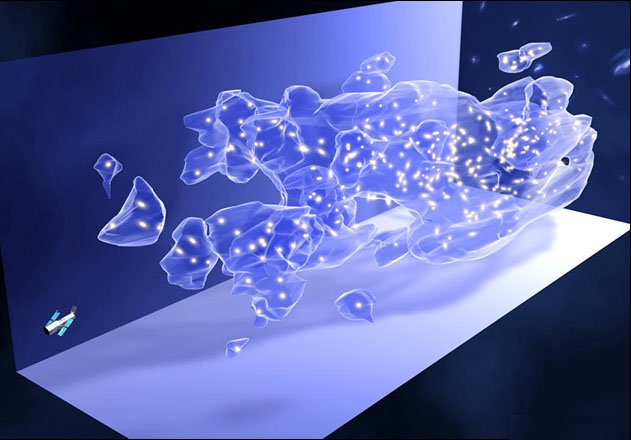
[Image: Courtesy of NASA/ESA/MASSEY, via the BBC, via BLDGBLOG].
"Astronomers have mapped the cosmic 'scaffold' of dark matter upon which stars and galaxies are assembled," the BBC reports. Producing the map "involved nearly 1,000 hours of observations with the Hubble Space Telescope." But it was time well-spent: the map now "confirms that galaxy clusters are located within clumps of this invisible material. These clumps are connected via bridges of dark matter called filaments. The clumps and filaments form a loose network – like a web."
So where do we start ?
For the people, for the earth ? ...
Now we have accepted we are in a multiverse, are we ready to engage with a "multinet" (multiple Internet)? Maybe an Openet (an open network) is a good start? Will the politic follow (Barack Obama: On Net Neutrality) ?
I made this "multinet" illustration from Matt Britt, wikipedia internet map.
This is the concept map of the project : read from the bottom to the top, from the 2012 fears volcano, giving birth to the open sailing station. Download pdf (11.6mb) / see .jpg (2.6mb) / see flickr page
This is the geographical map of both 2012hopes.com and opensailing.net : 2012hopes.com suggests the ideal location, Open Sailing figures out how we will live and thrive in this new geographical context. download pdf (7.6mb) / see .jpg (1.4mb) / flickr page
The maps have all been programmed on maps.google.com, you can save individual map and ad them as your own (if you have a gmail account which is free and amazing) : all maps directory by 2012hopes@googlemail.com. You can also view these maps confortably using google earth.
We have printed 300 of these maps to A1 size, if you want one email us, we'll arrange, we'll appreciate donations since they are expensive to print.
We might send the map as it is supposed to be : folded, to fit in your pocket, an authentic survival pratical map.
- Documenting the journey - exploring how communtiy builds along the journey, and how people's awareness of each other and of their environment alters. This could be used to emphasise the importance of open sailing in not just sustainable living through good applications of science and resources, but by building a strong community, which is, i believe, at the base of holistic practice.
-
- I wrote my Masters dissertation on looking at the links between protest walks and pilgrimage. Looking at the importance of the journey for people, at nomadic lifestyles, and of the spiritual importance of undertaking journeys. This project seems like a great way to extend my research.
-
- Developing some sort of outreach programme for the communities that we're passing through - not just in the cities but the villages also. Presumably you'll be passing a huge array of diverse communites - have you thought about how to talk to people about what you're up to/ get them involved and interested? I did an 80 mile walk across London last summer as part of the Climate Caravan - I found it was the best thing I've done to engage with people about issues we wanted to discuss, because we are coming to them, and getting involved in their communites. This seems to be the same, on an even bigger and more visual scale.
-
- Exploring ways for us to work as a community on board - modalities of socialising.
Gerard Rallo, a MA student of the Design Interactions, Royal College of Arts, London just made this fictional film using Open_Sailing as a background theme. If I got it right, the character receives everyday a bulletin of how many people remains, at some point, he decides to get away, and departs joining the Open_Sailing swarm agglomeration.
Related to the project (really far from being released), "who remains".
A social network application that helps people to design their own post apocalyptic micro community and draw a plan for the day of the human rebirth.
Yesterday, the boat carrying around 250 people is reported to have capsized 50km (30 miles) north of the Libyan coast in stormy seas and high winds. Libyan officials say 21 people are confirmed dead and 23 rescued. A second boat with around 350 migrants was rescued, an official from the IOM told the Associated Press news agency. The IOM's Laurence Hart said the rescued boat and all of its passengers were now safely back in the Libyan capital, Tripoli.
"Rescue was quick because they were near an oil platform that notified the Libyan coastal guards who quickly rescued the migrants," he said.
The missing boat is believed to be in the same area. Coastguards are looking for two other boats, which reportedly left for Italy in recent days. "This is the typical route for migrants from Libya to Italy," Mr Hart said. More than 200 African migrants (Egyptians, Tunisians and Palestinians) are feared dead after their boat sank off the coast of Libya, the International Organization for Migration (IOM) says.
Tens of thousands of migrants attempt to reach Europe by sea every year.
UN High Commissioner for Refugees Antonio Guterres expressed his "great sorrow, a global phenomenon in which desperate people take desperate measures to escape conflict, persecution and poverty in search of a better life". Hundreds of migrants have died in the last few months crossing the Mediterranean Sea from North Africa to Europe, and the Gulf of Aden from Somalia to Yemen. They are at the mercy of unscrupulous smugglers, unseaworthy vessels and the elements but many take these risks for the lure of a better life.
Can Open_Sailing have a role in these migrations?
Our floating living thing could either be used to live on; but also by rescue people, or national migration authorities against illegal migration. And it is getting very politiical... So, let's not get into this yet...
From Ocean Societies to Climate Refugee Islands With a great consciousness for the wellness of our planet, plans for sustainable living communities are being developed more rapidly than ever. This cluster examines some of these eco-friendly homes and sustainable living communities. You’ll notice a great focus on ocean societies within these innovations as more architects are realizing the development potential for this underutilized real estate space.
Open_Sailing has been invited in Barcelona by the CCCB for a lecture (below you can see the slideshow) and for a day-long workshop, as a part of the NOW festival and Atopia.
NOW is a reflection on the present based on the scientific, technological, artistic, social and spiritual transformations that are taking place at the start of the 21st century. It is a process of research, creation and dissemination that aims to bring together different local and international agents involved in the actions that are promoting a change of paradigm in the information and knowledge society and in globalised cultures.
Lecture
The first day, Cesar Harada presented Open_Sailing on a more historical perspective, explaining how it developed and where it is going, slideshow below.
Here is the structure of the workshop as a simpler array of instructions :
Dance
1. walk
2. run
stretch
3. walk eyes closed
4. run eyes closed
5. linear network - walk eyes closed
6. linear network - walk eyes closed - somebody takes the lead
7. branched network - walk eyes closed
8. branched network - walk eyes closed - somebody takes the lead
9. complex network - walk eyes closed
10. complex network - walk eyes closed - somebody takes the lead
11. splitting the group is sub-groups
Map
1. cover the floor with a large paper
2. draw YOUR world map
Tag
1. have 2 colours stikers : one "like" color, one "dislike" color
2. tag the map, write words on tags
3. map the whole world
Individual desire
1. think of where you personaly would prefer to live according to your map and tags
Group decision of a location
1. make a decision, as group, of one location, where you all agree to go together
Group decision of activities
1. as a group decide one activity in this new location
Individual involvment
1. as an individual, choose your activity within this group
Craft of the system
1. describe your location, group activity, personal activity, how the system would work (food, energy, political, technology ...)
Design of the system
1. optimize your system
Fabrication of models
1. as a group, fabricate the physical model of what you have been describing
Public presentation and debate
1. present your group work to other groups of works
2. compare, discuss.
3. general debate : what happened? what did you enjoy? what did you not enjoy? what did you learn? what will remain in your memory? How will this workshop affect your future life?
We are warmly encouraged to do our Open Sailing assembly at the Raven's Ait Eco conference center. A few weeks ago, we went to visit and meet the guys, it is very very interesting. check the flickr set, and wikipedia page. They are talking about our project in this video. Big up Pheonix and the circle community. We can make it ! Read Guardian article.
They are good people, the space is wonderful, it has everything. This place would be perfect to assemble our floating thing, and than take it down the river toward the north sea.
November 12 – 21, 2009
10 Days for Oppositional Architecture
New York City
...
When I think about it, Open_Sailing is really not opposition architecture... I think History is too powerful to go against it, instead we can deviate its course progressivly, by a silent patient powerful work.