The survival of human life depends on the restoration of the Oceans.
Showing posts with label Ocean. Show all posts
Showing posts with label Ocean. Show all posts
23/05/2010

03/04/2010
UK sets up Chagos Islands marine reserve
via Will Moller.
By Paul Rincon Science reporter, BBC News |


Conservationists say the area is a biodiversity hotspot
The UK government has created the world's largest marine reserve around the Chagos Islands.
The reserve would cover a 545,000-sq-km area around the Indian Ocean archipelago, regarded as one of the world's richest marine ecosystems.
This will include an area where commercial fishing will be banned.
But islanders, who were evicted to make way for the US air base on the island of Diego Garcia, say a reserve would effectively bar them from returning.
UK Foreign Secretary David Miliband said establishing the reserve would "double the global coverage of the world's oceans under protection".
 |  It will protect a treasure trove of tropical, marine wildlife for posterity  William Marsden Chagos Conservation Trust |
He commented: "Its creation is a major step forward for protecting the oceans, not just around BIOT [British Indian Ocean Territory] itself, but also throughout the world.
"This measure is a further demonstration of how the UK takes its international environmental responsibilities seriously."
Conservationists say the combination of tropical islands, unspoiled coral reefs and adjacent oceanic abyss makes the area a biodiversity hotspot of global importance.
The archipelago, which has been compared to the Galapagos Islands and to Australia's Great Barrier Reef, hosts the world's biggest living coral structure - the Great Chagos Bank. This is home to more than 220 coral species - almost half the recorded species of the entire Indian Ocean, and more than 1,000 species of reef fish.

William Marsden, chairman of the Chagos Conservation Trust, commented: "Today's decision by the British government is inspirational. It will protect a treasure trove of tropical, marine wildlife for posterity and create a safe haven for breeding fish stocks for the benefit of people in the region."
Mauritius has asserted a claim to sovereignty over the islands; and the UK has agreed to cede the territory when it is no longer required for defence purposes.
But in a letter to the Sunday Times newspaper earlier this year, Mauritius' High Commissioner Abhimanu Kundasamy said: "There can be no legitimacy to the [marine protected area] project without the issue of sovereignty and resettlement being addressed to the satisfaction of the government of Mauritius."
The former residents of the islands, who were evicted from the British overseas territory between 1967 and 1971 to make way for the US Air Force base on the largest island, Diego Garcia, have fought a long-running battle in the UK courts for the right to return.
Of the islands, only Diego Garcia, which has played a key role in the US-led operations in Iraq and Afghanistan, is currently inhabited.
Resettlement fight
Some Chagossians claim the marine protected area (MPA) would "severely jeopardise" any resettlement, because it would prevent them from fishing - their main livelihood.
The islanders' legal saga is not over; Chagossians are now pursuing their cause through European courts.
In a statement on its website, The UK Chagos Support Association said the Foreign Secretary's announcement left several key questions unanswered and called on Mr Miliband to involve Chagossians in the marine protection project.
| We don't want another state to come and exploit the area, do massive construction of hotels and bring in commercial fishing. Then the area will be finished Allen Vincatassin Diego Garcian Society |
The association said the announcement did not make clear whether zones could be established within the MPA in which "limited, sustainable fishing could take place".
The statement also criticised the timing of the decision: "It is... bitterly disappointing that the government has felt it appropriate to make its announcement now, whilst parliament is [in] recess."
In his statement, Mr Miliband pointed out that the decision had been taken following a consultation (in which 90% of those who responded supported greater marine protection). He also said the Foreign Office intended "to continue to work closely with all interested stakeholders".
He added that the decision over the protection zone "is, of course, without prejudice to the outcome of the current, pending proceedings before the European Court of Human Rights".
'Conservation legacy'
Some Chagossian representatives back the reserve. Allen Vincatassin, from the UK-based Diego Garcian Society, told BBC News: "I am personally delighted that the Foreign Secretary has made the brave decision to protect the (BIOT)."
Mr Vincatassin told me he regarded the issue of the MPA as separate from the question of the right to return: "If a resettlement occurs in future on the outer islands, the marine protected area can be adjusted. These are two separate issues and I think there has been a deep misunderstanding."
He called the exile of the Chagossians "a great injustice", but added: "We don't want another state to come and exploit the area, do massive construction of hotels and bring in commercial fishing. Then the area will be finished."
 The islands are home to almost half the coral species in the Indian Ocean |
Conservationists said the 545,000-sq-km (210,000-sq-mile) protection zone - an area twice the size of the UK - would prohibit activities such as industrial fishing and deep-sea mining.
Alistair Gammell, from the Pew Environment Group, said he was "thrilled" with the decision, adding that the oceans "desperately need better protection".
He commented: "In 2010, the International Year of Biodiversity, the UK has secured a conservation legacy which is unrivalled in scale and significance, demonstrating to the world that it is a leader in conserving the world's marine resources for the benefit of future generations."
The Foreign Office said it had been advised that the BIOT was crucial for repopulating coral systems along the East Coast of Africa and hence to the recovery in the marine food supply in sub-Saharan Africa.
The conditions of the MPA are expected to be enforced by the territory's patrol vessel.
23/03/2010
Project Kaisei
Project Kaisei is a project to study and clean up the garbage patch launched in March 2009. In August 2009 two project vessels, the New Horizon and the Kaisei, embarked on a voyage to research the patch and determine the feasibility of commercial scale collection and recycling.[34]
22/03/2010
Swarm of Underwater Drones To Help Explore Ocean
http://singularityhub.com/2009/11/16/swarm-of-underwater-drones-to-help-explore-ocean/
November 16th, 2009 by Aaron Saenz
Release the drones! Jules Jaffe from UC San Diego’s Scripps Institute just received $1 million in funding from the National Science Foundation to build a fleet of drones to explore the ocean. The Autonomous Underwater Explorers (AUE) could help track everything from tsunamis to squid spawn. Looking like miniature Death Stars, the soccer ball sized AUEs will be able to control their buoyancy as they are carried by currents to help researchers map the ocean’s behavior at different levels. Once deployed, the AUE program could help determine the efficacy of protected marine habitats, retrieve the black box from a crashed plane, or track an oil spill.
The underwater drone swarm will eventually help researchers at UC San Diego explore the ocean (left). Right now, there are only five or six of the prototypes (right).
While the AUEs aren’t exactly articulated machines, they have many of the features and benefits ofswarm robotics. As with many swarm robots, their strength is in numbers, and communication between individual bots. A solitary drone could only tell researchers about the conditions in its immediate vicinity. A fleet of drones will be able to describe their relative movement and the variations in ocean activity. It’s a cool concept that has great scalability. Right now Jaffe is planning on hundreds of drones, but imagine what we could learn with thousands or millions. The ocean is the last great frontier on Earth and these unmanned devices may be our best way of exploring it.
Jaffe is already building several prototypes for the AUE, including five or six of the soccer-ball sized ‘motherships’ and about 20 of a smaller version (the mini-AUE). The smaller and larger drones will be able to communicate via acoustic signals. A single mothership AUE could be moored while talking to free floating AUEs and mini-AUEs. The larger drones may have GPS trackers, while the smaller would not. This sort of network would allow Jaffe to measure ocean drift.
Other researchers have built buoyant drones before, some even more sophisticated. Yet none have taken measurements over the distance or period of time that Jaffe’s will. By dispersing a swarm of AUEs and mini-AUEs, Jaffe’s team could get a unique spatial and temporal understanding of the ocean. Here's a better look at what's going on inside the AUE.The following video is a presentation Jaffe gave explaining his AUE project. It’s a bit long and may not appeal to those unaccustomed to listening to scientific lectures. You can skip to 26:30 to hear Jaffe introduce the AUE device. He describes the mini-AUE (and shows a prototype) around 31:15. If you stick around to 38:25 and 47:30 he’ll tell you about the use of AUEs to locate plane crashes, and how building a mini-AUE might become a great project for middle school and high school students.

Release the drones! Jules Jaffe from UC San Diego’s Scripps Institute just received $1 million in funding from the National Science Foundation to build a fleet of drones to explore the ocean. The Autonomous Underwater Explorers (AUE) could help track everything from tsunamis to squid spawn. Looking like miniature Death Stars, the soccer ball sized AUEs will be able to control their buoyancy as they are carried by currents to help researchers map the ocean’s behavior at different levels. Once deployed, the AUE program could help determine the efficacy of protected marine habitats, retrieve the black box from a crashed plane, or track an oil spill.
The underwater drone swarm will eventually help researchers at UC San Diego explore the ocean (left). Right now, there are only five or six of the prototypes (right).
While the AUEs aren’t exactly articulated machines, they have many of the features and benefits ofswarm robotics. As with many swarm robots, their strength is in numbers, and communication between individual bots. A solitary drone could only tell researchers about the conditions in its immediate vicinity. A fleet of drones will be able to describe their relative movement and the variations in ocean activity. It’s a cool concept that has great scalability. Right now Jaffe is planning on hundreds of drones, but imagine what we could learn with thousands or millions. The ocean is the last great frontier on Earth and these unmanned devices may be our best way of exploring it.
Jaffe is already building several prototypes for the AUE, including five or six of the soccer-ball sized ‘motherships’ and about 20 of a smaller version (the mini-AUE). The smaller and larger drones will be able to communicate via acoustic signals. A single mothership AUE could be moored while talking to free floating AUEs and mini-AUEs. The larger drones may have GPS trackers, while the smaller would not. This sort of network would allow Jaffe to measure ocean drift.
Other researchers have built buoyant drones before, some even more sophisticated. Yet none have taken measurements over the distance or period of time that Jaffe’s will. By dispersing a swarm of AUEs and mini-AUEs, Jaffe’s team could get a unique spatial and temporal understanding of the ocean.
Here's a better look at what's going on inside the AUE.
The following video is a presentation Jaffe gave explaining his AUE project. It’s a bit long and may not appeal to those unaccustomed to listening to scientific lectures. You can skip to 26:30 to hear Jaffe introduce the AUE device. He describes the mini-AUE (and shows a prototype) around 31:15. If you stick around to 38:25 and 47:30 he’ll tell you about the use of AUEs to locate plane crashes, and how building a mini-AUE might become a great project for middle school and high school students.
As Jaffe briefly described in the video, the AUEs could be modified with different kinds of instrumentation. They may measure salinity, dissolved oxygen, pH, chlorophyll levels, or turbidity of water. Each of these variables has a significant effect on ocean life. Taken collectively they could give a detailed account of marine habitats, helping governments decide if protected areas of the ocean are thriving.
But there’s really no limit to what these drones could learn. Biological info on marine habitats, meteorological on currents, seismological measurements on underwater earthquakes…the list goes on. Which is probably why the NSF has given Jaffe and his colleagues another $1.5 million to help with the control mechanisms for the movement of the AUEs. Each little drone is just a ball bobbing along under the water’s surface. As a collective they could be a vast net to catch all the secrets of the ocean. Maybe they’ll finally be able to tell me where the monster from Cloverfield came from.
[photo credit: Jaffe Lab, UCSD]
[video credit: UCTV]
At long last, the Plastiki sets sail (photos)

March 20, 2010 12:18 PM PDT
SAUSALITO, Calif.--At 9:30 a.m. PDT Saturday, precisely on time, the Plastiki, a "boat made of 12,000 plastic bottles" and the brainchild of banking heir David de Rothschild, set sail from a berth here in this town just north of the Golden Gate Bridge.
The Plastiki is not just the world's first boat made buoyant by discarded soda bottles. It's also a statement about the world's garbage problem, and the fact that most plastic bottles are thrown away rather than recycled.
The intent is to sail the boat 11,000 nautical miles from Sausalito to Sydney, Australia. It is carrying about 1,000 liters of water, meaning the crew will have to stop from time to time to resupply. But they have fishing rods onboard, so at least some of their food, in theory, will come from the sea.
Among the inspirations for the project, in addition to bring attention to the way humans are treating our environment, is the Kon-Tiki expedition, Thor Heyerdahl's 1947 trip across the Pacific in a boat that was a reproduction of an Inca raft.
In keeping with tradition, the Plastiki will pay even more homage to Heyerdahl. Among the six crew members is Olav Heyerdahl, Thor's grandson.
Here, the Plastiki is seen as it has just sailed underneath the Golden Gate Bridge and heads for the Pacific. Its journey has just begun.
Photo by Daniel Terdiman/CNET
17/03/2010
Robot Fish Farms Under Development

Scientists looking at the problem of overfishing have come up with a bizarre solution – giant robotic cages that would roam the oceans farming fish for human consumption.
National Geographic magazine has reported that engineers and scientists in some of the world’s top institutions are working on designs for the autonomous fish farms. Remote-controlled prototypes have already been built.
Experts argue that this method of fish farming would produce more healthy and sustainable fish stocks at a time of great environmental concern – the United Nations’ Food and Agriculture Organization recently warned that 70 per cent of all the worlds’ fisheries are finding it extremely hard to replenish themselves at current catch rates.
Concerns over depleted natural fish stocks have meant that fish farming is increasingly seen as an alternative. A standard fish farm comprises a series of cages in shallow, calm coastal waters, but these are often susceptible to disease and poor hygiene.
This is why the concept of ‘smart’ cages allowed to roam autonomously in deeper waters are being researched by institutions such as the Massachusetts Institute of Technology’s Offshore Aquaculture Engineering Center (OAEC).
The OAEC’s director Cliff Goudey is making self-propelled cages which can be remotely-controlled by operators on a boat. He hopes that these automated cages could usher in a new era of fish farming.
“Why don’t we just go with the flow and behave more like the way a large school of fish behaves?” he asked the magazine. “I think most people would agree that would have a far less negative impact on the environment. I think the idea of mobile operations will be a natural evolution.”
Biological news posted by Daniel Coysh on Thursday, August 20, 2009
13/03/2010
A Robot Starts to Make Decisions on its Own
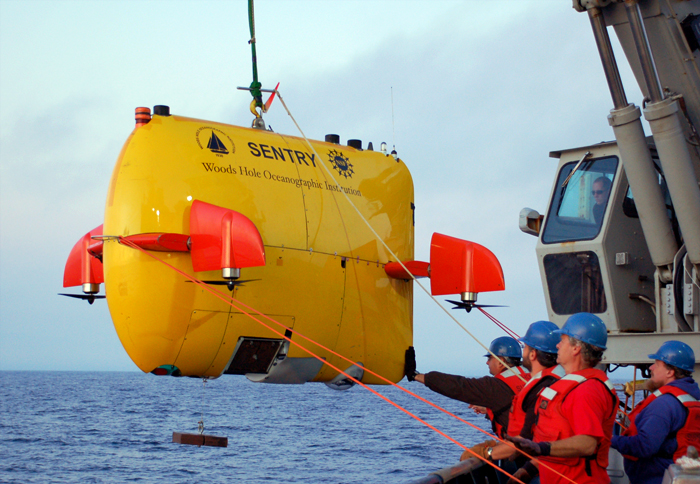
WHOI's new deep-diving autonomous underwater vehicle Sentry was launched from the WHOI research vessel Atlantis off the coast of Santa Barbara, Calif., to search for cold seeps—naturally occurring oil, gas, and other hydrocarbons that are leaking from the seafloor. Scientists are developing ways to give the robot abilities to interpret data on the fly and change operations to accomplish missions more effectively without human intervention. (Chris Reddy, Woods Hole Oceanographic Institution)
Before a dive, WHOI engineer Rod Catanach prepares Sentry's high-tech “nose”—an underwater mass spectrometer developed by WHOI scientist Rich Camilli that can detect and identify minute quantities of chemicals in seawater. The instrument, called TETHYS, is in the cylindrical gray metal housing with the multiple rows of band clamps around it. (Rich Camilli, Woods Hole Oceanographic Institution)
|
WHOI scientists Rich Camilli (left) and Dana Yoerger have spearheaded efforts to give more autonomy to the autonomous underwater vehicleSentry. Yoerger helped lead the development of the deep-sea robot. Camilli engineered the TETHYS underwater mass spectrometer that allows Sentryto collect chemical clues in the ocean. (Chris Reddy, Woods Hole Oceanographic Institution)
Enlarge ImageMarine geochemists Dave Valentine (left) of the University of California, Santa Barbara, and Chris Reddy of WHOI study natural oil seeps on the seafloor right off the coast of Santa Barbara. Above, they sniff a rock sample recovered from the ocean bottom that still retained its petrochemical odor. (Karin Lemkau, Woods Hole Oceanographic Institution)
It’s a lot easier to send a bloodhound to track a criminal, or your kid to pick up groceries, than it is to get a deep-sea robot to find something on the seafloor.
The dog will pick up the scent and know to turn around if the bad guy doubles back. The kid can use his eyes and brain to wend his way to the vegetable aisle and recognize a red pepper. But deep-sea robots are typically dispatched on programmed missions, swimming up and back along designated track lines, like a mower cutting a lawn, and blindly collecting data. Only after the vehicle resurfaces can scientists download the data to see what the robots may have found.
These autonomous underwater vehicles, or AUVS, move autonomously in that they swim unmanned and unconnected to a ship via a tether. But they have lacked that essential capability to think autonomously—to interpret cues they gather from the environment, make decisions on the fly, and change course as necessary to accomplish missions more effectively and efficiently.
Scientists are beginning to experiment with ways to give AUVs more decision-making capabilities, and on a research cruise in September 2009 off Santa Barbara, Calif., scientists from Woods Hole Oceanographic Institution (WHOI) demonstrated that they could teach a new robot some old tricks.
They equipped an AUV called Sentry with a high-tech “nose”—an underwater mass spectrometer developed by WHOI scientist Rich Camilli that can detect and identify minute quantities of chemicals in seawater. Then they gave Sentry some brains, in the form of software to analyze the chemicals it was sniffing—in this case, naturally occurring oil, gas, and other hydrocarbons leaking from the seafloor in areas known as “cold seeps.” Finally, they gave Sentry the ability to change its pre-programmed course and operating mode, so it could home in on targets and begin sampling right away, instead of waiting to return on a subsequent mission.
In engineers’ parlance, it’s called “dynamic re-tasking to execute non-deterministic missions.” In other words, Sentry took its first baby steps on the road toward making its own decisions without input from people.
'Extraterrestrial' environments
That’s precisely the capability NASA needs in vehicles to search for life in extreme environments on distant planetary bodies, where real-time command and control will be spotty, said WHOI scientist Dana Yoerger, who helped develop Sentry. Some scientists think that if extraterrestrial life forms exist—living, for example, beneath the presumed ice-covered ocean of Europa, one of Jupiter’s moons—they may resemble earthly organisms thriving on chemicals emanating from seafloor cold seeps.
So the expedition off Santa Barbara offered a double benefit: It provided a suitable analog of an “extraterrestrial” environment to test new ways to put more autonomy into an autonomous underwater vehicle. And, if successful, it would provide a better way to find and sample cold seeps for the marine geochemists leading the expedition, Dave Valentine of the University of California at Santa Barbara and Chris Reddy of WHOI.
The scientists did not want to send Sentry on its initial non-deterministic missions without some means of communication, even if it was sort of the oceanographic equivalent of a dog barking in the woods and handler whistling or hollering back. Two-way communication withSentry was limited to slow, low-bandwidth, intermittent acoustic signals (since radio or light waves are poorly transmitted in seawater). Yoerger said it is like “an ultra-limited Twitter on old-time dial-up—a few characters every minute.”
Just people and a robot talking
Sentry was deployed from the WHOI-operated research vessel Atlantis to search for cold seeps. But “there’s a lot of different flavors of cold seeps,” Camilli said, based on how the chemicals are produced. Thermogenic seeps leak heavier hydrocarbons forged by heat and pressure beneath the seafloor. Biogenic seeps leak lighter hydrocarbons such as methane, the metabolic byproducts of microbes decomposing organic matter.
Camilli’s mass spectrometer, called TETHYS, detected and distinguished a few key hydrocarbons. On a single mission, it made more than 1,1000 discrete measurements of chemicals in the water, and more than 7,000 during the entire cruise.
“Imagine collecting 1,000 water samples and then having to analyze them,” Yoerger said. “Rather than getting a few samples at great expense, we got volumes of information, and we had it before the vehicle came up, so we could makes changes based on what we found.”
“Sentry interpreted that data on the fly, made judgments, and could report it to us in real time,” Camilli said. “We could query Sentry, and it would respond, ‘I think there’s a biogenic source here, or a thermogenic source there,’ and make requests to re-visit areas it thought were the most interesting. And we could query: ‘Why do you think that?’ And it would send back some data it had processed, which we could examine and respond, ‘Go ahead and take a closer look at that particular target.’ ”
“It’s like when you send your kid to the grocery store for peppers, and he calls you up and says, ‘The red peppers look terrible; should I get the yellow ones at twice the price?’ ” Yoerger said. “If you don’t give him an answer, he just keeps going through the shopping list we gave him.”
“Using even these limited acoustic communications,” Camilli said, “we could get a clear picture of what’s going on faster and more effectively. And that solves one of the most difficult problems in reconnaissance: when to switch from wide-area surveying to focus on a target and then to sample it.”
From sunny Santa Barbara to icy Europa
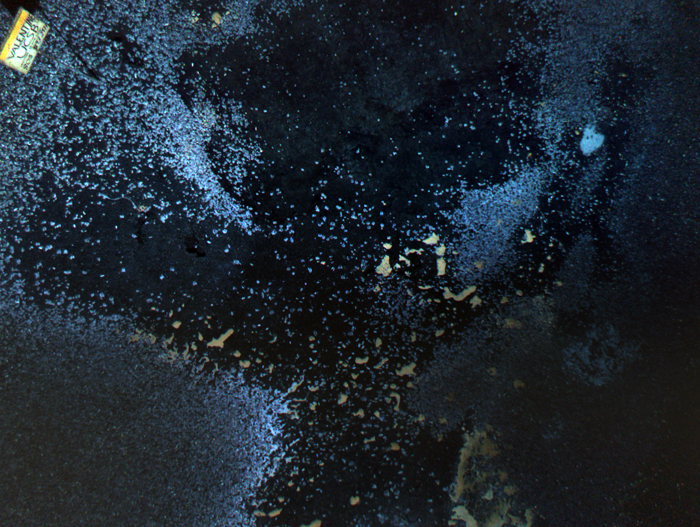
Once at a cold seep, Sentry demonstrated that it could also switch its operations. Using software developed by Mike Jakuba, Yoerger’s former graduate student, now at the Australian Centre for Field Robotics at the University of Sydney, Sentry stopped swimming and hovered over a target. It also adjusted its mass spectrometer to measure different selected chemicals to get more detailed chemical clues as to what types of life forms were present at the cold seep.
“I was deeply impressed by what Sentry and its handlers were able to accomplish during that mission,” said Valentine, the expedition’s chief scientist. “The photographs Sentry took while hovering over its target confirm that it had located an area of recent activity and go a long way to validating this approach.”
In the future, scientists envision adding more sensors—for example, one that can analyze DNA in the water in real time to identify organisms. And the scientists will continue to improveSentry’s capacities to make judgments and proceed without requesting permission.
Someday, one of Sentry’s progeny may leave Earth and boldly go to Europa, where it will be unable to phone home. By then, however, it will be fully capable of making decisions on its own.
The research cruise was funded by the National Science Foundation. The research withSentry was funded by NASA's Astrobiology Science & Technology Program. Funding for the development of Sentry was provided by NSF's Ocean Sciences Division, The Russell Family Foundation, the WHOI Deep Ocean Exploration Institute, the Comer Science and Education Foundation, and the WHOI Access to the Sea program.
06/03/2010
Research Vessel Heraclitus

http://www.rvheraclitus.org
Thanks to Felipe Fonseca, metareciclagem for the link.
Since it was built in 1975 by the Institute of Ecotechnics, the Heraclitus has sailed over 250,000 nautical miles studying oceans, coral reefs, rivers, lakes, estuaries and exploring the origins and futures of human cultures.
Planet Water Expeditions carries an unparalleled sailing record of continuous expeditions, which commenced in 1975 with the launch of the R/V Heraclitus from Oakland, California, and is currently sailing on a four-year expedition from the Coral Sea to the Black Sea. Members of the Institute of Ecotechnics, an international non-profit that aims to develop a “technics of ecology and an ecology of technics,” designed and built the Heraclitus in nine months in the mid-1970s. Designed as an expedition vessel, the Heraclitus demonstrates a unique blend of ancient Chinese junk design and modern technology.
PWE’s programs include all aspects of our water planet: oceans, rivers, lakes, ice, and estuaries. The R/V Heraclitus’ numerous voyages across oceans alternating with detailed visits to the great island, coast and estuary systems, provide an opportunity to develop an experiential understanding of our planet and the challenges we face in preserving it.
A present-day manifestation of the ancient cultural tradition known as “sea-people,” the crews of the Heraclitus explore the ecologies of human cultures, access the biodiversity of local regions, and directly experience the forces of nature that drive our rapidly changing planetary weather systems.
Expedition Chief and PWE executive vice-president Christine Handte currently directs PWE’s Heraclitus’ expeditions. An Ecotechnics director and fellow of The Explorers Club, Christine has over fifteen years experience operating the ship, and has led numerous Heraclitus expeditions. Captain Claus Tober, a veteran of tens of thousands of sea miles over a decade, is a master of this ancient Chinese junk sailing rig, and revered by his crews as a skilled and subtle Captain interfacing with local sea-people.
PWE’s volunteer directors are all also founding directors of the Institute of Ecotechnics and together have logged thousands of sea miles aboard the Heraclitus. PWE’s president, Capt. Robert “Rio” Hahn, director emeritus of The Explorers Club, led the Heraclitus’ planetary circumnavigation three-year voyage and a two-year Amazon research expedition. PWE’s other directors are Marie Harding, who served as the first captain of the Heraclitus; Bill Dempster, who oversees the engineering of the Heraclitus; and Judy “Chili” Hawes, Ecotechnics secretary and a veteran of the Heraclitus’ maiden Atlantic crossing. PWE’s adviser, John Allen, conceived the concept and co-designed the Heraclitus, is the co-founder of the world renowned Biosphere 2 Project.
Planet Water Expeditions offers a unique opportunity for self-motivated individuals seeking experiences of lifetime significance. Through PWE’s Heraclitus’ programs, and associated Ecotechnics projects, participants engage in a real-world cutting-edge enterprise that challenges and inspires creative approaches to living in today’s multi-cultural, environmentally fragile world.
05/03/2010
Either submarine or above the water.
I just recived feedback from someone with a lot of sailing experience about our design, spot on. Thanks dear Elliot Siemon.
 The red flag to me is the low profile - quite idyllic, lily pad-ish, but not only will the entire colony will be swamped in the most average gale it will be extremely difficult to keep in one location or move where you want to go.
Two possibilities: either go more submarine, a few feet below the surface or higher, like use hulls of ships connected via stand-off flexible struts. Ship hulls can be oriented in one direction so that when you need to move, it will be possible to do so, either by sail or by fuel derived from waste. That parachute would be difficult to make work; winds often are inconsistent and it would be difficult to keep airborne and/or the prevailing winds might not be blowing in the direction you need to go. Old ship hulls might not be as idyllic, but more sea worthy; the best thing might be sailing ships, because they are already rigged; the decks can be modified to be flat and more usable for farming and easier to get around on; between the hulls would be passage ramps, and of course there will have to be a sturdy fence around all perimeters.
There is a news report of heavy storm waves breaking the windows of a large cruise ship and killing two passengers.
http://www.msnbc.msn.com/id/35706695/
04/03/2010
Largest Marine Protected Area
This is a huge opportunity! http://www.avaaz.org/en/save_
Avaaz does great things for immediate and long term emergencies. The ocean faces long and short term crises every day. Please add your name and pass along. What a success this could be~
thank you! Colleen
Avaaz does great things for immediate and long term emergencies. The ocean faces long and short term crises every day. Please add your name and pass along. What a success this could be~

thank you! Colleen
01/03/2010
Carbon credits proposed for whale conservation
Thanks to Carolina Damian Mendoza
Published online 26 February 2010 | Nature | doi:10.1038/news.2010.96
Corrected online: 26 February 2010

Stopping whale hunting could help sequester millions of tonnes of carbon.
Richard A. Lovett
Whales are like trees — when it comes to carbon credits.Getty
Biological oceanographer Andrew Pershing wants carbon credits for whale conservation. That's because whales, he says, are like trees. "Like any animal or plant, they are made out of carbon. And whales are so big they each store a lot of carbon," he says.
Pershing, of the University of Maine in Orono and the Gulf of Maine Research Institute in Portland, Maine, calculates that even though some whale species are now recovering from the effects of factory whaling, total whale biomass today is less than one-fifth of what it was in 1900, before whaling decimated the population. Letting the whale population recover, he said on 25 February at the American Geophysical Union's 2010 Ocean Sciences meeting in Portland, Oregon, could eventually sequester 9 million tonnes of carbon in their combined biomass.
He compares it to planting trees. "In a forest, trees remove carbon dioxide from the atmosphere and accumulate that as biomass. Whales take carbon out of the system through their food, then incorporate that carbon in their tissues."
Whaling, by contrast, is like cutting down trees for firewood. "You're taking whales out of the population and putting their carbon somewhere else." In the early days of whaling, Pershing explains, that carbon was going straight into the atmosphere through the burning of whale oil in lamps, for example. More recently, he says, the carbon is released through the consumption of whale meat by humans, "but you're still taking carbon out of the whale and putting it into something that's going to respire it".
Furthermore, when whales die naturally, they usually sink to the bottom of the ocean, carrying their carbon with them. Back in 1900, when whale numbers were high, that would have totalled about 200,000 tonnes of carbon per year, Pershing estimates. Even though benthic creatures eventually eat the whale carcasses (see 'Bone-devouring worms discovered'), the carbon will remain in the depths, Pershing says, staying "out of the atmosphere for potentially hundreds of years".
Carbon consumers
By comparison, 9 million tonnes is only a small fraction of the 7 billion tonnes of carbon entering the atmosphere each year from human activities, Pershing says, but it's still a lot. It's equivalent to 11,000 square kilometres of temperate forest, or 11,000 Hummers driving for 100 years, says Pershing.
It's also comparable to the amount of carbon involved in forest-management schemes being proposed for buying and selling carbon credits, he said. "People would pay a lot to preserve an area of forest that big."
If whales increase in numbers, other species that compete for the same food might decline. But even if ocean food supplies are limited, there could still be a substantial increase in total biomass owing to the difference in size between whales and the organisms they could displace. Because large animals require less food per unit mass than smaller animals, any given food source (such as krill) can support a lot more biomass in a whale than in a small animal such as a penguin.
Rebuilding stocks
Other scientists greeted Pershing's presentation with enthusiasm. "It's exciting," says Daniel Costa, a professor of ecology and evolutionary biology at the University of California, Santa Cruz. "It means that whales are important not just because they're charismatic, but because they play an important role in the carbon cycle."
Furthermore, he says, Pershing's research may actually understate the degree to which whales could sequester carbon. The iron in whale faeces is an important micronutrient that is often in short supply in waters such as the Southern Ocean, and it can help boost algal growth — which ultimately means more food for everything, including whales. "In order to drive these large algal blooms you need iron," says Costa. In fact, he says, the indirect benefits of iron fertilization from whale faeces might remove more carbon from the atmosphere by boosting algal growth than the growth of the whales themselves.
Pershing adds that the same analysis applies to other large ocean animals whose populations have been drastically reduced, such as bluefin tuna and some species of shark. "These guys are huge," he says. And even though all of these animals' biomass combined represents a small fraction of total human carbon emissions, they could still sequester many tonnes of carbon. "You could use carbon as one of the incentives to rebuild the stores of these large organisms," Pershing says.
CORRECTED: An earlier version of this story incorrectly stated that letting whale biomass recover would sequester 105 million tonnes of carbon. Andrew Pershing has since recalculated this figure as 9 million tonnes of carbon.
25/02/2010
10/01/2010
Freak Current Takes Gulf Stream to Greenland
http://www.dailykos.com/story/2010/1/6/822520/-Freak-Current-Takes-Gulf-Stream-to-Greenland
Really interesting article on recent currents and how they are affecting the climate.
If you were wondering why it has been really freezing in Europe, the US and Russia - it is not a usual winter...

These regional contrasts in temperature anomalies resulted from a strongly negative phase of the Arctic Oscillation (AO). The AO is a natural pattern of climate variability. It consists of opposing patterns of atmospheric pressure between the polar regions and middle latitudes. The positive phase of the AO exists when pressures are lower than normal over the Arctic, and higher than normal in middle latitude. In the negative phase, the opposite is true; pressures are higher than normal over the Arctic and lower than normal in middle latitudes. The negative and positive phases of the AO set up opposing temperature patterns. With the AO in its negative phase this season, the Arctic is warmer than average, while parts of the middle latitudes are colder than normal. The phase of the AO also affects patterns of precipitation, especially over Europe.
The phase of the AO is described in terms of an index value. In December 2009 the AO index value was -3.41, the most negative value since at least 1950, according to data from the NOAA Climate Prediction Center.


Find out more in the original article : http://www.dailykos.com/story/2010/1/6/822520/-Freak-Current-Takes-Gulf-Stream-to-Greenland
Archive of the article.
14/12/2009
Open Call for projects - Curated Expedition to the Baltic Sea
Official W : http://capsulaexpeditions.com/
Applications : www.capsula.org.es
Conditions : http://00capsula00.wordpress.com/2009/09/30/open-call-for-projects-expedition-to-the-baltic-sea/
Applications : www.capsula.org.es
Conditions : http://00capsula00.wordpress.com/2009/09/30/open-call-for-projects-expedition-to-the-baltic-sea/

The Curated Expedition to the Baltic Sea invites artists to contemplate the natural phenomena and their own relationship with the changing sea. Researchers and other cultural agents are encouraged to join the expeditions, straddling the borderline between art and science.
Artists who live in Finland or Estonia, irrespective of their nationality, can take part in this open call. Also Finnish and Estonian artists living abroad may participate.
The project is intended to spur new works of art and inspire the public to take part in different creative processes. Artists decide, whether the general state of the sea is the phenomenon studied, or one of it´s numerous and singular phenomena and ecosystems will be under their exploration.
One of the key aspects of the marine expeditions is to travel slow, using methods of transport that only moderately burden the environment. A canoe, a hot air balloon, a jolly-boat, a marine research vessel or a rowboat are just some possible means of seafaring, used by artistic sea explorers.
Project proposals will be accepted until 21 December 2009. The project will be part of Turku’s programme for the European Capital of Culture year in 2011. Capsula and Bioart Society Finland are responsible for the project.
More information and the instructions for the application:
More information about the 1st Curated Expedition to the Total Solar Eclipse:http://capsulaexpeditions.com
>> So, shall we do it?
>> Are we going to be ready on time?
>> So, shall we do it?
>> Are we going to be ready on time?
An interesting article about fisheries in the Baltic sea.
Great article about the Baltic sea and its actual condition (below).
http://www.helcom.fi/environment2/nature/en_GB/nature/
The Baltic Sea is a small sea on a global scale, but as one of the world's largest bodies of brackish water it is ecologically unique. Due to its special geographical, climatological, and oceanographic characteristics, the Baltic Sea is highly sensitive to the environmental impacts of human activities in its sea area or in its catchment area, which is home to over 85 million people.
The Baltic Sea is a small sea on a global scale, but as one of the world's largest bodies of brackish water it is ecologically unique. Due to its special geographical, climatological, and oceanographic characteristics, the Baltic Sea is highly sensitive to the environmental impacts of human activities in its sea area or in its catchment area, which is home to over 85 million people.
What makes the Baltic so sensitive?

An almost enclosed sea
The Baltic Sea is only connected to the world’s oceans by the narrow and shallow waters of the Sound and the Belt Sea. This limits the exchange of water with the North Sea, and means that the same water remains in the Baltic for up to 30 years – along with all the organic and inorganic matter it contains.
The Baltic Sea consists of a series of sub-basins, which are mostly separated by shallow sills. These basins each have their own water exchange characteristics.
Runoff enters the shallow Baltic Sea from a large catchment area
At an average depth of just 53 metres, the Baltic Sea is much shallower than most of the world’s seas. It contains 21,547 km³ of water and every year rivers bring about 2% of this volume of water into the sea as runoff. The Baltic Sea’s catchment area is almost four times larger than the sea itself.
Brackish water
The brackish water of the Baltic Sea is a mixture of sea water from the North Sea and fresh water from rivers and rainfall. Thesalinity of its surface waters varies from around 20 psu (≈parts per thousand) in the Kattegat to 1–2 psu in the northernmost Bothnian Bay and the easternmost Gulf of Finland, compared to 35 psu in the open oceans.
A stratified sea
Salinity levels also vary with depth, increasing from the surface down to the seafloor. Saltier water flowing in through the Sound and the Belt Sea does not mix easily with the less dense water already in the Baltic, and tends to sink down into deeper basins. At the same time, the less saline surface water flows out of the Baltic. The boundary between these two water masses, known as thehalocline, consists of a layer of water where salinity levels change rapidly. In the Baltic Proper and Gulf of Finland, for instance, the halocline lies at a depth of around 60–80 m. Like a lid, the halocline limits the vertical mixing of water. This means that the oxygen content of the deep basins may decline due to biological and chemical oxygen consumption. The Baltic Proper is replenished by oxygen-rich saltwater flowing in from the North Sea along the sea floor.
The Gulf of Bothnia, separated by a shallow sill from the Baltic proper, has low bottom water salinity and, hence, a very weak or absent halocline. In summer a thermocline – a distinct layer of water where the temperature changes rapidly – divides surface waters into two layers: a wind-mixed surface layer down to a depth of 10–25 m, and a deeper, denser and colder layer extending down to the sea-bed or the halocline. Such temperature stratification ends as surface waters cool in the autumn.
Limited biodiversity
Compared to other aquatic ecosystems, only relatively few animal and plant species live in the brackish ecosystems of the Baltic Sea – although this limited biodiversity does include a unique mix of marine and freshwater species adapted to the brackish conditions, as well as a few true brackishwater species. Where salinity levels are low, in the Baltic’s northern and eastern waters, fewer marine species can thrive, and marine habitats are dominated by freshwater species, especially in estuaries and coastal waters.

Figure 1. Specific features and processes which make the Baltic Sea sensitive (green - natural characteristics, white - human impacts, yellow - harmful effects)
Subscribe to:
Posts (Atom)