Some of the ideas in this Venus Project are amazing, on the conceptual level, the pragmatic and creative ones. On the other hand, the designs Jacques Fresco is proposing really don't match the philosophy : "James Bond Grand architecture for a more equitable world" just don't really make me believe it is a "new direction". What disrupts me with a singular "ENTIRELY NEW UPDATED SYSTEM" : I don't believe a visionary architect can propose an entire new way of life and vocabulary ; I believe in how new technologies and new ideas slowly infiltrate and change people's lives, not as one grand radical proposal, but rather many small working transitions. So, as an architect you want to modify the system not by the designing the whole system, but designing intelligent components that will facilitate the creative sustainable activities of other humans. To summarize, it is not about inventing an entire new system, but about programming good building components. Also I must disagree on the discourse that says Industrial revolution will make us free. This is what we have been attempting since 300 years, the same old ideal future that we never reach, a future for a free "updated new" class (a rich minority of "visionaries") that the rest of humanity must labour and pay for it... Our society is industrial, I am not sure getting rid of 90% of human labour with new supertechnological means is the good underlying priority in the agenda... In other words, the Jaques Fresco "Venus Project" is an interesting and inspiring Utopian project. Someone has to dream, and show a bundle of possibilities to the majority, and the rest of us, as actor-consumers, can buy into it, more or less. Jacques Fresco is doing his job being the figure of the grand visionary architect for a glorious future, I respect that ; but I think to deeply impact the world, every single human needs to have the freedom, capacity and desire to the the architect of his/her own life. And that might not be possible in a world where resources are limited. So it goes back to the beginning of the Venus project : "a Resource Based Economy". On this everyone can agree, we need to start by considering the resource before making grand plans. The architect should publicly employ his creative mind to fabricate this fabulous tool that will give an entire new perception of our actual system, a tool with which a new -probably much less fancy than described- future can be built. Also, you cannot be ethically at both ends of the chains : you cant be judge and jury, and if you are : don't expect any credibility. It is scary for other to have one grand vision that incorporates all the aspects of a NEW life, it is too intimidating and normative. To conclude : to work out this "not-new" resource limited word, let's do it in the right order : first, let's set up the "sensors" to measure this limited and changing world. Before we invent super great grand designs and strategies, let's simply get to know what is happening, and make that knowledge available to everyone. - There is an open-source project that enables people to do that today : http://pachube.com - There is a global observatory system : http://earthwatch.unep.net/data/g3os.php - There is an ocean division of this global observation system that works : http://www.argo.net
So, at that point in history, the glory isn't in the grand future design, but being creatively contributing to these observation and action project.
Personally that's what I am trying to do with Open_Sailing project, and with the World Environment Organization : trying to build open-source instruments to contribute to existing necessary researches. What's interesting is that the complexity of the infrastructure make the CENTRAL figure of the architect obsolete, a good system needs that each participant of the distributed system is an architect, towards a collective wisdom and creativity, social innovation, object oriented politics (Latour), adhocracy, highly tolerant and entropic "open architecture" and "architecture of play".
>> Are we free on the internet ?
- No we are not. We are under surveillance.
>> Can we create an infrastructure-less internet? An Infrastructure-less civilization?
- The technology already exists, may it be mesh-networks on short ranges, or packet radios on long distances. The less infrastructure, the more robust, check this disaster wifi coverage devices!.
>> Do we need the companies, the states, the militaries to organise and moderate it?
- No we don't. The whole open-source communities will support this initiative, you will.
>> Can we can build a true civilian internet?
- Shall we try ... ?
We may not have to re-invent TCP-IP ... Some repeaters or open-source mesh-networking computer like the OXO OLPC (One Laptop Per Child) use something close to this system ...
Here is packet radio station brief video explanation :
This is the international symbol for amateur radio, included in the logos of many IARU member societies. The diamond holds a circuit diagram featuring components common to every radio: an antenna,inductor andground. antenna,inductor and ground. Maybe the openet doesn't have a ground, a country ...
And there are many ways to create signal relays : in the oceans, in the air (1966 military study), have strong long-wave signal that bounce on the atmosphere. Our network could be much more fluid, wet networks, creating nodes by capillary action, This is when loose network and thermodynamic system and notions of boundaries become useful / useless ... Open_Architecture ?
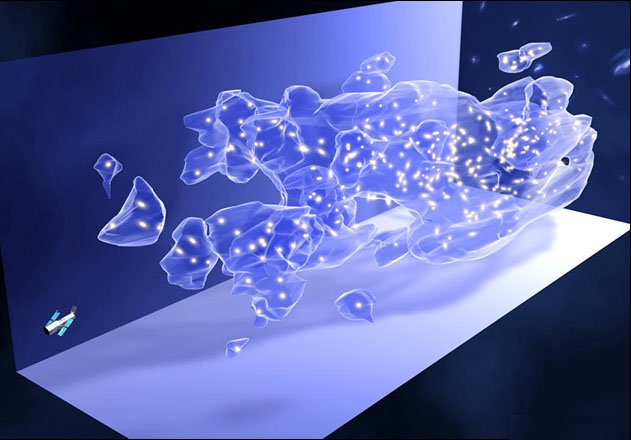
A "loose network", this is how our universe is being described anyway ...
[Image: Courtesy of NASA/ESA/MASSEY, via the BBC, via BLDGBLOG].
"Astronomers have mapped the cosmic 'scaffold' of dark matter upon which stars and galaxies are assembled," the BBC reports. Producing the map "involved nearly 1,000 hours of observations with the Hubble Space Telescope." But it was time well-spent: the map now "confirms that galaxy clusters are located within clumps of this invisible material. These clumps are connected via bridges of dark matter called filaments. The clumps and filaments form a loose network – like a web."
So where do we start ?
For the people, for the earth ? ...
Now we have accepted we are in a multiverse, are we ready to engage with a "multinet" (multiple Internet)? Maybe an Openet (an open network) is a good start? Will the politic follow (Barack Obama: On Net Neutrality) ?
I made this "multinet" illustration from Matt Britt, wikipedia internet map.
This is the concept map of the project : read from the bottom to the top, from the 2012 fears volcano, giving birth to the open sailing station. Download pdf (11.6mb) / see .jpg (2.6mb) / see flickr page
This is the geographical map of both 2012hopes.com and opensailing.net : 2012hopes.com suggests the ideal location, Open Sailing figures out how we will live and thrive in this new geographical context. download pdf (7.6mb) / see .jpg (1.4mb) / flickr page
The maps have all been programmed on maps.google.com, you can save individual map and ad them as your own (if you have a gmail account which is free and amazing) : all maps directory by 2012hopes@googlemail.com. You can also view these maps confortably using google earth.
We have printed 300 of these maps to A1 size, if you want one email us, we'll arrange, we'll appreciate donations since they are expensive to print.
We might send the map as it is supposed to be : folded, to fit in your pocket, an authentic survival pratical map.
As a child my dream was to become an astronaut. Until it dawned on me that with my congenital heart defect plus being slightly claustrophobic this was not likely going to happen. What remained was a fascination for exploring outer space, the dream of one day being able to colonize distant planets and re-creating Earth under new (and hopefully improved) circumstances. I was sure that if I could, I would be one of the first ones to go.
"Aerial view of Biosphere 2 in the Arizona desert"
A project that truly awed me at that time was the Biosphere 2, a giant man-made enclosed ecosystem completely sealed off from its surroundings. Two "closed bubble" missions were carried out, the first lasting from 1991-93 with a crew of 8 people sealed inside; the second, starting in 1994, had to be broken off prematurely due to internal quarrels about the project's funding and the direction in which research was going. I remember seeing images of pale, thin scientists being ushered out of the gigantic complex by US Federal Marshals. All in all, Biospehere 2 was considered to be a tremendous flop. Both Missions had trouble regulating the oxygen levels inside the sealed structure. Animals died or failed to reproduce while one ant species which was accidentally locked in, became too dominant.
Now, more than 15 years later, the structure still stands, and is a research site under the management of the University of Arizona. Wired Science has recently launched some interesting articles, which sum up the problems and points out that there actually were valubale papers written and insights gained from this large scale, scientific, social and psychological experiment.
Just some design concepts for getting up wind... with out the need of a rudder- but a deep keel!
Depending on the size kite / wind strength the mounting & rings might have to take quite load.
There is an alternative to useing a ring of less than 360º but that would require the "tack" to turn the whole vessel around! The idea is a major addition/complication as it would need a clear run all the way around the vessel and nothing can run over the top of it. - Although the double ring would also work as a safety banister if mounted waist high- "killing 2 birds with one stone".
the Tacking process.
[caption id="attachment_1346" align="alignnone" width="450" caption="Tacking process. (wind from the North, vessel heading from south to north / bottom to top)"][/caption]
Material wise- the rings could be made in the same manner / same material as windsurfing masts, but you have the added problem of the point loading of the wheels - instead of runner wheels on the inner side a "sled" could be made to distribute the force on the rings.
rupert>
This is fantastic! So simple, so adaptable. Note that the interior is the first thing to be put in – the whole structure is built around people, not people having to fit round constraints of the structure. Lovely!
The Plastiki design brief calls for an off-grid habitation—a house in essence—that would function as the cabin for a catamaran. The middle of the Pacific Ocean is the ultimate off-grid site. At Architecture for Humanity (AfH), we are always searching for prototypes, systems and materials that have broad relief applications. As the Plastiki is literally composed of re-purposed materials and off-grid systems, anything we learn through the boat design/build process carries over into our housing and systems initiatives.
Innovation is challenging. The biggest challenge here was adapting a new material system (srPET) for what promises to be a demanding voyage. The Plastiki will literally float on post-consumer bottles nested within a re-purposed plastic panel system. The major challenge of naval design more generally is to reconcile the often contradictory demands of what makes a boat perform well and what people need on an extended voyage.
The adoption of the egg as a generative form is a clear example of ‘biomimicry;’ that is to say, looking to nature for design solutions. In this case, a strong shape was needed to handle wave and storm forces during the voyage. The design of the Plastiki cabin is informed by the shells of several long-term earth residents. Turtle shells, Horseshoe Crab armor, Dinosaur plating, and eggs all contributed to the overall form, fused plates and folds that comprise the cabin shell geometry.
Working with design team members, we are integrating waste and water systems into the cabin. The cabin shell is our primary source for collecting rainwater, which will be filtered and stored. Solar photovoltaic panels are arrayed on the shell roof. Other energy exhibits, such as wind, water, bicycle and possibly wave power are being situated on the deck along with a modern-day ‘canoe garden’ that echoes the on-board gardens of ancient Polynesian mariners who brought staple plants and animals on voyages to ensure their sustainability.
As we need backup plan, what if we simply build in London, and drift it down the Thames, into the north sea, toward the Netherlands? London - Rotterdam, not bad. It is also shorter, and there is more people around to ensure safety.
London to Rotterdam = 350 km.
These are the main currents.
Wave height
Winds in the UK (southwest north sea), Netherlands
Well, it actually sounds simpler and safer than Morocco to start with. Also, it is quite "simple" to bring our object back to London to exhibit it for the RCA SHOW. We could let people visit our machine and attract more investors for future plans ! Also being in Rotterdam could be good to meet deutch people, that's quite a massive construction harbour in there.
Bernd and Hilla Becher
The industry exists, it is actually quite common, people have to renew them and they even sometimes pay to get rid of them! ... Today I (Cesar) got a ticket for Morocco to visit the main potential construction site, in Jedida... I'll be there between the 14th and 18th of march 2009, I will take many pictures and videos and make fist solid contact with local authorities, industries and people...
Patri Friedman wants to make it easy for anyone to build an independent country: "If we make one seastead, there's room for thousands."
Photo: Dustin Aksland
Several dozen conference-goers are filing into the Mendocino Room of the Embassy Suites Hotel in Burlingame, a San Francisco suburb, arming themselves with coffee and muffins as they shuffle to their seats. It's the kind of scene that occurs daily—if not hourly—in the Bay Area, where techies and businesspeople forever squeeze into drab meeting rooms to discuss how they are going to change the world. But even by local standards, the attendees gathered here are chasing a dream so grand and exotic it makes the typical Internet confab look like an OSHA seminar. Anyone can build a game-changing social-network platform or a virtual community or a set of open APIs. But the people here want to start a nonmetaphorical revolution by creating their own independent nations. In the middle of the ocean. On prefab floating platforms.
At 9:12 am, Patri Friedman stands up to address the group. A former Google software engineer, Friedman is 32 but comes off much younger, with close-cropped hair and a slightly nasal voice. He is executive director of the Seasteading Institute, the nonprofit he founded in April 2008, and this is the group's first major event. He surveys the room, taking in a cross section of Silicon Valley culture: A white-haired nanotech millionaire in a suit sits next to a grad student in a Transformers T-shirt. If you were to break down the audience into high school classifications, you'd find a couple of hippies and goths, a few hipsters, and several preppies. The rest would definitely be at the nerd table. The male-female ratio is 7 to 1. "This isn't enough to create a whole new civilization," Friedman says. "But this is a seed."
The morning sessions from the first annual Seasteading conference, held in Burlingame California on October 10th.
Friedman and his followers are not the first band of wide-eyed dreamers to want to build floating utopias. For decades, an assortment of romantics and whack jobs have fantasized about fleeing the oppressive strictures of modern government and creating a laissez-faire society on the high seas. Over the decades, they've tried everything from fortified sandbars to mammoth cruise ships. Nearly all have been disasters. But the would-be nation builders assembled here are not intimidated by that record of failure. After all, their plans are inspired by the ethos of the modern tech industry, where grand quixotic visions are as common as BlackBerrys, and they see their task not as a holy mission but as something like a startup. A couple of software engineers came up with an innovative concept, then outsourced it to a community and let the wisdom of the crowd improve on it. They scored financing from a top-tier venture capitalist and assembled a board of directors. They will be transparent, blogging their progress. If they fail—which, let's face it, is the most likely outcome—they will do so quickly, in time-honored Valley fashion. But if they succeed, they have one hell of an exit strategy.
Friedman launches into what he calls "my standard rant"—a spiel about government's shortcomings and why they're so hard to repair. In his eyes, government is a sclerotic monopoly that can count on high customer lock-in thanks to inertia and the lack of alternatives. "Government is an inefficient industry because it has an insane barrier to entry," he says. "To compete with governments on existing land, you have to win a war, an election, or a revolution." He points to the democracy that emerged from the American Revolution as the last successful rollout and attributes the subsequent dry spell to the lack of uncolonized space on the map. "We've run out of frontier," he says.
But there's still one virgin realm left, and it covers 70 percent of the earth's surface.
The purpose of the Seasteading Institute—and of this gathering—is to figure out how to make aquatic homesteads a reality. But Friedman doesn't just want to create huge floating platforms that people can live on. He's also hoping to create a platform in the sense that Linux is a platform: a base upon which people can build their own innovative forms of governance. The ultimate goal is to create standards and blueprints that can be easily adapted, allowing small communities to rapidly incubate and test new models of self-rule with the same ease that a programmer in his garage can whip up a Facebook app. "You could roll your own government out of pieces copied from all the societies around you," Friedman says. "Google set my standards for how fast something should grow. This has potential to exceed those standards—if we make one seastead, there's room for thousands."
Your Home Away From... Everything!
You're ready to move to the middle of the ocean. What will your new digs look like? The Seasteading Institute hired Marine Innovation & Technology, an oil rig designer, to sketch out a $50 million, 20,000-ton platform with multistory living quarters and helipads.
1// Living Platform
The 160,000-square-foot steel expanse puts the cruise ship lido deck to shame. Carbon-fiber cables anchored to the pillars reinforce the structure and make possible a larger platform surface.
2// Water Supply
Water, water everywhere—and plenty for you to drink! Desalination equipment provides potable freshwater and gray water for gardening.
3// Foot Tanks
Leave the Dramamine ashore. Water tanks inside four flotation pillars hold the seastead 30 feet above water and minimize the impact of rogue waves.
4// Engine Room
Don't like your neighbors? Move! The island can travel at speeds of up to 2 knots, powered by four diesel engines that double as electrical generators.
Illustration: Kate Francis
Friedman's optimism is easier to buy into if you ignore the history of previous would-be nation builders. There was Operation Atlantis, created by Ayn Rand admirer Werner Stiefel in the late 1960s. Stiefel, who made a fortune selling dermatology products, devoted his life to creating a sovereign society with the freest markets imaginable. He started with a ferro-cement boat that made a single successful voyage on the Hudson River. He erected a system of seabreaks near the coast of Haiti but was run off by president Franè7ois Duvalier's gunboats before he could put land on it. He bought an oil rig and tried to anchor it between Cuba and Honduras, where it was destroyed by a storm. Stiefel died in 2006 with little more than a sporadically published newsletter to show for his efforts.
In 1971, real estate millionaire and committed libertarian Michael Oliver dumped large quantities of sand on two coral reefs in the South Pacific and dubbed it the Republic of Minerva, a land with "no taxation, welfare, subsidies, or any form of economic interventionism." Minerva was soon invaded by the nearby kingdom of Tonga, and it dissolved back into the ocean shortly thereafter.
The Oceania city project, a plan for a vast floating settlement off the coast of Panama, emerged in 1993. The founders took out a two-page ad in Reason, a libertarian magazine, promising to free prospective residents from governments "entangled in bureaucracy, corruption, and the free lunch philosophy." The project was disbanded the following year due to lack of interest and funds. "The Libertarian party is small in number and too few members have the financial resources to bankroll their beliefs," founder Eric Klien wrote on Oceania's Web site.
Other projects still exist as hypothetical concepts. There's the Freedom Ship, a mile-long floating tax haven, which will come into being just as soon as its organizers can drum up the $10 billion needed to build it. (They've accused their former president of absconding with the first $400,000 they raised.) The concept of failed aquatic libertarian havens has even entered the pop consciousness, providing the setting for the blockbuster videogame BioShock.
Wayne Gramlich will never move to the middle of the ocean—his wife forbids it. But when the former software engineer, who has been "on sabbatical" since the late 1990s, stumbled across the Oceania Web site about a decade ago, he was both enthralled by the vision and dismayed at the execution. An early Sun Microsystems employee who worked on browser security at the dawn of the World Wide Web, he thought what was needed was a dispassionate perspective—a realistic plan to build floating autonomous countries. "Oceania had a lot of pretty pictures, pretty concept art, but that was it," he says. In 1998 he wrote a modest proposal, SeaSteading—Homesteading on the High Seas, to get beyond the grandiloquence. "Big and expensive projects will have a very difficult time attracting the requisite capital," Gramlich wrote. An engineer at heart, he tried to devise a way to build islands on the cheap. His report outlined how thousands of empty 2-liter soda bottles could be used to create a floating platform.
That sounded like paradise to Friedman when he saw the paper on Gramlich's site. He had always been interested in big-picture socioeconomic theories. The son of libertarian legal theorist David Friedman and grandson of the Nobel Prize-winning free-market economist Milton Friedman, Patri had until then expressed his worldview mainly through his lifestyle: engaging in "radical self-expression" at Burning Man, experimenting with drugs, living in intentional communities with several other families, and maintaining a polyamorous relationship with his wife. His BMW 328i has a customized license plate: FRRREAK.
Friedman had read about money holes like Oceania and considered them too fantastical to bother with. But the relative practicality of Gramlich's ideas appealed to the software engineer in him. Here was a simple kludge for a floating platform that might be affordable. And if it could work, Friedman would love to be among the first settlers to live on the open sea. "My dad and grandfather write about stuff," he says. "What interests me is doing something." He sent an email to Gramlich, and the two discovered that they lived a few miles apart in Sunnyvale, California. In late 2001, they began to collaborate on a new paper on seasteading. They posted everything online, including their notes to each other. (Friedman coded a Perl script that would allow anyone to submit comments on each paragraph.)
Over the next couple of years, Friedman and Gramlich assembled a 150-page book on the logistics of seasteading. Their guidelines were intensely pragmatic, explaining everything from how to fend off barnacles (a "continuous discharge of low-level chlorination") to how to fend off foreign navies ("sea-skimming anti-ship cruise missiles like the Chinese Silkworm are fairly cheap and quite effective"). They described the least far-fetched, least expensive design for a safe seastead they could find—the floating spar. The hypothetical dwelling looks like a giant dumbbell standing on end, with a large steel ballast underwater and a 48,000-square-foot platform suspended above, where 120 people could live. They estimated it could be built for about $3 million. "That's the same price as a nice house in San Francisco," Friedman says. (Their design has since evolved, as shown at above.)
Gramlich and Friedman's online tome captured the imagination of like-minded geeks, who peppered it with suggestions and criticisms. It was also brought to the attention of millionaire tech investor Peter Thiel, who shared Friedman and Gramlich's dissatisfaction with land-bound governments. Thiel was a cofounder of PayPal, and he viewed that company as a way to further his libertarian ideals—a way to move money around the world as 1s and 0s without the involvement of nations or their currencies. After selling PayPal to eBay and walking away with a reported $55 million, Thiel started the hedge fund Clarium Capital, which made a fortune earlier this decade by correctly betting that oil prices would rise and the dollar would weaken.
Thiel has invested in Facebook, Friendster, LinkedIn, and Slide. He has also donated $3.5 million to Aubrey de Grey's Methuselah Foundation, which seeks to extend longevity, and given money to the campaigns of small-government conservatives like Ron Paul.
"Peter wants to end the inevitability of death and taxes," Friedman says. "I mean, talk about aiming high!"
Last April, Thiel pledged a $500,000 investment and installed his right-hand man, Joe Lonsdale, as chair of the Seasteading Institute. "Decades from now, those looking back at the start of the century will understand that seasteading was an obvious step toward encouraging the development of more efficient, practical public-sector models around the world," Thiel said in a statement at the time. Three months after the wire transfer went through, Friedman left his job at Google.
Friedman is quick to acknowledge that not everyone will share his vision. "At first blush, this all sounds kind of crazy, and to see the potential beyond that—that's pretty awesome," he tells his fellow enthusiasts at the seasteading conference. "There's a lot of good craziness in this room!"
The afternoon sessions from the first annual Seasteading conference, held in Burlingame California on October 10th.
But good craziness alone will not make seasteads work, and most of the day is spent discussing the nuts and bolts of creating a floating community. First is the question of structure. "The ocean is a harsh and corrosive environment," Friedman says. In addition to rust and barnacles, there's wave motion, which is disorienting in the best of times and potentially fatal during a storm. The Seasteading Institute hired Marine Innovation & Technology as a consultant to solve these problems. Naval architect Alexia Aubault takes the lectern to describe the results of wave-motion analyses her engineering firm performed. To protect the organization from frivolous infringement lawsuits, she is barred by the institute's lawyer from showing off the refined design until a patent gets filed. (That has since been done.)
And that's just one of the legal torpedoes that seasteaders must dodge. According to the UN's Law of the Sea, the jurisdiction of traditional nations extends up to 200 miles from shore, an exclusive economic zone within which countries can control fishing and mineral rights and police polluters. Friedman hopes there will someday be self-sufficient seasteads that can thrive on the high seas, beyond the purview of any country. But for the near future, he concedes, they'll probably need to remain near shore and operate like cruise ships, which are bound by the laws of the country where they're registered. Most governments won't attack these kinds of vessels as long as they behave. "At this point, it matters who you piss off," he says. (Raymond Peck, a former Reagan administration official, has agreed to do further research for the institute on the Law of the Sea.)
At 11 am, attendees break up into small groups to brainstorm business models. Seasteaders can depend on like-minded benefactors for only so long. Ultimately, these nations will need to pay the bills. Friedman notes that some enterprises—like euthanasia clinics—would incense local authorities, but almost all the ideas attendees come up with would capitalize on activities that skirt existing laws and regulations: Fish farming and aquaculture. Prisons. Med schools. Gold warehouses. Brothels. Cryonics intakes. Gene therapy, cloning, augmentation, and organ sales. Baby farms. Deafeningly loud concerts. Rehab/detox clinics. Zen retreats. Abortion clinics. Ultimate ultimate fighting tournaments.
During the Seasteading conference, Vince Cate showed video of a floating prototype of his own design: The WaterWalker, a tripod lashed to three soccer balls.
(Lonsdale has his own ideas. "Bazooka bikini bachelor parties," he says. "You get there and a Lithuanian model hands you a rocket-propelled grenade launcher.")
But in the end, the seasteaders may face an even more fundamental challenge. During an afternoon session, Friedman asks, "How many people here know how to sail?" Few hands go up. He says plans are under way to offer group instruction at discount rates.
The first annual seasteading conference adjourns at 6 pm. A kayaking trip around the bohemian houseboat community just off Sausalito has been scheduled for the following morning, but it is canceled because of high winds.
Forbes Island isn't really an island at all but a 5,000-square-foot, 700-ton sea vehicle decked out with palm trees, a white-sand beach, and a lighthouse. A houseboat designer named Forbes Kiddoo, inspired by the science fiction of Jules Verne, spent five years building it. In 1999, he converted it into a restaurant that today floats near San Francisco's kitschy Pier 39, serving $35 rack of lamb to tourists who watch sea lions flop around on the nearby docks. Tonight, the eatery is hosting the Seasteading Institute's post-conference dinner.
Kiddoo himself ferries the seasteaders from shore to restaurant in a tiny pontoon boat. On the way over, he explains that obtaining clearance for his island was a nightmare. "I had to get city, county, state, and federal permits," he says, shouting to be heard over the bellowing of sea lions. "I had to deal with the ADA, the ABC ... I had to become a merchant marine captain."
Houseboat designer Forbes Kiddoo gives a tour of his manmade island. The structure, now converted into a restaurant, was host to the Seasteading Institute's post-conference dinner last October.
Afterward, in the island's bar, Friedman seems happy with how the event went, though he says some of his plans will have to be scaled back. He had wanted to hold a floating festival dubbed Ephemerisle on Fourth of July weekend; it was to be a sort of Burning Man on the high seas, where everything is permitted. But several conference attendees expressed concern about the logistics—and advisability—of a free-floating bacchanal of guns and drugs. He'll still host some sort of gathering to test a few miniature floating-island prototypes but expects it to be held in San Francisco Bay, not out on the open sea. "It'll probably take a few iterations to get there," he says. "But at least we're doing something."
Eventually, the seasteaders move to the Tahiti Room, which has a lovely moonlit view of Alcatraz. Chatter around the table gets louder as the wine flows, but the subject matter remains wonky. "The interesting issues are social and legal," says Mikolaj Habryn, a site reliability engineer at Google. "You'll get slavery. You'll get drug dealing. Maybe there'll be polygamous Mormons. The first people involved will inevitably be those who want to do things they can't do on land, and we have to deal with that." A ship passes, and even though Forbes Island is firmly moored a few hundred feet from shore and separated from the bay by a breakwater, the restaurant sways so much that some diners have to breathe deeply and focus on the horizon to settle their stomachs.
At the other end of the table, Patri Friedman raises his glass to make a toast. "I want to see us all at the 10th Annual Seasteading Conference," he says, implying that he expects it to take place on an actual seastead, not in an Embassy Suites or a floating theme restaurant. "It'll be in a bigger room, there will be a better view, it won't move up and down as much, and there'll be a better wine selection and better things to smoke!"
Friedman is joined by a raucous round of toasts. "To Peter Thiel for financing this!" "To having more women here!" "To being on the water!" "To freedom!"
Friedman wraps it up: "To being crazy in a good way!"
Senior editor Chris Baker (chris_baker@wired.com) wrote about Star Wars continuity in issue 16.09.
So now the question is, how do we get to collaborate with these people?
This is our official 9 folds A1 format, 2012hopes.com + international-ocean-station.org threat nd concept map, beta 01.
It is creative commons It combines :
- high human density
- responsivness to pandemics
- recent violent conflicts
- maritime piracy
- hypothetical nuclear fallouts (from civilian power plants, based on the footprint of Chernobyl)
- high sea pollution
- sea level rise endangered land
- pole shift hypothesis location
- tsunami risk exposure
- earthquakes
- cold sea
- cold land
- intense sea wind
- low biomass, low chlorophyll
- a grayscale composite of all these maps
You can download both maps in both .pdf and .jpg in a .zip file (21mb).
This concept map explains how we researched originally about 2012 and how the project transformed into a sea steading project.
These 2 maps will answer :
- where on earth are we less exposed to threats.
- what we are interested in, and where our research is going.
Following is the text on the map :
Open Sailing
The best way to predict our future is to invent it.
Open Sailing aims to design and invent future lifestyles to overcome any possible natural and manmade disasters stimulating people's ingenuity and sense of solidarity. Might it be global warming or energy conflicts, we are living in a time where we are sniffing the 'Apocalypse', finally realising our human part of responsibility as the earth is crumbling. 2012 is a year when a collection of apocalyptic events are rumored to happen. We are taking 2012 as an ideal dystopic symbol we design for. 2012 is tomorrow, we must design quickly using these constraints and invent bootstrapping DIY technologies.
Open Sailing method is to convert apocalyptic threats into design constraints. From our compiled set of threat maps, we found that oceans are the safest locations. Ocean survival architecture became our new starting point, but we need to go further than surviving : how can we live together in this new fluid configuration and remain a hyper-connected intelligent social being? We are trying to make a truly "open architecture" : pre-broken, under-defined, reconfigurable, moveable, pluggable, organic, fluid. Can we reach a harmonious dynamic state of interdependence with each other and the earth? Is this the next step of civilization progress? Will we dissociate our concept of progress with infrastructure and metropolis?
NEXT STEPS IN 2009
Finding motivated knowledgeable collaborators and funders (february).
Prototyping technology equipment for ocean living, UK (march ~ april).
Testing the Open Sailing in the Atlantic ocean, Morocco (may).
Public presentation of Open Sailing researches (june)
To achieve such a fluid lifestyle discussed in this project (and many other fluid/bio architectural projects developed recently) it is vital to conceive of a global information exchange system which is able to sustain itself as part of the Earth's eco system, but is still capable to store information extremely accurately. Biotechnology and Nanotechnology could possibly provide a key for such a system.
A good example of structure modules and components forming a super-organism. Swarm robotics is a good source of inspiration when thinking about formations of "mini-gaias" through fluid, mobile living.
The main scientific objective of this research project is the design, implementation and control of a novel distributed robotic system. The system will be made up of heterogeneous, dynamically connected, small autonomous robots. Collectively, these robots will form what we call a swarmanoid. The swarmanoid that we intend to build will be comprised of numerous (about 60) autonomous robots of three types: eye-bots, hand-bots, and foot-bots.
In this era of omni-surveillance, in the case of war, it's not so easy to remain undercover... Earth has become a military panopticon. How can one evade the authorities when everybody's freedom is claimed by the war-industry? Any individual can legitimately seek peace and escape conflict, but who amongst us does not belong to a nation? Is freedom the nature of not belonging? Or is it just to hide?
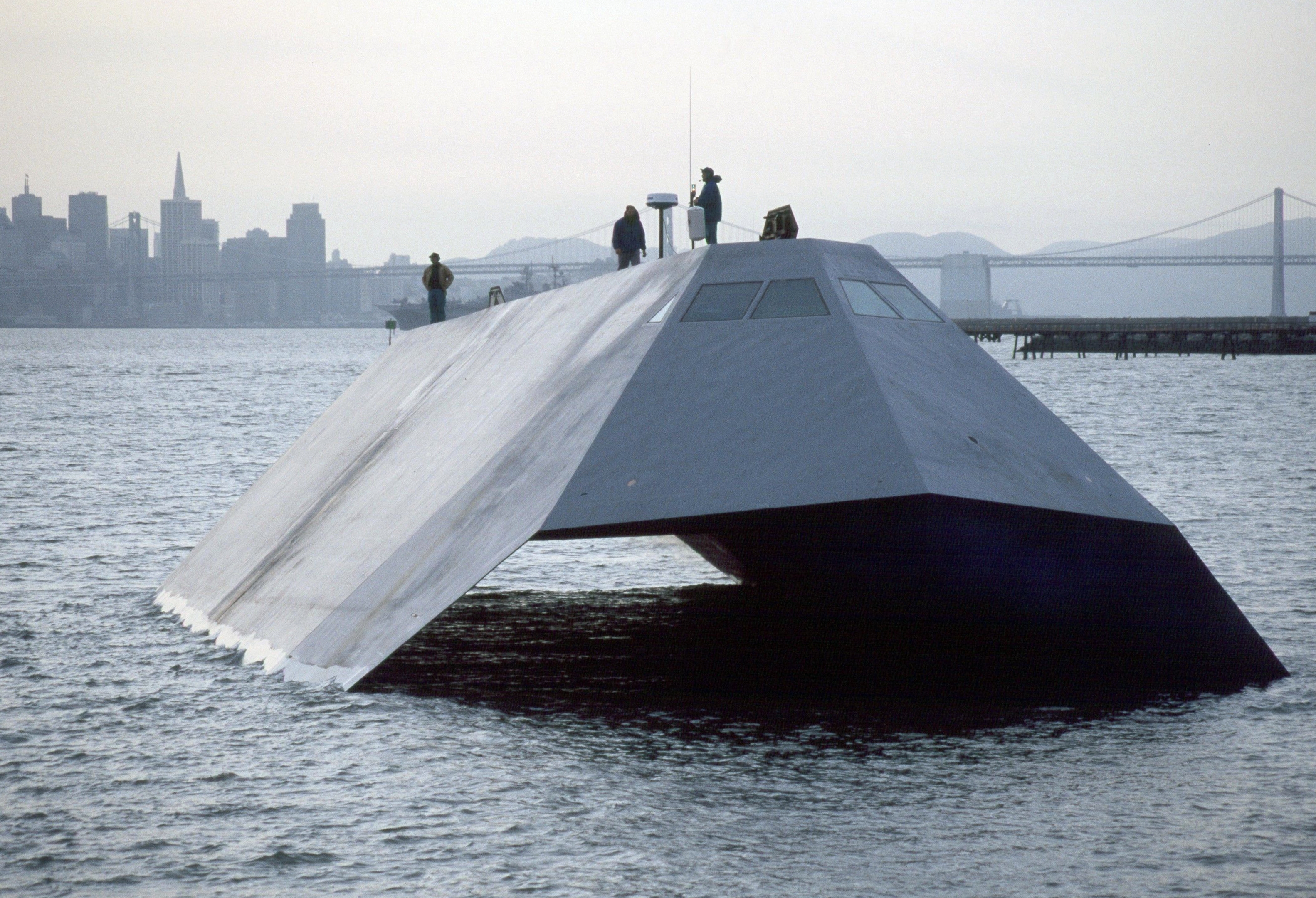
The electronic war has been raging for a very long time now. Every object is shown as a signature on the radar (see above). We must ensure our low observability with a Radar cross-section (RCS) reductions, vehicle shape, non-metallic airframe, radar absorbing material, acoustics, visibility, infrared and by reducing radio frequency (RF) emissions. Some of the most horrible inventions are inspiring for the best purposes : naval mines.
So here's the plan: instead of large units with an obvious signature, the most powerful way of hiding is to spread over small units.
Grid computing can happen in low visibility flock, herd or crowd formation, most pervasive and resilient to attacks :
We can "mechanize" our system, optimize our communication routes, ventilations, with the superorganism mind...
Please watch this video right to the end! We dont have to be big to be successful! And ants can even go over the water!!!! Look at the video below! download the film .flv