Showing posts with label exploration. Show all posts

13/03/2010

A Robot Starts to Make Decisions on its Own


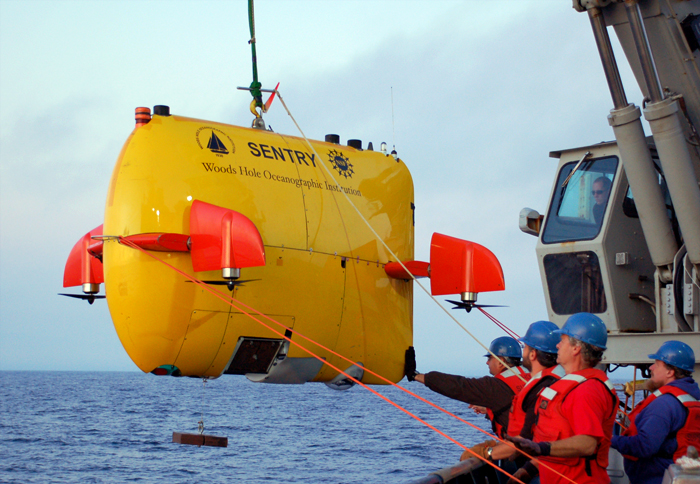
WHOI's new deep-diving autonomous underwater vehicle Sentry was launched from the WHOI research vessel Atlantis off the coast of Santa Barbara, Calif., to search for cold seeps—naturally occurring oil, gas, and other hydrocarbons that are leaking from the seafloor. Scientists are developing ways to give the robot abilities to interpret data on the fly and change operations to accomplish missions more effectively without human intervention. (Chris Reddy, Woods Hole Oceanographic Institution)

Before a dive, WHOI engineer Rod Catanach prepares Sentry's high-tech “nose”—an underwater mass spectrometer developed by WHOI scientist Rich Camilli that can detect and identify minute quantities of chemicals in seawater. The instrument, called TETHYS, is in the cylindrical gray metal housing with the multiple rows of band clamps around it. (Rich Camilli, Woods Hole Oceanographic Institution)
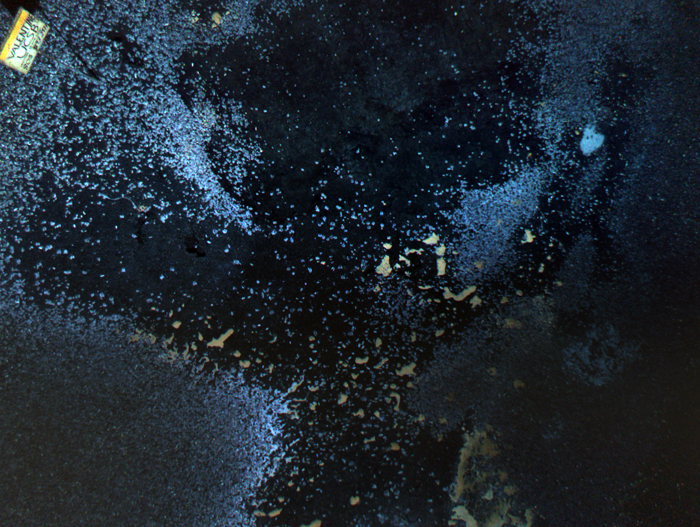

The TETHYS mass spectrometer aboard Sentry detected chemicals clues of a cold seep and the robot requested permission to change course and see if a cold seep was actually there. Sentry turned out to be right. It homed in on a site where UCSB scientist Dave Valentine, diving in the submersible Alvin, had found a cold seep and left a marker with his name on it (upper left) in 2007. (Courtesy of Dave Valentine, University of California, Santa Barbara)

WHOI scientists Rich Camilli (left) and Dana Yoerger have spearheaded efforts to give more autonomy to the autonomous underwater vehicleSentry. Yoerger helped lead the development of the deep-sea robot. Camilli engineered the TETHYS underwater mass spectrometer that allows Sentryto collect chemical clues in the ocean. (Chris Reddy, Woods Hole Oceanographic Institution) 

Enlarge ImageMarine geochemists Dave Valentine (left) of the University of California, Santa Barbara, and Chris Reddy of WHOI study natural oil seeps on the seafloor right off the coast of Santa Barbara. Above, they sniff a rock sample recovered from the ocean bottom that still retained its petrochemical odor. (Karin Lemkau, Woods Hole Oceanographic Institution)


It’s a lot easier to send a bloodhound to track a criminal, or your kid to pick up groceries, than it is to get a deep-sea robot to find something on the seafloor.

The dog will pick up the scent and know to turn around if the bad guy doubles back. The kid can use his eyes and brain to wend his way to the vegetable aisle and recognize a red pepper. But deep-sea robots are typically dispatched on programmed missions, swimming up and back along designated track lines, like a mower cutting a lawn, and blindly collecting data. Only after the vehicle resurfaces can scientists download the data to see what the robots may have found.

These autonomous underwater vehicles, or AUVS, move autonomously in that they swim unmanned and unconnected to a ship via a tether. But they have lacked that essential capability to think autonomously—to interpret cues they gather from the environment, make decisions on the fly, and change course as necessary to accomplish missions more effectively and efficiently.

Scientists are beginning to experiment with ways to give AUVs more decision-making capabilities, and on a research cruise in September 2009 off Santa Barbara, Calif., scientists from Woods Hole Oceanographic Institution (WHOI) demonstrated that they could teach a new robot some old tricks.

They equipped an AUV called Sentry with a high-tech “nose”—an underwater mass spectrometer developed by WHOI scientist Rich Camilli that can detect and identify minute quantities of chemicals in seawater. Then they gave Sentry some brains, in the form of software to analyze the chemicals it was sniffing—in this case, naturally occurring oil, gas, and other hydrocarbons leaking from the seafloor in areas known as “cold seeps.” Finally, they gave Sentry the ability to change its pre-programmed course and operating mode, so it could home in on targets and begin sampling right away, instead of waiting to return on a subsequent mission.

In engineers’ parlance, it’s called “dynamic re-tasking to execute non-deterministic missions.” In other words, Sentry took its first baby steps on the road toward making its own decisions without input from people.

'Extraterrestrial' environments
That’s precisely the capability NASA needs in vehicles to search for life in extreme environments on distant planetary bodies, where real-time command and control will be spotty, said WHOI scientist Dana Yoerger, who helped develop Sentry. Some scientists think that if extraterrestrial life forms exist—living, for example, beneath the presumed ice-covered ocean of Europa, one of Jupiter’s moons—they may resemble earthly organisms thriving on chemicals emanating from seafloor cold seeps.

So the expedition off Santa Barbara offered a double benefit: It provided a suitable analog of an “extraterrestrial” environment to test new ways to put more autonomy into an autonomous underwater vehicle. And, if successful, it would provide a better way to find and sample cold seeps for the marine geochemists leading the expedition, Dave Valentine of the University of California at Santa Barbara and Chris Reddy of WHOI.

The scientists did not want to send Sentry on its initial non-deterministic missions without some means of communication, even if it was sort of the oceanographic equivalent of a dog barking in the woods and handler whistling or hollering back. Two-way communication withSentry was limited to slow, low-bandwidth, intermittent acoustic signals (since radio or light waves are poorly transmitted in seawater). Yoerger said it is like “an ultra-limited Twitter on old-time dial-up—a few characters every minute.”

Just people and a robot talking
Sentry was deployed from the WHOI-operated research vessel Atlantis to search for cold seeps. But “there’s a lot of different flavors of cold seeps,” Camilli said, based on how the chemicals are produced. Thermogenic seeps leak heavier hydrocarbons forged by heat and pressure beneath the seafloor. Biogenic seeps leak lighter hydrocarbons such as methane, the metabolic byproducts of microbes decomposing organic matter.

Camilli’s mass spectrometer, called TETHYS, detected and distinguished a few key hydrocarbons. On a single mission, it made more than 1,1000 discrete measurements of chemicals in the water, and more than 7,000 during the entire cruise.

“Imagine collecting 1,000 water samples and then having to analyze them,” Yoerger said. “Rather than getting a few samples at great expense, we got volumes of information, and we had it before the vehicle came up, so we could makes changes based on what we found.”

“Sentry interpreted that data on the fly, made judgments, and could report it to us in real time,” Camilli said. “We could query Sentry, and it would respond, ‘I think there’s a biogenic source here, or a thermogenic source there,’ and make requests to re-visit areas it thought were the most interesting. And we could query: ‘Why do you think that?’ And it would send back some data it had processed, which we could examine and respond, ‘Go ahead and take a closer look at that particular target.’ ”

“It’s like when you send your kid to the grocery store for peppers, and he calls you up and says, ‘The red peppers look terrible; should I get the yellow ones at twice the price?’ ” Yoerger said. “If you don’t give him an answer, he just keeps going through the shopping list we gave him.”

“Using even these limited acoustic communications,” Camilli said, “we could get a clear picture of what’s going on faster and more effectively. And that solves one of the most difficult problems in reconnaissance: when to switch from wide-area surveying to focus on a target and then to sample it.”

From sunny Santa Barbara to icy Europa
Once at a cold seep, Sentry demonstrated that it could also switch its operations. Using software developed by Mike Jakuba, Yoerger’s former graduate student, now at the Australian Centre for Field Robotics at the University of Sydney, Sentry stopped swimming and hovered over a target. It also adjusted its mass spectrometer to measure different selected chemicals to get more detailed chemical clues as to what types of life forms were present at the cold seep.

“I was deeply impressed by what Sentry and its handlers were able to accomplish during that mission,” said Valentine, the expedition’s chief scientist. “The photographs Sentry took while hovering over its target confirm that it had located an area of recent activity and go a long way to validating this approach.”

In the future, scientists envision adding more sensors—for example, one that can analyze DNA in the water in real time to identify organisms. And the scientists will continue to improveSentry’s capacities to make judgments and proceed without requesting permission.

Someday, one of Sentry’s progeny may leave Earth and boldly go to Europa, where it will be unable to phone home. By then, however, it will be fully capable of making decisions on its own.

The research cruise was funded by the National Science Foundation. The research withSentry was funded by NASA's Astrobiology Science & Technology Program. Funding for the development of Sentry was provided by NSF's Ocean Sciences Division, The Russell Family Foundation, the WHOI Deep Ocean Exploration Institute, the Comer Science and Education Foundation, and the WHOI Access to the Sea program.

06/03/2010

Research Vessel Heraclitus


http://www.rvheraclitus.org
Thanks to Felipe Fonseca, metareciclagem for the link.

Since it was built in 1975 by the Institute of Ecotechnics, the Heraclitus has sailed over 250,000 nautical miles studying oceans, coral reefs, rivers, lakes, estuaries and exploring the origins and futures of human cultures.


Planet Water Expeditions carries an unparalleled sailing record of continuous expeditions, which commenced in 1975 with the launch of the R/V Heraclitus from Oakland, California, and is currently sailing on a four-year expedition from the Coral Sea to the Black Sea. Members of the Institute of Ecotechnics, an international non-profit that aims to develop a “technics of ecology and an ecology of technics,” designed and built the Heraclitus in nine months in the mid-1970s. Designed as an expedition vessel, the Heraclitus demonstrates a unique blend of ancient Chinese junk design and modern technology.

PWE’s programs include all aspects of our water planet: oceans, rivers, lakes, ice, and estuaries. The R/V Heraclitus’ numerous voyages across oceans alternating with detailed visits to the great island, coast and estuary systems, provide an opportunity to develop an experiential understanding of our planet and the challenges we face in preserving it. 

A present-day manifestation of the ancient cultural tradition known as “sea-people,” the crews of the Heraclitus explore the ecologies of human cultures, access the biodiversity of local regions, and directly experience the forces of nature that drive our rapidly changing planetary weather systems. 

Expedition Chief and PWE executive vice-president Christine Handte currently directs PWE’s Heraclitus’ expeditions. An Ecotechnics director and fellow of The Explorers Club, Christine has over fifteen years experience operating the ship, and has led numerous Heraclitus expeditions. Captain Claus Tober, a veteran of tens of thousands of sea miles over a decade, is a master of this ancient Chinese junk sailing rig, and revered by his crews as a skilled and subtle Captain interfacing with local sea-people.

PWE’s volunteer directors are all also founding directors of the Institute of Ecotechnics and together have logged thousands of sea miles aboard the Heraclitus.  PWE’s president, Capt. Robert “Rio” Hahn, director emeritus of The Explorers Club, led the Heraclitus’ planetary circumnavigation three-year voyage and a two-year Amazon research expedition. PWE’s other directors are Marie Harding, who served as the first captain of the Heraclitus; Bill Dempster, who oversees the engineering of the Heraclitus; and Judy “Chili” Hawes, Ecotechnics secretary and a veteran of the Heraclitus’ maiden Atlantic crossing. PWE’s adviser, John Allen, conceived the concept and co-designed the Heraclitus, is the co-founder of the world renowned Biosphere 2 Project. 

Planet Water Expeditions offers a unique opportunity for self-motivated individuals seeking experiences of lifetime significance.  Through PWE’s Heraclitus’ programs, and associated Ecotechnics projects, participants engage in a real-world cutting-edge enterprise that challenges and inspires creative approaches to living in today’s multi-cultural, environmentally fragile world.
 

23/11/2009

Proposal : Open_Sailing_01 Technical Drawing

We have now the design of the Open_Sailing_01 ready to submit to the British maritime authorities. This ship design has been tested in the water on models (iteration 1, iteration 2), so we have confirmed that the vessel is :
- large enough to host 4 people and equipment
- self-righting, hard to capsize, automatically fliping back in place
- insubmersible, resitant to internal pressure
- impact resistant, composite skin made of recycled material (see rogue waves)
- complying with SOLAS regulations and much more...


Download the ready-to-print 10 pages pdf technical drawing folder 13mb.

Download the 3d model on google 3D warehouse, sketchup, .dwg, .3ds.


front

right


left

back

top

bottom

Boat Made From Plastic PET Bottles To Sail on 11,000 Mile Ocean Voyage


The Plastiki launches in Spring 2009 on a 7,500-mile route from San Francisco to Sydney

Plastiki Workshop GigaPan 1 | GigaPan 2

The Plastiki design brief calls for an off-grid habitation—a house in essence—that would function as the cabin for a catamaran. The middle of the Pacific Ocean is the ultimate off-grid site. At Architecture for Humanity (AfH), we are always searching for prototypes, systems and materials that have broad relief applications. As the Plastiki is literally composed of re-purposed materials and off-grid systems, anything we learn through the boat design/build process carries over into our housing and systems initiatives.

Innovation is challenging. The biggest challenge here was adapting a new material system (srPET) for what promises to be a demanding voyage. The Plastiki will literally float on post-consumer bottles nested within a re-purposed plastic panel system. The major challenge of naval design more generally is to reconcile the often contradictory demands of what makes a boat perform well and what people need on an extended voyage.

The adoption of the egg as a generative form is a clear example of ‘biomimicry;’ that is to say, looking to nature for design solutions. In this case, a strong shape was needed to handle wave and storm forces during the voyage. The design of the Plastiki cabin is informed by the shells of several long-term earth residents. Turtle shells, Horseshoe Crab armor, Dinosaur plating, and eggs all contributed to the overall form, fused plates and folds that comprise the cabin shell geometry.

Working with design team members, we are integrating waste and water systems into the cabin. The cabin shell is our primary source for collecting rainwater, which will be filtered and stored. Solar photovoltaic panels are arrayed on the shell roof. Other energy exhibits, such as wind, water, bicycle and possibly wave power are being situated on the deck along with a modern-day ‘canoe garden’ that echoes the on-board gardens of ancient Polynesian mariners who brought staple plants and animals on voyages to ensure their sustainability.

[CNN and Architecture for Humanity, gizmodo, thanks to Vahakn]

Winners of VIDA 11.0 announced (part 1)

Republished from We-Make-Money-Not-Art


0asidebysidd.jpg

One of the issues raised by the development of new technologies, is how they will impact our identity of human beings. Interested in the conversation between art, science, technology and society, Fundación Telefónica has launched an International competition dedicated to art and artificial art called VIDA . This years they are celebrating the 11th edition of the competition by launching an online archive that documents thematically and chronologically the evolution of the discipline it has been so closely following for more than a decade.

Besides, Fundación Telefónica is setting up for the first time an exhibition of the winners of its competition (outside of the usual booth at the ARCO art fair that is). The three winners of VIDA 11.0 as well as a couple of other pieces are currently on view at Matadero Madrid. During the press conference yesterday, Francisco Serrano, Director of the foundation, couldn't help but point to the irony of hosting VIDA (which means 'life' in spanish) into a stunning art center called Matadero ('slaughterhouse' in spanish.)

hylozoic.jpg
Hylozoic Soil © Philip Beesley & Rob Goberz

The winner of the first prize this year is the uncanny, poetical and fascinating Hylozoic Soil, an immersive sculpture by artist and architect Philip Beesley.

Hylozoic Soil takes its cue from Hylozoism, the philosophical view that all or some material things possess life. It takes the shape of an artificial environment that seems to be made of the same substance as jellyfish, breathing like one, wrapping itself around you and exhibiting complex behaviour as you walk through it.

0aapremioggh.jpg

Delicate arms made of a shape memory alloy called nitidol gently move in reaction to people's behaviour, while hanging pillars transmit a very quiet energy, miles away from the more direct and manly energy displayed by most robotic installations. Although the work manage to almost absorb visitors it has been developed using as little material as possible. The structure was expanded into an ethereal meshwork.

Allow me to copy and past a short text that gives more details about the artwork:
Hylozoic Soil implements a distributed sensor network driven by dozens of microprocessors, generating waves of reflexive responses to those drawn into its vast array of acrylic fern stalagmites. Different levels of programmed activity encourage the emergence of coordinated spatial behaviour: thirty-eight controller boards produce specific responses to local action, while a bus controller uses sensor activity collated from all the boards to command an additional "global" level of behaviour. The forest thus manifests a haunting, breathing organicity, as it stirs to envelop and charm its human explorers. In keeping with the tradition of biologist artist Ernst Haeckel's Riddle of the Universe (1899), which traced actions of organic and inorganic nature alike back to natural causes and laws, Beesley's Hylozoic Soil stands as a magically moving contemporary symbol of our aptitude for empathy and the creative projection of living systems.

Video documenting the construction of Hylozoic Soil, at the Montreal Museum of Fine Arts in September, 2007:


More information in the book Hylozoic Soil, published by Riverside Architectural Press.

Part two of the report: Winners of VIDA 11.0 (part 2)

More details about the VIDA awards: Interview with Daniel Canogar. Last year's coverage: Winners of VIDA 10.0, Honorary Mentions at VIDA 10.0.

15/11/2009

Thor Heyerdahl, Kon-Tiki

The Kon-Tiki Expedition Across the Pacific Ocean by balsa wood raft (1947)

III
In 1947 the balsa wood raft Kon-Tiki was launched. It was named after a legendary seafaring sun-king common to both the old Inca kingdom and the islands of Polynesia. The raft hoisted sail outside the port of Callào in Peru with 6 men onboard. With Thor were 4 other Norwegians, Herman Watzinger, Knut Haugland, Torstein Raaby and Erik Hesselberg, and a Swede, Bengt Danielsson.
During the course of 101 days the raft sailed approx. 8,000 km over the open Pacific Ocean and landed on the Raroia Atoll in the Tuamotu Archipelago. The voyage put the existing view of the balsa wood raft to shame and proved that Polynesia was well within the range of prehistoric South American seafarers. Some scientists refused to believe that the incredible voyage had actually taken place until a documentary film about the expedition was released. The film won an Oscar for best documentary. Thor’s popular book The Kon-Tiki Expedition was later translated into 70 languages.

The Ra Expeditions
Across the Atlantic Ocean by papyrus boat (1969-1970)


During the expedition to Easter Island in 1955-1956, Heyerdahl became interested in reed boats and their seagoing properties. The archaeologists’ excavations had uncovered pictures of large reed boats with masts and sails engraved in the buried statues and painted on flagstones in prehistoric houses. It soon became clear to Heyerdahl that not only balsa wood rafts, but also reed boats, with pre-Incan sailors could have carried the earliest South Americans out over the open Pacific Ocean.
Other researchers had pointed out the obvious similarity between the old reed boats from Mexico and Peru, and the papyrus boats from the earliest civilisations in the Mediterranean region. These anthropologists, who were known as ‘diffusionists’, had listed reed boats as one of the many cultural parallels between the great civilisations of pre-Columbian times on both sides of the Atlantic Ocean. They used the reed boat as an argument in the discussion about transoceanic-contact prior to the arrival of the Europeans. Their opponents meanwhile, the ‘isolationists’, pointed to the accepted view that reed boats could not cross oceans. They believed that cultural parallels could be ascribed to independent development.


The Papyrus Institute in Egypt had determined that papyrus-reed rotted and dissolved after two weeks in a water tank.
Despite this, Heyerdahl was convinced that ship builders in the time of the pharaohs would never have used this reed to built enormous seagoing vessels if they had only stayed afloat on the ocean for two weeks. He decided to build a reed boat and cross the Atlantic Ocean with it to see whether or not his assumption was correct.
Ra was launched in the spring of 1969 in the old Phoenician seaport of Safi, Morocco. In order to show that people from different nations could work together even under pressure and difficult circumstances, Heyerdahl picked a crew of 7 men from 7 nations and sailed under the flag of the UN. Ra sailed west with the trade winds and the Northern Equatorial Stream. The reed bundles proved to be incredibly buoyant. Despite broken steering oars and poor weather, Ra had sailed 5,000 km in 8 weeks before the loss of bundles on the starboard side made Heyerdahl call off the experiment, just one week before they would have reached Barbados, in the West Indies.


Ten months later Heyerdahl launched a new papyrus boat – Ra II – from the same Moroccan seaport.

This time he had brought four Aymara Indians over from Lake Titicaca in South America to build the vessel.
The Aymara still built reed boats on the shores of this stormy mountain lake in the Andes, 4,000 m above sea level, using the same methods used in ancient Mesopotamia and Egypt.
The entire crew from the first Ra voyage wanted to repeat the experiment and, with the addition of a representative from yet another nation, Heyerdahl hoisted the sail on Ra II. This boat was only 12 m long, but was structurally far stronger than Ra.

Ra II crossed the Atlantic Ocean and sailed the approx. 6,100 km from Safi in Morocco to Barbados in the West Indies in 57 days. Since this time the experiment had been successful, anthropologists across the entire world had to forget the old dogma that papyrus boats could not have brought cultural impulses from North Africa to Central America in pre-Columbian times.


During the Ra voyage, Heyerdahl wrote his first letter to the UN about the fact that the oceans of the world were becoming polluted. He was asked by the Secretary-General of the UN to make daily pollution observations during the Ra II voyage. Hardened clumps of tar were collected on 43 days of the 57-day voyage. In this way the voyage helped to raise awareness of the need to stop the pollution of the world’s seas.
Heyerdahl presented reports about the pollution problem to the UN’s first conference on oceanic law, committees of the USA’s senate and congress, the USSR’s scientific academy and in a long series of campaigns for the conservation of the world’s seas.

Following the expedition a book was published about the Ra expeditions, as well as a documentary, which was nominated for an Oscar.


The Tigris Expedition
Across the Indian Ocean by reed boat (1978)


In ancient times, reed boats were used as vessels in the Mediterranean from the Middle East to the Atlantic coast.
Thor Heyerdahl now became interested in the highly controversial question concerning whether or not there had originally been contact between the three ‘mother’ civilisations in Mesopotamia, Egypt, and the Indus Valley.
In all of these three culturally related regions prehistoric artists had left behind illustrations of the same kind of reed boat on which he himself had crossed the Atlantic Ocean.


Heyerdahl had learnt from the Marsh Arabs in the former Sumerian region of Iraq that the reeds would only retain their buoyancy properties if they were cut in the month of August. Heyerdahl decided to try this, and at the same time experiment with the navigation of a reed ship. His previous sea voyages had been purely drifting voyages.
In 1977, Heyerdahl built his largest reed vessel, 18 m long, where the Euphrates and Tigris rivers meet in the former Mesopotamia, now Iraq. The vessel was named Tigris.


Tigris was constructed of reed bundles lashed together by marsh Arabs under the leadership of the same South American Indians who had built Ra II. Once again Heyerdahl sailed under the flag of the UN, with an international crew of 11 men, of whom 3 were earlier companions from the two Ra voyages: Norman Baker (USA), Yuri Senkevich (USSR), and Carlo Mauri (Italy).
Tigris sailed 6,800 km. First they sailed down Shatt-el-Arab in Iraq to the Persian Gulf and out into the Indian Ocean. Thereafter the voyage took them, via Muscat in Oman, to the Indus Valley in Pakistan, before finally le
aving Asia and sailing across the Indian Ocean to Africa.


The 5 month long journey ended in Djibouti at the mouth of the Red Sea. Surrounded by wars on all sides, the expedition’s members decided in April 1978 to burn the vessel.
At the same time the expedition’s members also sent a unanimous appeal to the UN asking it to stop arms deliveries to developing countries in the region of the world where the foundations of our own civilisation were laid.


Tigris had, unlike Kon-Tiki and the two Ra boats, sailed to predetermined harbours independent of the wind and current conditions, and lay high enough in the water to be consumed by flames.


.........


Space elevator

I know it can sound a bit far off and out of reach (at least for our budget), but the space elevator project is an amazingly interesting idea :


AND HAVE YOU NOTICED !!!!??? : the space elevator is anchored on earth in a offshore petrol platform looking thing!


It is actually is a simple solar powered elevator on a tense cable, attached in space to a "satellite" in synchronous orbit, EXCITING! Maybe open sailing can be a very interesting laboratory for testing many of these ideas, also before a cable in space we can think of a cable in the depth of the ocean. And by the way, what if we concentrate huge beam of solar power in the direction of the ocean? What would we see? ... To be continued!

Labels

design (116) structure (81) architecture (69) Energy_Animal (53) Nomadic_Ecosystem (46) art (43) Instinctive_Architecture (42) free energy (36) 3d (34) graphic (33) Swarm_Operating_System (32) Ocean (31) presentation (31) maps (28) Ocean_Cookbook (23) biology (23) communication (23) navigation (21) Open_Politics (20) strategy (20) water (20) boat (19) computing (19) survival (19) Life_Cable (18) construction (18) farm (18) safety (17) algae (16) posting (16) materials (15) wave (15) ecology (14) politics (14) technology (14) london (13) physics (13) agriculture (12) battery (12) Openet (11) food (11) animal (10) craft (10) culture (10) fishes (10) mechanics (10) Open_Sailing (9) chemistry (9) media (9) open-source (9) plastic (9) theory (9) video (9) TED (8) behaviour (8) competition (8) engine (8) exploration (8) performance (8) technique (8) philosophy (7) sociology (7) Open_Games (6) biomass (6) inflatable (6) seasteading (6) wind (6) OS_Polar (5) USA (5) animation (5) electronics (5) legal (5) medecine (5) pollution (5) berlin (4) data (4) ethics (4) money (4) psychology (4) reportage (4) service (4) statistics (4) sun (4) Brazil (3) Cesar Harada (3) Observation (3) Protei (3) TEDxOilSpill (3) catastrophy (3) engineering (3) garbage (3) google (3) history (3) identity (3) kite (3) mapping (3) metareciclagem (3) oil spill (3) recovery (3) research (3) sailing (3) science (3) space (3) spain (3) sustainable (3) tradition (3) AI (2) Argo (2) CAD (2) Environment (2) Exploration. Robots Swarm .Sea (2) Jellyfish (2) LABB (2) Louisiana (2) NL (2) NOLA (2) Object Oriented Politics (2) Open Hardware (2) Pachube (2) Pacific (2) Plastiki (2) TEDxBoston (2) UK (2) World Environment Organization (2) ants (2) austria (2) autonomy (2) com (2) coral (2) des (2) endangered species (2) fiction (2) geography (2) gulf of mexico (2) model (2) news (2) open architecture initiative (2) open innovation (2) organisation (2) plant (2) post (2) preservation (2) product (2) protection (2) rca (2) reserve (2) robots (2) simulation (2) skeleton (2) social (2) symbol (2) text (2) treatment (2) waste (2) Adhocracy (1) Aerial (1) Articles (1) BBC (1) BLDGBLOG (1) BP (1) BP oil spill (1) Balloon (1) Bangladesh (1) Barataria (1) Barcelona (1) Bay (1) Black (1) Boston (1) CCCB (1) Colet Castano (1) Crafts (1) Decentralize (1) Distributed System (1) Documentary (1) Dream (1) Environmental Concerns (1) Europe (1) Flight (1) Germany (1) Grassrootsmapping (1) Grenelle (1) Grier (1) Helium (1) Hydrogenase. Architecture (1) Institute (1) JP (1) Jimmy (1) John (1) Kaku (1) Kiel (1) Kim (1) Korea (1) LA Bucket Brigade (1) Luxembourg (1) NOAA (1) New Orleans (1) New York (1) Nina (1) Noah (1) Norway (1) Oceanography (1) Oil (1) Photography (1) Plane (1) Plater (1) Pope (1) Pragmatism (1) Resistance (1) Robot (1) Rotterdam (1) Ruairi Glynn (1) Sketchup (1) Snyder (1) Sphere (1) Spill (1) Stitching (1) TEDxMidAtlantic (1) Talk (1) Tilling (1) Tribe (1) Trondheim (1) Tumas (1) Uros (1) V2_ (1) Vision (1) Washington DC (1) Werner (1) Wood (1) Woods Hole (1) YouTube (1) Zygmunt (1) accident (1) admin (1) alternative (1) anaconda (1) appropedia (1) aquanaut (1) architecture for humanity (1) ars (1) autarcy (1) autark (1) awareness (1) ball (1) baltic (1) belgium (1) biodiversity (1) biofuel (1) brainstorming (1) broadcast (1) buoy (1) canada (1) carbon (1) cardboard (1) carton (1) cesar (1) clear climate code (1) climate (1) cold fusion (1) collaboration (1) concepts (1) cruise (1) current (1) deadly (1) deep (1) departure (1) developing (1) disposal (1) dispute (1) diving (1) diy (1) drone (1) eartquake (1) edgcm (1) events (1) excellent (1) experimental (1) exploring (1) farming (1) farms (1) file (1) fire (1) flickr (1) floating (1) florida (1) fluid dynamics (1) forum (1) france (1) future (1) futurology (1) generator (1) geodesic (1) geoengineering (1) graduate (1) green (1) grey (1) habitation (1) halley vi research station (1) harada (1) hybrid (1) icon (1) ideas (1) ideology (1) independent (1) indian (1) indonesia (1) industrial (1) inhabitat (1) innovation (1) instructables (1) insurance (1) japan (1) kelp (1) ledger (1) lloyds (1) louisina (1) machine (1) magnet (1) maths (1) message (1) messaging (1) metal (1) mimicry (1) mission blue (1) mobile (1) modular (1) monitoring (1) nasa (1) natural (1) naviagation (1) nice (1) nucelar (1) open source (1) opportunity (1) pachbox (1) park (1) participation (1) patch (1) pelamis (1) people (1) photo (1) pirate radio (1) planning (1) pods (1) polar (1) pop (1) popular (1) power (1) pr (1) press (1) raft (1) reef (1) render (1) renewable (1) repost (1) rogue (1) sewage (1) ship (1) ships (1) shit (1) software (1) sound (1) speculation (1) studies (1) study (1) super-collider (1) sylvia earle (1) system (1) temporary (1) toxic (1) tv (1) typography (1) underwater (1) utopia (1) weather (1) web (1) whales (1) wired (1) workshops (1) young (1) youth (1)

This blog is embeded inside the official Open_Sailing website, visit us here : http://opensailing.net

Open_Sailors