Showing posts with label Openet. Show all posts

10/01/2010

how many antennas in the sea...

I was just having fun trying to calculate how many antennas we would need to create an ocean data mesh network.


Argo floats


Mesh network with diversified nodes

>>>
If I would like to create a global ocean data mesh network, I would like to :
- determine the best long distance data intensive communication technology we should use.
- the energy necessary to each floating antenna-relay.
- calculate the number of floating objects required
- determine roughly the cost of such a technology to be implemented.

I will do the calculation on what I could find on the internet, as a very rough sketch of calculation.
For the example, the antenna I found for WIFI long range are 80km in range (radius), and cost say 3000£, just as example.

To cover up an area of 1000 km2, I need to set up a grid of 25 x 25 80km long range WIFI antennas in the seas.
The antennas signal need to overlap, so I can only exploit a 40km radius (this is why I dont have 12.5 antennas for 1000 km long square).
So I need 25x25, 625 floating antennas to cover up 1000km2 of sea.
So the ratio of antenna needed on 1m2 is 1/1600.

The ocean is ~3.61 x 10E14 m2 (361'000'000'000'000m2)
So to cover the oceans with antennas I will need
~3.61 X 10E14 m2 / 1600 = 225'625'000'000 antennas

Let's say that each antenna is 3000£.
225'625'000'000 x 3000 = 676'875'000'000'000£

We were 6,692,030,277 humans in 2008.
676'875'000'000'000 / 6,692,030,277 = 101'146.43£ / per person to cover the ocean with antennas.

This is too expensive, the environmental impact negatively huge. I blame it on :
- the idea, perhaps a stupid idea, perhaps not.
- the technology efficiency
- the cost of technology
- the lack of money in the world

So my question is : What is the technology that would enable the world population to have an entirely free ocean wireless data mesh network? At what price? How?
It is a technology question at this point.

So anyone : just an advice, of which technology to look into for long distance wireless mesh network would be amazing.
If you know someone who could answer this question I would be very happy to know about.
Please add in the comments below, or send me an email cesar.harada@opensailing.net

13/12/2009

infrastructure geopolitics -> Infrastructure-less civilization


Parag Khanna maps the future of countries

Parag Khanna suggests frontiers are oppressive violent constraints. He suggests we should focus on infrastructure. I would rather suggest we focus on how to stop being dependent of infrastructure. For the simple reason is that infrastructure is what takes the most time to change, it is much slower to change infrastructure than it is to change political landscape or culture.
Most the conflicts he is giving details on are based on infrastructure and their economical consequent politcal power.
Energy is everywhere, we don't need grand infrastructures. So we either global decentralization, or design of mobile sources of renewable energies (Energy_Animal). Just as countries divided, grids should divide, that would also increase local responsabilities and less energy loss on infrastructures. This video also reveals that "new territories" correspond to tribal ancient bodies of population, that used to live there, before infrastructures and imperialists, by traditional means... Another strong argument not to re-arrange frontiers by economical means.

This century has mostly been the century of migrations, see the wonderful exhibition "Terre Natale" an incredibly powerful vizualization of world migrations (by Stewdio, framed by Paul Virilio).


People have legs and dreams. They also have problems, many don't choose to move but have to. Those who have the choice : why are they moving? And where are they moving? I believe most of them are moving because of their aspiration for a better life, an for that reason the image of the territory they are aspiring to go is crucial.

The territory, the population builds the image, and the most attractive bodies of people are the one that build rich bodies of imageries, that appeal by marketing a powerful dreampolitk (Stephen Duncombe) if not many (plurality, heterodox regimes). Enough of realpolitik. Would America as we know it even exist without the American Dream?


So instead of focusing on infrastructure and economy :

Focus on education : facilitating language learning, facilitating trade in general is a good way to create emotional bridges between populations, ensure peace and cooperation durably.

Design culture : the art, design, crafts, music are powerful identification figures for people; a nation unites under a flag, a symbol represents a common interest. I have identified earlier surculture as major force for cultural change in the cultural feedback loop.

Design mobility : human migration is one of the major factor to influence global politics for the coming century. Transports & national borders.

Design infrastructure-less civilization : In the Darwinian sense, fitness does not necessarily mean strength so much as the capacity to adapt successfully. Infrastructure is the power of ancient civilizations ; mobility, flexibility adaptability is at the advantage of the leading group of individuals and of the destitute. Who knows what happens if you generalize these capacities to the majority? World hotel (static infrastructure + nomadic people) or moving cities (nomadic infrastructures)? Ultimately why would people want to travel, especially since they can download HQ national geographic documentaries? Well, it seems that since National Geographic is doing a pretty awesome work, more and more people traveled so, communication again did encourage tourism if not migration.

I don't think Open_Sailing can propose to build a new civilization at all. Many ethnies have been living on water since errr forever, maybe we should learn from them first. But the middle of the ocean, or on really long distances and really different climates ... That's a new exciting story...

12/12/2009

xMAx for the Energy_Animal communication device

Broadband On Radio Waves Speeds Beyond Wi-Max: xMax is Next. Thanks to Joe Mauriello for this link.

http://www.masternewmedia.org/broadband/broadband_technologies/wireless/xMax_radio_based_wireless_broadband_20050707.htm

A new wireless communications technology that symbiotically rides on existing public broadcast radio frequency waves could revolutionize the way we could connect to the Internet or provide broadband access to remote areas that are too expensive to be served by cable or present-day data-transmission technologies.

This latest innovation in broadband communications, is a "discrete" radio-frequency-based data transmission system that leverages traditional television, radio and pager systems bands without ever interfering with them.

The new system effectively extends what was thought possible until now, extending our ability to deliver data at lower cost and over greater distances than existing technologies.

The new technology may also come to be appreciated for its non-harmful effects on humans. The new radio-based approach may in fact spare us quite a few health risks (nobody ever talks about this side of things) which are instead a constant factor when we deal with today's popular very high-frequency transmission bands, like the ones used by mobile phones and other wireless transmission systems.

Overall, the advantages offered are then not only the fact that the public radio spectrum can be stretched in its capacity while not requiring the use of additional frequencies, but also the fact that at the lower frequency bands in which this new technology works data can travel much farther while having greater ease to pass through buildings walls and physical barriers than other existing competing wireless technologies.

Long range and high-speed are two of the key characteristics of xMax, a cutting edge radio-waves-based broadband solution which appears to be even better than Flash-OFDM, an alternative broadband system approach for remote and rural areas.

As a wireless data distribution system, xMax promises a reach of over 40-square miles while being able to serve between a minimum of a few hundred users to a theoretical maximum of a thousand or more.

xMax leverages a unique approach to data distribution via radio frequencies by embedding a very weak signal within the selected radio carrier band. The signal used is so weak that it cannot be easily picked-up by traditional radio antennas.

By using unique receiving units equipped with special filters, xMax-enabled devices can detect and receive the weak radio signal embedded in the radio wave without ever interfering or disturbing the main carrier.

Though prestigious academics like Princeton University Professor Schwartz have declared xMax not a very efficient way to send data over the airwaves, they also concluded that the results that can be achieved are indeed effective.

Obviously such a technology could represent a boon to many Internet service providers and telecom operators who would be able to offer and utilize this cost-effective technology to serve wireless broadband to rural and geographically remote areas which other competing operators would find too costly to cover.

Present third-generation mobile phone networks need base-stations to relay the signals every few miles. With xMax that can be significantly improved as the new technology offers a 400 to 500 percent improvement in range over more traditional technologies.

With WiMax and Flash OFDM, which need dedicated radio frequency bands, if you they are set to operate at frequency ranges above 1GHz, the signal used has no comparable effectiveness in penetrating physical obstacles and building walls as well as being able to have reach greater than a few miles.

XG Technology, the Florida-based company behind this revolutionary invention company behind xMax, has already been talking to multiple chip makers to make this new technology become a market reality. According to the company, xMax-enabled radio chips should cost $5-$6 when built in large quantities while base stations will be around $350,000.
Stay tuned.
Exelent news for openet.org and the Energy_Animal.

openet.org

>> Are we free on the internet ?
- No we are not. We are under surveillance.
>> Can we create an infrastructure-less internet? An Infrastructure-less civilization?
- The technology already exists, may it be mesh-networks on short ranges, or packet radios on long distances. The less infrastructure, the more robust, check this disaster wifi coverage devices!.
>> Do we need the companies, the states, the militaries to organise and moderate it?
- No we don't. The whole open-source communities will support this initiative, you will.

>> Can we can build a true civilian internet?
- Shall we try ... ?

openet.org

We may not have to re-invent TCP-IP ... Some repeaters or open-source mesh-networking computer like the OXO OLPC (One Laptop Per Child) use something close to this system ...


More video detailled explanations and relation to the smart grid ...

Here is packet radio station brief video explanation :


File:International amateur radio symbol.svg

This is the international symbol for amateur radio, included in the logos of many IARU member societies. The diamond holds a circuit diagram featuring components common to every radio: an antenna,inductor andground. antenna,inductor and ground. Maybe the openet doesn't have a ground, a country ...

See also OpenNet.net initiative, more about politics, let's be about empowering people with simple technical solutions. Coolest group here. We can do pretty wild stuff, like bouncing a radio wave signal to the moon - back to earth with a relatively simple equipment !


And there are many ways to create signal relays : in the oceans, in the air (1966 military study), have strong long-wave signal that bounce on the atmosphere. Our network could be much more fluid, wet networks, creating nodes by capillary action, This is when loose network and thermodynamic system and notions of boundaries become useful / useless ... Open_Architecture ?

File:System boundary.svg

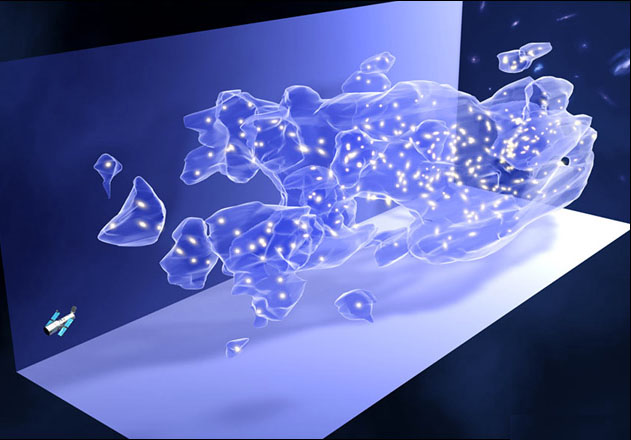
A "loose network", this is how our universe is being described anyway ...


[Image: Courtesy of NASA/ESA/MASSEY, via the BBC, via BLDGBLOG].

"Astronomers have mapped the cosmic 'scaffold' of dark matter upon which stars and galaxies are assembled," the BBC reports. Producing the map "involved nearly 1,000 hours of observations with the Hubble Space Telescope." But it was time well-spent: the map now "confirms that galaxy clusters are located within clumps of this invisible material. These clumps are connected via bridges of dark matter called filaments. The clumps and filaments form a loose network – like a web."

So where do we start ?
For the people, for the earth ? ...


Now we have accepted we are in a multiverse, are we ready to engage with a "multinet" (multiple Internet)? Maybe an Openet (an open network) is a good start? Will the politic follow (Barack Obama: On Net Neutrality) ?


I made this "multinet" illustration from Matt Britt, wikipedia internet map.

Vital function map, world threat maps

OpenSailing.net & 2012hopes.com concept and world map by you.
This is the concept map of the project : read from the bottom to the top, from the 2012 fears volcano, giving birth to the open sailing station. Download pdf (11.6mb) / see .jpg (2.6mb) / see flickr page

OpenSailing.net & 2012hopes.com concept and world map by you.
This is the geographical map of both 2012hopes.com and opensailing.net : 2012hopes.com suggests the ideal location, Open Sailing figures out how we will live and thrive in this new geographical context. download pdf (7.6mb) / see .jpg (1.4mb) / flickr page


The maps have all been programmed on maps.google.com, you can save individual map and ad them as your own (if you have a gmail account which is free and amazing) : all maps directory by 2012hopes@googlemail.com. You can also view these maps confortably using google earth.

open sailing world map
We have printed 300 of these maps to A1 size, if you want one email us, we'll arrange, we'll appreciate donations since they are expensive to print.


We might send the map as it is supposed to be : folded, to fit in your pocket, an authentic survival pratical map.

Creative Commons License

26/11/2009

CCCB Open_Sailing taller

Open_Sailing @ the Now festival, CCCB Barcelona

Open_Sailing has been invited in Barcelona by the CCCB  for a lecture (below you can see the slideshow) and for a day-long workshop, as a part of the NOW festival and Atopia
NOW is a reflection on the present based on the scientific, technological, artistic, social and spiritual transformations that are taking place at the start of the 21st century. It is a process of research, creation and dissemination that aims to bring together different local and international agents involved in the actions that are promoting a change of paradigm in the information and knowledge society and in globalised cultures.


Lecture
The first day, Cesar Harada presented Open_Sailing on a more historical perspective, explaining how it developed and where it is going, slideshow below.


Workshop
The second day 27 person participated the Open_Sailing workshop with Cesar Harada, Ruairi Glynn, Ollie Palmer, Carla Colet Castano. It was about dance, sensible linear - branched and complex networks, mapping, tagging, geostrategy, group and decision making, adhocracy, object oriented politics, open architecture, town-planning, renewable energies, sustainable design, hedonism, fun, architecture of play.

Here is the structure of the workshop as a simpler array of instructions :

Dance
1. walk
2. run
stretch
3. walk eyes closed
4. run eyes closed
5. linear network - walk eyes closed
6. linear network - walk eyes closed - somebody takes the lead
7. branched network - walk eyes closed
8. branched network - walk eyes closed - somebody takes the lead
9. complex network - walk eyes closed
10. complex network - walk eyes closed - somebody takes the lead
11. splitting the group is sub-groups

Map
1. cover the floor with a large paper
2. draw YOUR world map


Tag
1. have 2 colours stikers : one "like" color, one "dislike" color
2. tag the map, write words on tags
3. map the whole world


Individual desire
1. think of where you personaly would prefer to live according to your map and tags


Group decision of a location
1. make a decision, as group, of one location, where you all agree to go together


Group decision of activities
1. as a group decide one activity in this new location


Individual involvment
1. as an individual, choose your activity within this group


Craft of the system
1. describe your location, group activity, personal activity, how the system would work (food, energy, political, technology ...)


Design of the system
1. optimize your system


Fabrication of models
1. as a group, fabricate the physical model of what you have been describing


Public presentation and debate
1. present your group work to other groups of works
2. compare, discuss.
3. general debate : what happened? what did you enjoy? what did you not enjoy? what did you learn? what will remain in your memory? How will this workshop affect your future life?

thanks !


Promotional video


download flv 12.mb

14/11/2009

Bio-Hypercommunication

How can we exchange and transfer information through another media and method from the current internet? What is bio-computing?

http://en.wikipedia.org/wiki/Communication
http://en.wikipedia.org/wiki/Biocomputation
http://en.wikipedia.org/wiki/Computational_biology

Replacing the Internet

To achieve such a fluid lifestyle discussed in this project (and many other fluid/bio architectural projects developed recently) it is vital to conceive of a global information exchange system which is able to sustain itself as part of the Earth's eco system, but is still capable to store information extremely accurately. Biotechnology and Nanotechnology could possibly provide a key for such a system.


tri

BioComputing HyperText

... Openet.org !!!!!!

.

11/11/2009

earthquakes map video


I like the sound : tiny sound - tiny earthquake, big sound - big earthquake...

Acali Expedition

lexpdition_acali

Le 13 mai 1973 (était-ce un vendredi?), 5 hommes et 6 femmes qui ne se connaissaient ni d'Eve ni d'Adam, embarquaient pour une expérience humaine unique de 101 jours en mer sur le radeau "Acali" (du nom d'une province mexicaine). Une coque de noix dessinée par l'architecte britannique Colin Mudie, reconstructeur, entre autres, de l'Argo amarré à Gênes.

A lire ou à relire, "L'expédition Acali" par l'anthropologue mexicain Santiago Genovès, le premier radeau moderne à ralier l'Afrique au Mexique. Je n'ai trouvé aucun site internet y faisant référence, alors bonne lecture. Santiago Genovès a participé aux expéditions Ra 1 et Ra 2 de Thor Heyerdahl, navigateur, anthropologue et archéologue ayant traversé l'Atlantique sur des radeaux en papyrus.

Extrait: "Entre les chercheurs qui restèrent à terre et nous qui prîmes la mer se produisirent des heurts; il y eut de l'envie, de la jalousie, de la peur. Dans le radeau et loin du radeau. Dans la science et hors de la science. C'est de tout cela qu'il s'agit dans le projet Acali".

20 ans après l' "Acali", l'expédition "Hsu-Fu" reliait la Chine aux côtes de l'Amérique en jonque traditionnelle de bambou. [source : http://www.leblognautique.com/livres/index.html]

Labels

design (116) structure (81) architecture (69) Energy_Animal (53) Nomadic_Ecosystem (46) art (43) Instinctive_Architecture (42) free energy (36) 3d (34) graphic (33) Swarm_Operating_System (32) Ocean (31) presentation (31) maps (28) Ocean_Cookbook (23) biology (23) communication (23) navigation (21) Open_Politics (20) strategy (20) water (20) boat (19) computing (19) survival (19) Life_Cable (18) construction (18) farm (18) safety (17) algae (16) posting (16) materials (15) wave (15) ecology (14) politics (14) technology (14) london (13) physics (13) agriculture (12) battery (12) Openet (11) food (11) animal (10) craft (10) culture (10) fishes (10) mechanics (10) Open_Sailing (9) chemistry (9) media (9) open-source (9) plastic (9) theory (9) video (9) TED (8) behaviour (8) competition (8) engine (8) exploration (8) performance (8) technique (8) philosophy (7) sociology (7) Open_Games (6) biomass (6) inflatable (6) seasteading (6) wind (6) OS_Polar (5) USA (5) animation (5) electronics (5) legal (5) medecine (5) pollution (5) berlin (4) data (4) ethics (4) money (4) psychology (4) reportage (4) service (4) statistics (4) sun (4) Brazil (3) Cesar Harada (3) Observation (3) Protei (3) TEDxOilSpill (3) catastrophy (3) engineering (3) garbage (3) google (3) history (3) identity (3) kite (3) mapping (3) metareciclagem (3) oil spill (3) recovery (3) research (3) sailing (3) science (3) space (3) spain (3) sustainable (3) tradition (3) AI (2) Argo (2) CAD (2) Environment (2) Exploration. Robots Swarm .Sea (2) Jellyfish (2) LABB (2) Louisiana (2) NL (2) NOLA (2) Object Oriented Politics (2) Open Hardware (2) Pachube (2) Pacific (2) Plastiki (2) TEDxBoston (2) UK (2) World Environment Organization (2) ants (2) austria (2) autonomy (2) com (2) coral (2) des (2) endangered species (2) fiction (2) geography (2) gulf of mexico (2) model (2) news (2) open architecture initiative (2) open innovation (2) organisation (2) plant (2) post (2) preservation (2) product (2) protection (2) rca (2) reserve (2) robots (2) simulation (2) skeleton (2) social (2) symbol (2) text (2) treatment (2) waste (2) Adhocracy (1) Aerial (1) Articles (1) BBC (1) BLDGBLOG (1) BP (1) BP oil spill (1) Balloon (1) Bangladesh (1) Barataria (1) Barcelona (1) Bay (1) Black (1) Boston (1) CCCB (1) Colet Castano (1) Crafts (1) Decentralize (1) Distributed System (1) Documentary (1) Dream (1) Environmental Concerns (1) Europe (1) Flight (1) Germany (1) Grassrootsmapping (1) Grenelle (1) Grier (1) Helium (1) Hydrogenase. Architecture (1) Institute (1) JP (1) Jimmy (1) John (1) Kaku (1) Kiel (1) Kim (1) Korea (1) LA Bucket Brigade (1) Luxembourg (1) NOAA (1) New Orleans (1) New York (1) Nina (1) Noah (1) Norway (1) Oceanography (1) Oil (1) Photography (1) Plane (1) Plater (1) Pope (1) Pragmatism (1) Resistance (1) Robot (1) Rotterdam (1) Ruairi Glynn (1) Sketchup (1) Snyder (1) Sphere (1) Spill (1) Stitching (1) TEDxMidAtlantic (1) Talk (1) Tilling (1) Tribe (1) Trondheim (1) Tumas (1) Uros (1) V2_ (1) Vision (1) Washington DC (1) Werner (1) Wood (1) Woods Hole (1) YouTube (1) Zygmunt (1) accident (1) admin (1) alternative (1) anaconda (1) appropedia (1) aquanaut (1) architecture for humanity (1) ars (1) autarcy (1) autark (1) awareness (1) ball (1) baltic (1) belgium (1) biodiversity (1) biofuel (1) brainstorming (1) broadcast (1) buoy (1) canada (1) carbon (1) cardboard (1) carton (1) cesar (1) clear climate code (1) climate (1) cold fusion (1) collaboration (1) concepts (1) cruise (1) current (1) deadly (1) deep (1) departure (1) developing (1) disposal (1) dispute (1) diving (1) diy (1) drone (1) eartquake (1) edgcm (1) events (1) excellent (1) experimental (1) exploring (1) farming (1) farms (1) file (1) fire (1) flickr (1) floating (1) florida (1) fluid dynamics (1) forum (1) france (1) future (1) futurology (1) generator (1) geodesic (1) geoengineering (1) graduate (1) green (1) grey (1) habitation (1) halley vi research station (1) harada (1) hybrid (1) icon (1) ideas (1) ideology (1) independent (1) indian (1) indonesia (1) industrial (1) inhabitat (1) innovation (1) instructables (1) insurance (1) japan (1) kelp (1) ledger (1) lloyds (1) louisina (1) machine (1) magnet (1) maths (1) message (1) messaging (1) metal (1) mimicry (1) mission blue (1) mobile (1) modular (1) monitoring (1) nasa (1) natural (1) naviagation (1) nice (1) nucelar (1) open source (1) opportunity (1) pachbox (1) park (1) participation (1) patch (1) pelamis (1) people (1) photo (1) pirate radio (1) planning (1) pods (1) polar (1) pop (1) popular (1) power (1) pr (1) press (1) raft (1) reef (1) render (1) renewable (1) repost (1) rogue (1) sewage (1) ship (1) ships (1) shit (1) software (1) sound (1) speculation (1) studies (1) study (1) super-collider (1) sylvia earle (1) system (1) temporary (1) toxic (1) tv (1) typography (1) underwater (1) utopia (1) weather (1) web (1) whales (1) wired (1) workshops (1) young (1) youth (1)

This blog is embeded inside the official Open_Sailing website, visit us here : http://opensailing.net

Open_Sailors