Showing posts with label computing. Show all posts

13/03/2010

A Robot Starts to Make Decisions on its Own


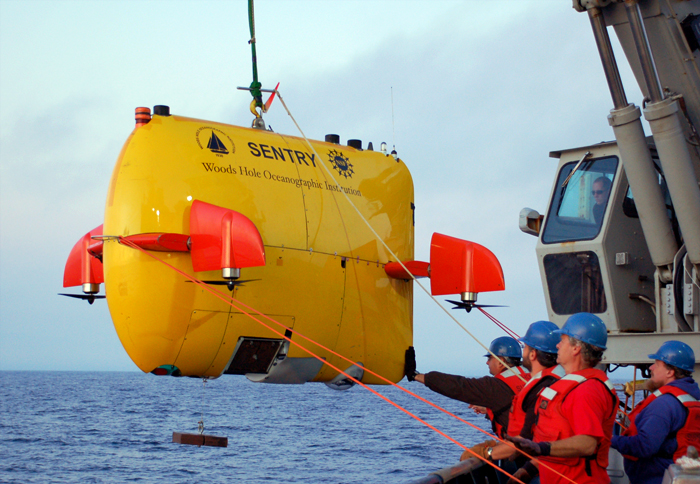
WHOI's new deep-diving autonomous underwater vehicle Sentry was launched from the WHOI research vessel Atlantis off the coast of Santa Barbara, Calif., to search for cold seeps—naturally occurring oil, gas, and other hydrocarbons that are leaking from the seafloor. Scientists are developing ways to give the robot abilities to interpret data on the fly and change operations to accomplish missions more effectively without human intervention. (Chris Reddy, Woods Hole Oceanographic Institution)

Before a dive, WHOI engineer Rod Catanach prepares Sentry's high-tech “nose”—an underwater mass spectrometer developed by WHOI scientist Rich Camilli that can detect and identify minute quantities of chemicals in seawater. The instrument, called TETHYS, is in the cylindrical gray metal housing with the multiple rows of band clamps around it. (Rich Camilli, Woods Hole Oceanographic Institution)
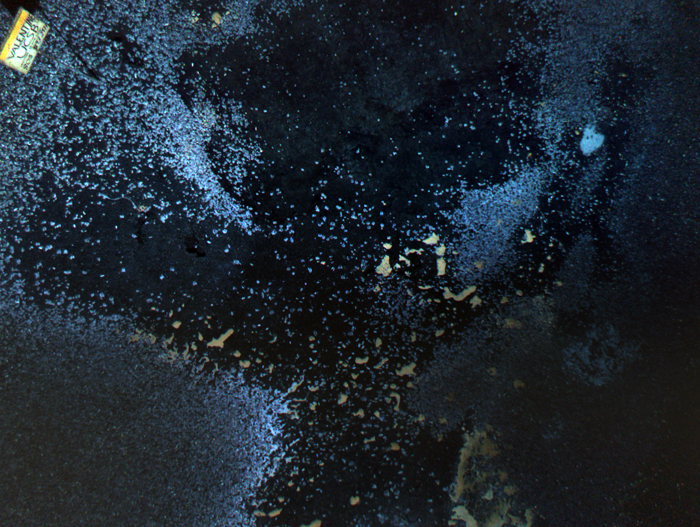

The TETHYS mass spectrometer aboard Sentry detected chemicals clues of a cold seep and the robot requested permission to change course and see if a cold seep was actually there. Sentry turned out to be right. It homed in on a site where UCSB scientist Dave Valentine, diving in the submersible Alvin, had found a cold seep and left a marker with his name on it (upper left) in 2007. (Courtesy of Dave Valentine, University of California, Santa Barbara)

WHOI scientists Rich Camilli (left) and Dana Yoerger have spearheaded efforts to give more autonomy to the autonomous underwater vehicleSentry. Yoerger helped lead the development of the deep-sea robot. Camilli engineered the TETHYS underwater mass spectrometer that allows Sentryto collect chemical clues in the ocean. (Chris Reddy, Woods Hole Oceanographic Institution) 

Enlarge ImageMarine geochemists Dave Valentine (left) of the University of California, Santa Barbara, and Chris Reddy of WHOI study natural oil seeps on the seafloor right off the coast of Santa Barbara. Above, they sniff a rock sample recovered from the ocean bottom that still retained its petrochemical odor. (Karin Lemkau, Woods Hole Oceanographic Institution)


It’s a lot easier to send a bloodhound to track a criminal, or your kid to pick up groceries, than it is to get a deep-sea robot to find something on the seafloor.

The dog will pick up the scent and know to turn around if the bad guy doubles back. The kid can use his eyes and brain to wend his way to the vegetable aisle and recognize a red pepper. But deep-sea robots are typically dispatched on programmed missions, swimming up and back along designated track lines, like a mower cutting a lawn, and blindly collecting data. Only after the vehicle resurfaces can scientists download the data to see what the robots may have found.

These autonomous underwater vehicles, or AUVS, move autonomously in that they swim unmanned and unconnected to a ship via a tether. But they have lacked that essential capability to think autonomously—to interpret cues they gather from the environment, make decisions on the fly, and change course as necessary to accomplish missions more effectively and efficiently.

Scientists are beginning to experiment with ways to give AUVs more decision-making capabilities, and on a research cruise in September 2009 off Santa Barbara, Calif., scientists from Woods Hole Oceanographic Institution (WHOI) demonstrated that they could teach a new robot some old tricks.

They equipped an AUV called Sentry with a high-tech “nose”—an underwater mass spectrometer developed by WHOI scientist Rich Camilli that can detect and identify minute quantities of chemicals in seawater. Then they gave Sentry some brains, in the form of software to analyze the chemicals it was sniffing—in this case, naturally occurring oil, gas, and other hydrocarbons leaking from the seafloor in areas known as “cold seeps.” Finally, they gave Sentry the ability to change its pre-programmed course and operating mode, so it could home in on targets and begin sampling right away, instead of waiting to return on a subsequent mission.

In engineers’ parlance, it’s called “dynamic re-tasking to execute non-deterministic missions.” In other words, Sentry took its first baby steps on the road toward making its own decisions without input from people.

'Extraterrestrial' environments
That’s precisely the capability NASA needs in vehicles to search for life in extreme environments on distant planetary bodies, where real-time command and control will be spotty, said WHOI scientist Dana Yoerger, who helped develop Sentry. Some scientists think that if extraterrestrial life forms exist—living, for example, beneath the presumed ice-covered ocean of Europa, one of Jupiter’s moons—they may resemble earthly organisms thriving on chemicals emanating from seafloor cold seeps.

So the expedition off Santa Barbara offered a double benefit: It provided a suitable analog of an “extraterrestrial” environment to test new ways to put more autonomy into an autonomous underwater vehicle. And, if successful, it would provide a better way to find and sample cold seeps for the marine geochemists leading the expedition, Dave Valentine of the University of California at Santa Barbara and Chris Reddy of WHOI.

The scientists did not want to send Sentry on its initial non-deterministic missions without some means of communication, even if it was sort of the oceanographic equivalent of a dog barking in the woods and handler whistling or hollering back. Two-way communication withSentry was limited to slow, low-bandwidth, intermittent acoustic signals (since radio or light waves are poorly transmitted in seawater). Yoerger said it is like “an ultra-limited Twitter on old-time dial-up—a few characters every minute.”

Just people and a robot talking
Sentry was deployed from the WHOI-operated research vessel Atlantis to search for cold seeps. But “there’s a lot of different flavors of cold seeps,” Camilli said, based on how the chemicals are produced. Thermogenic seeps leak heavier hydrocarbons forged by heat and pressure beneath the seafloor. Biogenic seeps leak lighter hydrocarbons such as methane, the metabolic byproducts of microbes decomposing organic matter.

Camilli’s mass spectrometer, called TETHYS, detected and distinguished a few key hydrocarbons. On a single mission, it made more than 1,1000 discrete measurements of chemicals in the water, and more than 7,000 during the entire cruise.

“Imagine collecting 1,000 water samples and then having to analyze them,” Yoerger said. “Rather than getting a few samples at great expense, we got volumes of information, and we had it before the vehicle came up, so we could makes changes based on what we found.”

“Sentry interpreted that data on the fly, made judgments, and could report it to us in real time,” Camilli said. “We could query Sentry, and it would respond, ‘I think there’s a biogenic source here, or a thermogenic source there,’ and make requests to re-visit areas it thought were the most interesting. And we could query: ‘Why do you think that?’ And it would send back some data it had processed, which we could examine and respond, ‘Go ahead and take a closer look at that particular target.’ ”

“It’s like when you send your kid to the grocery store for peppers, and he calls you up and says, ‘The red peppers look terrible; should I get the yellow ones at twice the price?’ ” Yoerger said. “If you don’t give him an answer, he just keeps going through the shopping list we gave him.”

“Using even these limited acoustic communications,” Camilli said, “we could get a clear picture of what’s going on faster and more effectively. And that solves one of the most difficult problems in reconnaissance: when to switch from wide-area surveying to focus on a target and then to sample it.”

From sunny Santa Barbara to icy Europa
Once at a cold seep, Sentry demonstrated that it could also switch its operations. Using software developed by Mike Jakuba, Yoerger’s former graduate student, now at the Australian Centre for Field Robotics at the University of Sydney, Sentry stopped swimming and hovered over a target. It also adjusted its mass spectrometer to measure different selected chemicals to get more detailed chemical clues as to what types of life forms were present at the cold seep.

“I was deeply impressed by what Sentry and its handlers were able to accomplish during that mission,” said Valentine, the expedition’s chief scientist. “The photographs Sentry took while hovering over its target confirm that it had located an area of recent activity and go a long way to validating this approach.”

In the future, scientists envision adding more sensors—for example, one that can analyze DNA in the water in real time to identify organisms. And the scientists will continue to improveSentry’s capacities to make judgments and proceed without requesting permission.

Someday, one of Sentry’s progeny may leave Earth and boldly go to Europa, where it will be unable to phone home. By then, however, it will be fully capable of making decisions on its own.

The research cruise was funded by the National Science Foundation. The research withSentry was funded by NASA's Astrobiology Science & Technology Program. Funding for the development of Sentry was provided by NSF's Ocean Sciences Division, The Russell Family Foundation, the WHOI Deep Ocean Exploration Institute, the Comer Science and Education Foundation, and the WHOI Access to the Sea program.

07/02/2010

Ant computer


http://www.flickr.com/photos/worldworldworld/4336652574/sizes/m/
Schematics for making a cybernetic computer with ants. By Cesar Harada for Ollie Palmer. Wellcome trust, London, UK.
Roughly the idea is to have a large bed made with many small magnets, controlled by an LED Matrix controller, via USB -> Arduino -> proce55ing. The bed is covered with a sheet of Teflon. On the bed metallic powder can be reconfigured and become a magnetic display, a little bit like the ferrofluid experiments of Sachiko Kodama. 
The metallic powder would be coated with ant pheromones ("pick me up" / "leave me here").
2 gates (one in, one out) would be a ant (bit) counter (webcam video processing).
Another webcam would be used for general visual control, and feedback.
The pattern the computer would draw as initial position of the metallic powder would be progressively reconfigured by the ants activities, bringing back the content of the "bed" into the "store room". The pattern on the bed would correspond to the program in the computer : a self modifying software and hardware, as one thing. 
The computer could get complex if we would assign ants a color or an RFID tag, of if we had a less binary information to carry ("pick me up" / "leave me here", "pick me up for a while", "exchange me", ask someone to help pick me up" etc).
Such computer would be interesting to evaluate the capacity of learning of ants and of the machine.
We could also use ants methods of optimization for some of our human activities (find people under collapse buildings after avalanches, earthquakes...) or computer routines (web crawling), or new types or architecture generation...

12/12/2009

Open_Sailing_Data


screenbeglobal

For the Danube River journey after Ars Electronica we're designing a 'box' which sends information of the vessel (GPS, pressure, temperature, humidity) to Pachube so people could observe our conditions online.  Data logging is also very beneficial for our research in Nomadic_Ecosystem and Energy_Animal!

The source code of hi-ve is now made public and open on source forge.
the address is here:
http://sourceforge.net/projects/hi-ve/
its development svn can be accessed with the following commands.
svn co https://hi-ve.svn.sourceforge.net/svnroot/hi-ve hi-ve


We will put up the hi-ve executables for download very shortly.


Here are some notes of the current design direction of the 'data log box'
Please comment if you have any good insights on any of these mentioned below.

Sensing
-Arduino
-USB Weather Board $124.95 (barometric pressure, ambient light sensor, humidity sensor, temperature)
-GPS (position, speed, altitude, date, time) already have
-Memsic 2125 Accelerometer $29.99
Interfacing the above - Estimate 3 days

Communication
-Xbee $32 (for communication with vessels in vicinity 1.6km if Xbee Pro, 90m with standard Xbee)
- GM862 Cellular Quad Band Module £78.70
-Information sent to Pachube using Serial2Mobile library
-Motorola C168i $10
(HELP NEEDED : Has anyone managed to work with sending SMS messages from Arduino in Europe/UK? Especially with Motorolla C168i, which is mentioned in the example above?)
-Mobile phone Interface - Estimate 7 days
-Xbee Interface - Estimate 3 days

Powering
Solar Powered, Self Sufficient Arduino + charge the mobile? 65.00EUR
http://www.libelium.com/tienda/catalog/product_info.php?cPath=21&products_id=67
-Build - Estimate 2 days

Interesting References
- GM862 Cellular Quad Band Module
- http://note19.com/2008/12/20/how-to-control-gm862-from-arduino/
- http://tinkerlog.com/2009/05/15/interfacing-arduino-with-a-telit-gm862/

http://note19.com/2009/01/14/power-sparkfun-usb-evaluation-board-gm862-from-arduino/
Wireless + Arduino
http://www.littlebirdelectronics.com/products/wishield-1-0 $89.35
http://www.geocities.jp/arduino_diecimila/wifi/index_en.html
AT Commands
http://www.traud.de/gsm/index.html
http://www.developershome.com/sms/smsIntro.asp
Memory
http://www.arduino.cc/playground/Main/UsbMemory 20.00EUR
SD Card Shield
http://www.libelium.com/tienda/catalog/product_info.php?cPath=21&products_id=66


Blackout threat map

Because several people have been asking, and because we are a totally open-project, here is the original blackout map :

Blackout map of the world, where do you want to be? by you.

Blackout map photoshop file .psd (with layers) 86 mb

OpenSailing.net & 2012hopes.com concept and world map by you.

Colored map, photoshop file .psd (with layers) 177 mb

More "raw" maps.

WAVE Patent platform

Google is using an interesting patent system to ensure the open-source nature of its WAVE platform. According to the FAQ, "The technology behind Google Wave is licensed under a liberal patent license to help implementers and contributors be comfortable implementing the protocol."

Patent License

Subject to the terms and conditions of this License, Google and its affiliates hereby grant to you a perpetual, worldwide, non-exclusive, no-charge, royalty-free, irrevocable (except as stated in this License) patent license for patents necessarily infringed by implementation of this specification. If you institute patent litigation against any entity (including a cross-claim or counterclaim in a lawsuit) alleging that the implementation of the specification constitutes direct or contributory patent infringement, then any patent licenses for the specification granted to you under this License shall terminate as of the date such litigation is filed.
Open_Sailing is open source. Our principals are similar to WAVE - we want as many people as possible to be able to contribute to the system, and benefit from it. We've been looking at open source software (licensed under General Public License), Creative Commons and Copyleft.

Maybe we should investigate a similar stance to Google WAVE as a legal standpoint? (Plus, the 'WAVE" name ties in with Open_Sailing nicely, don't you think?!)

Any thoughts?

Google WAVE Protocol
Protocol license

Transdanube, David Boardman

www.netzfunk.org/?prj=transdanube

http://kitchenbudapest.hu/en/projects/transdanube

(By summer resident David Boardman during August of 2007.) TransDanube is a networked object, a spime, a blogject, a "thing that thinks". It is a home-made boat equipped with technological stuff that flows randomly along Danube river according to its unpredictable dynamics. It's our Balkans' Voyager I spaceship. No way to control it. We can just collect data from TD's boat as they come. Right now it should be located somewhere between Budapest and the Black Sea. Google him. Or watch what's going on around the tiny and fragile boat. Our "thing that thinks" will compose daily his travel log, using informations on acrossed locations and environment conditions that will create the base of the discourse. That is a discourse of a blogject. An object that blogs.


very interesting project :

I worked on Transdanube during August 2007 during my residence in KiBu.
In that period, I focused on the concept then developed the web application (to hook the data to environmentXML - now Pachube - GoogleMaps and other geo-based webservices - weather channel, georss, wikipedia, etc) and built a preliminary physical prototype with a cell phone + gps + arduino and a bunch of environmental sensors.
And by the way Daniel Spitzberg mentionned wunderground.com, the best weather data site, let's play!

Biomodding - living sculpture combines computers, gaming culture& ecology

Hey, guys, check this out. It's a greenhouse sculpture powered by excess heat from a giant, overclocked computer.

biomoddath1installationview

Artist Angelo Vermeulen, drawing inspiration from the case-modding scene, came up with this idea of fusing art, ecology and technology. In the inside of the case are computer parts, plants and a system of pipes and tubes for water. The computer is a game server with individual game stations surrounding the case. In a collaborative effort, game enthusiasts have developed a multiplayer game which picks up biomodding themes and translates them into a game experience. This way, visitors can become part of the installation by interacting and affecting the ecosystem inside of the case.

But watch for yourself:


The fist version of the sculpture, called Biomodd [ATH1] was built in Athens, Ohio. Soon more experiments are to follow in Manila, Singapore and Brazil!

23/11/2009

Open Sailing 4 minutes concept video


Download the original quicktime .mov video here (44 mb).

Also visible on vimeo / youtube / dailymotion / sevenload : Script of the video in .txt (3 kb).

This 3 minutes video explains the Open_Sailing main concepts. Buzz it, spread the world.

shipais.com, amazing feed

http://www.shipais.com/currentmap.php?map=thamesrhine

shipais1

shipais2

Really cool feed of major ship positions. Below, from their FAQ :

http://www.shipais.com/what.php (very interesting page by the way, telling us who need to publisize its position constantly by categories).
As part of the global maritime safety system, ships over 300 tons are now required to broadcast their positions using AIS.
A ship transmits "dynamic" information at intervals of between 2 and 12 seconds depending on the vessel's speed or 3 minutes if at anchor.

Thanks to Ollie Palmer for the link.

Siphonophora by Rob Davis and Usman Haque


It's not exactly Open_Sailing, but it looks very similar! This is a cool project looking at making aquatic devices that react to their surroundings. They should be living in Gunpowder park right now.
The Siphonophiora project uses small reactive devices situated in one of Gunpowder Parks lakes to record and observe environmental data. Borrowing its name from a class of marine invertebrates, Siphonophora is an interactive research project by Rob Davis and Usman Haque. The small reactive devices will track light, temperature, pH levels and other pond life activity, feeding this information live onto pachcube.com, a website which collects environmental data worldwide and which will compare this information with other natrual sites all over the world.
Images © Rob Davis. Images and words taken directly from the project website. Find out more here.

open_Sailing on Twitter


We're now on Twitter. Follow is at www.twitter.com/opensailing

Life cable terminal inspiration, all in the same place

http://www.banik.org/constr/FiltreEauMer.htm

Most boats have at least 3 holes directly into the sea... 3 holes? WHAT? Yes, one for the cooling of the engine, one for the toilets, one for grey-water evacuation. A french DIY sailor made this little instructable (in french sorry) of how to put these function in one hole, with one valve instead of 3, clever, safer.


Tribal Search Engine

Hiromi Ozaki and  Cesar Harada invented the "Tribal Search Engine":

We have the technology to make this world a better place, but as of yet we haven’t quite managed it - because we don't seem to know each other very well, and we don't collaborate efficiently enough. The Tribal Engine is a social search engine which can bring people with similar interests together to solve problems together.

A traditional search engine simply offers you a list of results from a search query. During a search, you would normally think alone, and solve problems alone. Using the Tribal Search Engine, you enter your likes, dislikes, fears and interests related to a physical space. The Tribal Search Engine suggests you a location, you go there in the physical space, and you meet people with the same questions, interests or fears. Together than, you resolve the "problem".

For example, you could set the parameters to indicate that you like good food and dislike loud music venues in order to decide where to go on a Friday night. You can then view other people who have gathered near your results in real time – they are likely to be the people who share similar interests. From there you can meet in physical space or online to collectively decide where to go, or even solve problems related to your interests and fears. By talking to and sharing knowledge with people doing the same search together you can dramatically speed up your problem solving!

19_0001usersweb
Users in different locations entering constraints to find optimal locations

19_animmm
Tribal Engine suggesting areas - you can adjust how much you like or dislike certain things with the sliders.

19_003togetherweb
Users with similar constraints meeting in physical space

19_global-threat-anim
Tribal Search Engine works on every scale, from a urban block to the world map, here it is suggesting safe areas to avoid global threats.

From the datas 2012hopes threats collected, Tribal Search Engine determined the location and the dynamic shape of the fluid structure of the Open Sailing. That's our concept.
19_005diagramdi
Timeline Comparison of Google and Tribal Engine. Google lacks physical existence, Tribal Search engine brings real people in real space to solve the real problems of this world.

15/11/2009

Open_Sailing in Wikipedia


For the first time in our history we appear in Wikipedia, thanks to the ARS Electronica : http://en.wikipedia.org/wiki/Prix_Ars_Electronica

Individual proprietary solution VS open collective solution

We got a new member! Today we talked to Ed and again, the project took a refreshing turn. Ed's suggestions are roughly described below, to which I added some notes... Where's the "edit" button.

We can make the choice to survive on our own and design an individual system, but what's the point of it? We don't want to be forever on our own, and we have observed that many people are excited about the perspective we are forming.
We technically can survive on the oceans, but we can only do it together, so we want to design collectively the system the community will use and modify over time, we need to build the community.
But we cannot wait for everybody to agree on our model, so we need to propose some ideas, designs (compatible standards), constitution, an architectural API.

Ed says :
A modular society can only function efficiently if there is an API (application Programming Interface) standard that all entities joining the society adheres to.
Flows:
Solids
Stability
Continuity

Liquid:
Water pipes ø
Fuel pipes ø
Waste ø
Data ø
see http://lifecable.org/
economy, see http://liquideconomy.org/

Data:
Human languages
Academixml : http://www.academixml.org/
EEML, Extended Environments Markup Language (http://www.eeml.org/)
Pachube, http://www.pachube.com/

Rules:
share knowledge
security
Property (intellectual, see creative commons)

Philosophy:
Ethics
All people equal...

Cesar made a presentation on the theme of APIs and there application in the context of the "Open Sailing platform" at Future Karaoke, a lot about the same topic...

11/11/2009

Waterproofing things

careless systems to protect water-sensible things, for big and small units. food, devices, organic, shelter, raft...

waterproof laptop 5

Labels

design (116) structure (81) architecture (69) Energy_Animal (53) Nomadic_Ecosystem (46) art (43) Instinctive_Architecture (42) free energy (36) 3d (34) graphic (33) Swarm_Operating_System (32) Ocean (31) presentation (31) maps (28) Ocean_Cookbook (23) biology (23) communication (23) navigation (21) Open_Politics (20) strategy (20) water (20) boat (19) computing (19) survival (19) Life_Cable (18) construction (18) farm (18) safety (17) algae (16) posting (16) materials (15) wave (15) ecology (14) politics (14) technology (14) london (13) physics (13) agriculture (12) battery (12) Openet (11) food (11) animal (10) craft (10) culture (10) fishes (10) mechanics (10) Open_Sailing (9) chemistry (9) media (9) open-source (9) plastic (9) theory (9) video (9) TED (8) behaviour (8) competition (8) engine (8) exploration (8) performance (8) technique (8) philosophy (7) sociology (7) Open_Games (6) biomass (6) inflatable (6) seasteading (6) wind (6) OS_Polar (5) USA (5) animation (5) electronics (5) legal (5) medecine (5) pollution (5) berlin (4) data (4) ethics (4) money (4) psychology (4) reportage (4) service (4) statistics (4) sun (4) Brazil (3) Cesar Harada (3) Observation (3) Protei (3) TEDxOilSpill (3) catastrophy (3) engineering (3) garbage (3) google (3) history (3) identity (3) kite (3) mapping (3) metareciclagem (3) oil spill (3) recovery (3) research (3) sailing (3) science (3) space (3) spain (3) sustainable (3) tradition (3) AI (2) Argo (2) CAD (2) Environment (2) Exploration. Robots Swarm .Sea (2) Jellyfish (2) LABB (2) Louisiana (2) NL (2) NOLA (2) Object Oriented Politics (2) Open Hardware (2) Pachube (2) Pacific (2) Plastiki (2) TEDxBoston (2) UK (2) World Environment Organization (2) ants (2) austria (2) autonomy (2) com (2) coral (2) des (2) endangered species (2) fiction (2) geography (2) gulf of mexico (2) model (2) news (2) open architecture initiative (2) open innovation (2) organisation (2) plant (2) post (2) preservation (2) product (2) protection (2) rca (2) reserve (2) robots (2) simulation (2) skeleton (2) social (2) symbol (2) text (2) treatment (2) waste (2) Adhocracy (1) Aerial (1) Articles (1) BBC (1) BLDGBLOG (1) BP (1) BP oil spill (1) Balloon (1) Bangladesh (1) Barataria (1) Barcelona (1) Bay (1) Black (1) Boston (1) CCCB (1) Colet Castano (1) Crafts (1) Decentralize (1) Distributed System (1) Documentary (1) Dream (1) Environmental Concerns (1) Europe (1) Flight (1) Germany (1) Grassrootsmapping (1) Grenelle (1) Grier (1) Helium (1) Hydrogenase. Architecture (1) Institute (1) JP (1) Jimmy (1) John (1) Kaku (1) Kiel (1) Kim (1) Korea (1) LA Bucket Brigade (1) Luxembourg (1) NOAA (1) New Orleans (1) New York (1) Nina (1) Noah (1) Norway (1) Oceanography (1) Oil (1) Photography (1) Plane (1) Plater (1) Pope (1) Pragmatism (1) Resistance (1) Robot (1) Rotterdam (1) Ruairi Glynn (1) Sketchup (1) Snyder (1) Sphere (1) Spill (1) Stitching (1) TEDxMidAtlantic (1) Talk (1) Tilling (1) Tribe (1) Trondheim (1) Tumas (1) Uros (1) V2_ (1) Vision (1) Washington DC (1) Werner (1) Wood (1) Woods Hole (1) YouTube (1) Zygmunt (1) accident (1) admin (1) alternative (1) anaconda (1) appropedia (1) aquanaut (1) architecture for humanity (1) ars (1) autarcy (1) autark (1) awareness (1) ball (1) baltic (1) belgium (1) biodiversity (1) biofuel (1) brainstorming (1) broadcast (1) buoy (1) canada (1) carbon (1) cardboard (1) carton (1) cesar (1) clear climate code (1) climate (1) cold fusion (1) collaboration (1) concepts (1) cruise (1) current (1) deadly (1) deep (1) departure (1) developing (1) disposal (1) dispute (1) diving (1) diy (1) drone (1) eartquake (1) edgcm (1) events (1) excellent (1) experimental (1) exploring (1) farming (1) farms (1) file (1) fire (1) flickr (1) floating (1) florida (1) fluid dynamics (1) forum (1) france (1) future (1) futurology (1) generator (1) geodesic (1) geoengineering (1) graduate (1) green (1) grey (1) habitation (1) halley vi research station (1) harada (1) hybrid (1) icon (1) ideas (1) ideology (1) independent (1) indian (1) indonesia (1) industrial (1) inhabitat (1) innovation (1) instructables (1) insurance (1) japan (1) kelp (1) ledger (1) lloyds (1) louisina (1) machine (1) magnet (1) maths (1) message (1) messaging (1) metal (1) mimicry (1) mission blue (1) mobile (1) modular (1) monitoring (1) nasa (1) natural (1) naviagation (1) nice (1) nucelar (1) open source (1) opportunity (1) pachbox (1) park (1) participation (1) patch (1) pelamis (1) people (1) photo (1) pirate radio (1) planning (1) pods (1) polar (1) pop (1) popular (1) power (1) pr (1) press (1) raft (1) reef (1) render (1) renewable (1) repost (1) rogue (1) sewage (1) ship (1) ships (1) shit (1) software (1) sound (1) speculation (1) studies (1) study (1) super-collider (1) sylvia earle (1) system (1) temporary (1) toxic (1) tv (1) typography (1) underwater (1) utopia (1) weather (1) web (1) whales (1) wired (1) workshops (1) young (1) youth (1)

This blog is embeded inside the official Open_Sailing website, visit us here : http://opensailing.net

Open_Sailors